FAQ zu LED-Streifen: Installation & Fehlerbehebung Guide
2025-04-07

Beste LED -Lichtstreifen FAQ

FAQ zu den besten LED-Streifen

LED-Streifenlichter haben explosionsartig an Popularität gewonnen und verwandeln Räume mit ihrem lebendigen Glanz und ihrer unglaublichen Vielseitigkeit. Von der Hinzufügung einer subtilen Atmosphäre bis zur Hervorhebung architektonischer Details und der powering kreativer DIY-Projekte sind diese flexiblen Wunder zu einer bevorzugten Beleuchtungslösung für homes, businesses und darüber hinaus geworden.

Aber bei so vielen Optionen und Anwendungen ist es natürlich, Fragen zu haben. Kann man sie schneiden? Wie verbindet man sie? Was ist der Unterschied zwischen RGB und RGBW?

Fürchten Sie sich nicht, Lichtbegeisterte! Willkommen zu Ihrer ultimativen Ressource – einer ausführlichen FAQ, die alles beleuchtet, was Sie über LED-Streifenlichter für den Außenbereich wissen müssen. Ob Sie ein erfahrener DIYer sind oder gerade erst beginnen, die Welt der LED-Beleuchtung zu erkunden, dieser Leitfaden wird Ihre brennenden Fragen beantworten und Sie befähigen, Ihre Beleuchtungsvisionen selbstbewusst zum Leben zu erwecken.
Diese umfassende FAQ behandelt häufige Fragen zu LED-Streifenlichtern für das Schlafzimmer und hilft Ihnen, sie effektiv zu verstehen, auszuwählen, zu installieren und zu verwenden.
LED-Terminologie
Grundlegende Fragen zu LED-Streifen
Installation und Verwendung von LED-Streifen
Qualitätskontrolle bei LED-Streifen
Fehlerbehebung bei LED-Streifen
Fazit

LED-Terminologie


Was sind Lumen (lm)?

Lumen (lm) sind eine Maßeinheit für die gesamte Menge an sichtbarem Licht, die von einer Lichtquelle emittiert wird. Betrachten Sie Lumen als ein Maß für die Helligkeit von LED-Bandlicht oder LED-Leuchten, wie sie vom menschlichen Auge wahrgenommen wird. Die Lumenleistung ist von größter Bedeutung bei der Auswahl von LED-Streifen oder Leuchten für den Außenbereich. Priorisieren Sie den Vergleich von Lumenwerten, um sicherzustellen, dass Sie das ideale Helligkeitsniveau für Ihr Projekt auswählen.

Was ist AC?

AC ist Wechselstrom, der Standardstrom, der in den meisten homes und commercial spaces verwendet wird. Oft als Netzspannung bezeichnet, variiert sein Wert je nach Land. In den USA beträgt die Netzspannung typischerweise 120V, während sie in Europa usually 220V beträgt.

Was ist DC?

DC ist Gleichstrom. Die Mehrheit der besten verfügbaren LED-Streifenlichter nutzt Niederspannungs-DC, commonly 12V oder 24V. Folglich ist häufig ein LED-Transformator oder eine Niederspannungsbatterie erforderlich, um die AC-Spannung in die appropriate DC-Ausgabe umzuwandeln.

Was ist CRI?

Die Abkürzung CRI steht für Color Rendering Index (Farbwiedergabeindex). Es ist ein quantitatives Maß auf einer Skala von 0 bis 100, das angibt, wie genau eine Lichtquelle die Farben von Objekten im Vergleich zu einer natürlichen Referenzlichtquelle, wie Tageslicht oder einer Glühlampe, wiedergibt. Der LED-Band-Industriestandard von CRI 80+ ist für die meisten Anwendungen geeignet. Für Situationen, die eine präzise Farbgenauigkeit erfordern, ist jedoch oft ein CRI von 90+ notwendig. Unsere High CRI LED-Band-Serie zeichnet sich diesbezüglich aus und macht sie ideal für Fotografie, Retail-Displays, Badezimmer, Salons und Wohnbeleuchtung, wo eine wahre Farbwiedergabe von größter Bedeutung ist.

Was ist eine IP-Schutzart?

Die IP-Schutzart für LED-Leuchten indicates the level of protection against solid objects and liquids. Die erste Ziffer represents dust and solid object protection, während die zweite Ziffer water resistance indicates. Eine höhere IP-Schutzart means generally greater protection.
IP20 ist für trockene Innennutzung, während IP54, IP65, IP67 und IP68 increasing protection for outdoor and wet environments offer. Choose the appropriate IP rating based on your application.

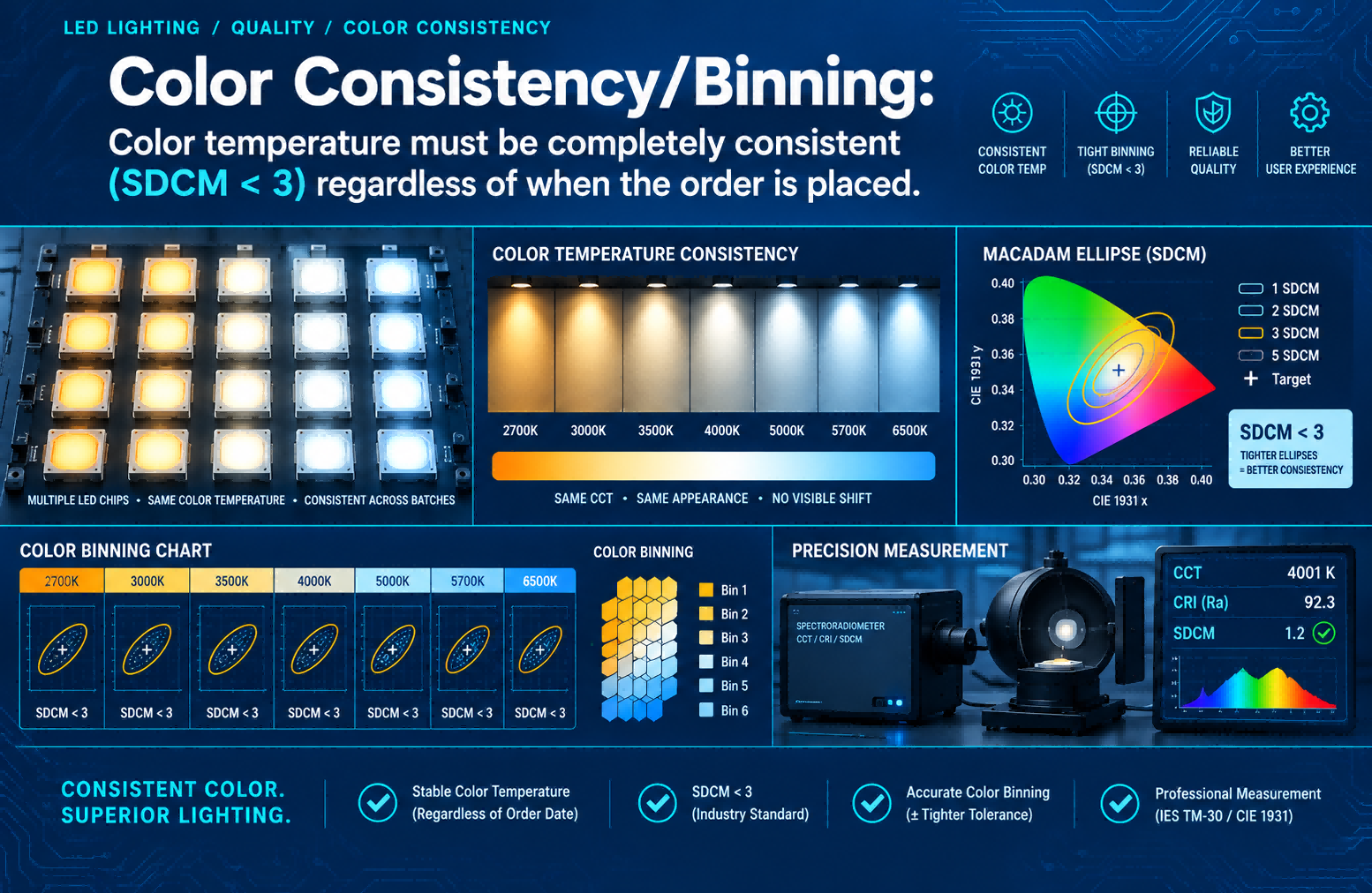
Was ist Farbtemperatur (Kelvin)?

Farbtemperatur, gemessen in Kelvin (K), ist eine Möglichkeit, die Farbeigenschaften von Licht zu beschreiben. Im Wesentlichen tells you whether a light source appears warm or cool.
Here's a breakdown of common Kelvin ratings and their corresponding color temperatures:
2700K-3000K: Warmweiß, ähnlich wie Glühlampen.
3500K-4000K: Hellweiß, manchmal called "cool white" or "neutral white".
4500K-5500K: Tageslicht, bright and clear.
5500K-6500K: Ultra-Tageslicht, very bright and bluish.

Was bedeutet "adressierbar" bei LED-Streifen?

Im Kontext von LED-Streifenlichtern means "addressable", dass jede einzelne LED auf den Bandlichtern independently controlled werden kann. This allows for complex and dynamic lighting effects that are impossible with standard under cabinet LED strip lighting.

Was bedeutet SMD?

SMD steht für Surface Mounted Device. It refers to the way the LED chips are mounted onto the circuit board. Instead of having traditional "through-hole" components with leads that go through holes in the board, SMD components are soldered directly onto the surface of the board. The size of the SMD LED is often indicated by a four-digit number (e.g., 2835, 5050), which represents the dimensions of the chip in millimeters. For example a 5050 LED is 5mm by 5mm. SMD LEDs are very common in LED strip lighting due to their versatility.

Was bedeutet COB?

COB steht für Chip On Board. It refers to a method of packaging LED chips. Instead of individual LED packages being soldered onto a circuit board, multiple LED chips are directly bonded to a substrate (usually a ceramic or metal board). Then, a phosphor layer is applied over the chips. The phosphor layer over the chips creates a more uniform and diffused light output, eliminating the distinct "dots" of light seen in traditional SMD LED strip. This is the main benefit of LED strip COB.

Was ist RGB?

RGB steht for Red, Green, Blue, und es refers to the primary colors of light used in digital displays like computer monitors, televisions, and smartphones. By combining different intensities of these three colors, a wide range of colors can be produced.

Was ist RGBW?

RGBW steht for Red, Green, Blue, and White, a color model that extends traditional RGB lighting to include a dedicated white light component. This addition allows for more accurate and versatile color mixing, creating a wider range of hues and a more natural white light.

Was ist Spannungsabfall bei LED-Streifen?

Spannungsabfall in cuttable LED strips refers to the gradual loss of voltage along the length of the warm white LED strip. This loss of voltage results in a decrease in brightness, particularly noticeable at the far end of longer dimmable LED strip lights runs.
Beste LED-Streifen require a specific voltage (typically 12V or 24V) to operate correctly. As electricity travels through the thin wires and conductive traces of the flexible LED strip lights, it encounters resistance. This resistance causes a loss of voltage, similar to how water pressure decreases as it flows through a long pipe. The extra long LED strip lights, the more resistance, and the greater the voltage drop. Thinner wires also increase resistance, and therefore voltage drop.

Was ist die Beziehung zwischen Wattage und Stromstärke bei LED-Streifen?

Niederspannungs-LED-Streifenlichter operate typically on low-voltage DC power, usually 12V or 24V.
The wattage of an white LED strip indicates the amount of power it consumes.
The amperage indicates the amount of current the bulk LED strip lights draws.
Example: If you have a 12V LED tape light that draws 5 amps, the wattage would be: 12V × 5A = 60W

Grundlegende Fragen zu LED-Streifen


Was ist ein LED-Streifen?

LED-Streifenlichter, auch bekannt als LED tape lights oder LED ribbon lights, is a flexible circuit board populated with surface-mounted light-emitting diodes (SMD LEDs) and other components. It typically comes with an adhesive backing, making it easy to stick to various surfaces.

Welche verschiedenen Arten von LED-Streifenlichtern gibt es?

  • COB-LED-Streifen

COB-Streifenlicht, auch bekannt als seamless LED strip oder dotless LED strip lights, feature densely packed LED chips covered by a phosphor diffuser for a smooth, continuous light output. Their flexibility allows for installation in both curved and angular spaces. Like standard surface mount strip light, COB LED tape light can be cut at marked intervals or soldered for custom lengths.
COB-LED-Streifen
  • SMD-LED-Streifen

SMD-LED-Flexstreifen sind eine beliebte Wahl für versatile illumination. These under counter LED strip lights feature individual LED chips mounted and fused onto a circuit board, with spacing between each chip. Common chip sizes, such as 2835, 5050, 2110, 2216, 5730, 3528, 3535, 3030, and 315, allow for varied light output. Their bendable and customizable nature, combined with the ability to cut or solder them, makes them ideal for a wide range of applications.
SMD-LED-Streifen
  • RGB-LED-Streifen

RGB-LED-Streifenlichter sind eine versatile and popular lighting solution that allows you to create a wide range of colors and lighting effects. RGB steht for Red, Green, and Blue. These are the three primary colors of light. An smart LED strip lights contains tiny LEDs that can emit red, green, or blue light. By varying the intensity of each color, you can mix them to create virtually any color in the visible spectrum.
RGB-LED-Streifen
  • RGBW-LED-Streifen

RGBW-LED-Band expand upon the capabilities of standard RGB light strip by adding a dedicated white LED chip. This addition significantly improves the quality of white light and offers greater versatility in color mixing. color changing LED strip lights require a compatible controller to manage the color mixing and white light output. These controllers allow you to independently control the RGB and white channels.
RGBW-LED-Streifen
  • Adressierbarer LED-Streifen

Individually addressable LED strip a type of LED lighting that offers individual control over each LED on the strip. This allows for incredibly dynamic and complex lighting effects, setting them apart from standard RGB, RGBW or smart LED strip. Unlike standard LED lights strip where all LEDs display the same color at once, RGBIC led strip have an integrated circuit (IC) chip associated with each LED. This IC allows you to send unique signals to each LED.
RGBIC-LED-Streifen

Was ist der Unterschied zwischen SMD- und COB-LED-Streifen?

When comparing Surface Mounted Device LED strip and Chip On Board LED strip, the key differences lie in light uniformity, brightness, applications, and heat. Here's a breakdown:
Light Uniformity: COB provides a seamless, dot-free light, while SMD can produce a "dotty" effect.
Brightness: COB often offers higher brightness.
Applications: SMD is more versatile for general use, while COB excels in applications requiring uniform lighting.
Heat: COB-LED-Flexstreifen können mehr Wärme erzeugen.

Was ist der Unterschied zwischen RGB- und RGBW-LED-Streifen?

RGB-LED-Streifen use red, green, and blue LEDs to create a wide range of colors by mixing these primary colors. while RGBW-LED-Band add a dedicated white LED chip alongside the red, green, and blue LEDs.

Welche LED-Streifenlichter sind die hellsten?

Determining the "brightest" flexible LED strip involves considering several factors, as brightness isn't a single, straightforward measurement. Larger LED chips generally emit more light. For instance, 5050 SMD LEDs are typically brighter than 2835 or 3528 SMD LEDs. The number of LEDs per meter significantly impacts brightness. Higher LED density means more light output. Lumens are the actual measurement of light output. A higher lumen rating indicates a brighter LED strip. Higher wattage professional LED strip generally produce more light. However, efficiency also plays a role, so wattage alone isn't the sole determinant.

Sind LED-Streifenlichter sicher?

UL-gelistete LED-Streifenlichter are generally considered safe when installed and used correctly. However, like any electrical device, they can pose risks if mishandled or improperly installed. When used with the correct power supply, properly wired, and installed according to the manufacturer's instructions, ceiling strip lights are very safe. Paying attention to wattage, amperage, IP ratings, and the quality of the recessed LED strip lighting is essential for ensuring safety.

Was ist der Unterschied zwischen 12V- und 24V-LED-Streifenlichtern?

When considering 12V and 24V flexible LED strip, the primary differences revolve around how they handle power distribution, especially over longer distances. Here's a breakdown:
Voltage Drop: 24V-LED-Streifen experience significantly less voltage drop compared to 12V-LED-Streifenlichtern. This means that over longer runs, the brightness of best 24V-LED-Streifen remains more consistent. Voltage drop is the gradual loss of voltage along the length of the commercial LED strip lights, which can result in the LEDs at the far end becoming dimmer.
Longer Runs: Due to reduced voltage drop, 24V white LED strip are better suited for longer installations. You can run them for greater distances without encountering noticeable dimming. 12V strips are generally preferred for shorter runs. Current Draw: For the same power output, LED strip 24V warm white draw half the current of 12V-LED-Streifen. This lower current draw allows for the use of thinner wires, which can simplify installations.
Cut Points: light strip 12V typically have more frequent cut points than 24V-LED-Streifen-Großhandel, providing greater flexibility for installations that require precise cuts or tight corners.
Power Efficiency: hellste 24V-LED-Streifen are more power efficient. This is again due to the lower current that is being used.
Applications: flexible LED strip 12V are often used in automotive applications or smaller projects where 12V power is readily available. 24V dimmable LED strip are preferred for larger installations, commercial projects, and any application requiring long runs.

Was sind Konstantspannungs- gegenüber Konstantstrom-LED-Streifen?

Constant voltage LED strips are designed to operate at a fixed voltage, typically 12V or 24V DC. The power supply provides a stable voltage, and the current drawn by the LED strip lights bendable varies depending on the number of LEDs and their power consumption. These LED stripe flex often include built-in resistors to regulate the current flowing through the LEDs.
Constant current LED tape require a constant current power supply, which regulates the current flowing through the LEDs. The voltage provided by the power supply varies to maintain the constant current. This ensures that each LED receives the same amount of current, regardless of the length of the under cabinet strip lighting or variations in voltage.

Installation und Verwendung von LED-Streifen


Kann ich einen LED-Streifen schneiden?

Yes, most flexible strip are designed to be cut, but it's crucial to do it correctly to avoid damaging them.

Wie schneidet man LED-Streifenlichter?

Cutting LED strip lights is a relatively simple process, but it's essential to do it correctly to avoid damaging the long LED light strips. Here's a step-by-step guide:
1. Disconnect the Power: Before you begin, always disconnect the kitchen LED strip lights from its power source. This prevents any electrical hazards.
2. Locate the Cut Points: Bright LED strip lights have designated cut points, usually marked with a scissor icon or a line printed on the tape lights. These cut points are located between circuits, ensuring that you don't damage the LEDs or the circuitry. It is very important that you only cut at these points.
3. Measure (If Necessary): If you need a specific length, use a ruler or measuring tape to measure the desired length. Mark the cut point with a pen or marker.
4. Make the Cut: Using sharp scissors or a utility knife, carefully cut the super bright LED strips at the designated cut point. Ensure the cut is clean and straight.
5. Seal (For Waterproof LED Strip): If you're cutting waterproof LED strip lights, you'll need to reseal the cut end to maintain its waterproof rating. Use end caps or other appropriate sealant recommended by the manufacturer.
6. Test (After Connecting): After you have connected the dimmable LED strip, test the best LED strips to ensure that it is working properly.

Wie verbinde ich LED-Streifenlichter?

Connecting LED strip lights can be done in a few different ways, depending on your needs and the type of ceiling strip lights you're using. Here's a breakdown of the common methods:
1. Using LED Strip Connectors (Solderless):
These connectors are designed to clamp onto the LED strip's contact pads, creating an electrical connection without soldering.
They're available in various types, including straight connectors, corner connectors, and jumper connectors.
2. Soldering:
Soldering creates a strong, permanent electrical connection by melting solder onto the LED strip's contact pads and the connecting wires.
3. Using Wire and Terminal Blocks:
This method involves connecting wires directly to the LED strip's contact pads using terminal blocks or screw terminals.

Wie verwendet man LED-Streifenlicht-Verbinder?

LED strip light connectors are a convenient way to connect LED light strips together without soldering. Here's a guide on how to use them effectively:
1.Prepare the LED Strip: Ensure the best strip lights is disconnected from the power supply. If necessary, cut the continuous LED strip at the designated cut points. Clean the contact pads on the recessed strip lighting to ensure a good connection.
2. Open the Connector: Most LED strip connectors have a clasp or a hinged cover that opens to allow you to insert the linkable LED strip lights.
3. Insert the LED Strip: Carefully insert the spotless LED strip into the connector, ensuring that the contact pads on the wholesale LED strip lights align with the connector's pins. Pay close attention to the polarity (+ and -) markings on the white LED strip and the connector.
4. Close the Connector: Once the cuttable LED strip lights is properly inserted, close the connector to secure the connection. Ensure the clasp or cover is firmly closed to create a tight connection.
5. Connect Wires (If Applicable): If using wire lead connectors, connect the wires to the power supply or controller, paying attention to the polarity. Some wire lead connectors use screw terminals, while others use push-in terminals.
6. Test the Connection:Before permanently installing the long LED light strips, test the connection to ensure it's working correctly. Connect the power supply and check that the strip lights LED lights light up.

Wie lötet man LED-Streifen?

1. Prepare: Clean the high quality LED light strips contact pads and the wires you'll connect. Tin the wire tips and the LED contact pads with a small amount of solder.
2. Position: Hold the wire against the warm white LED strip lights contact pad, ensuring correct polarity (+ to + and - to -).
3. Solder: Apply heat from the soldering iron to the connection point, melting the solder to create a secure bond.
4. Insulate: Cover the soldered connection with heat shrink tubing or electrical tape to prevent short circuits.
5. Test: After soldering, test the connection to ensure it works correctly.

Welches Netzteil benötige ich für LED-Streifenlichter?

The power supply must match the voltage of the dimmable LED strip (usually 12V or 24V DC). The power supply's wattage must be equal to or greater than the total wattage of the recessed LED strip lighting.

Wie berechnet man das benötigte Netzteil für LED-Streifen?

Calculate Total Wattage: Find the wattage per meter of your commercial LED strip lights. Multiply that by the total length of the dotless LED strip. Add a 20% safety margin to account for potential voltage drops and power supply fluctuations.
Determine Amperage: Divide the total wattage by the voltage of the DC LED strip lights (Watts / Volts = Amps). Select Power Supply: Choose a power supply that meets or exceeds the calculated wattage and amperage.

LED-Streifen richtig installieren

Clean Surface: Ensure the mounting surface is clean and dry.
Measure and Cut: Measure the desired length and cut the LED strip per meter at the designated cut points.
Adhesive Backing: Peel off the adhesive backing and carefully adhere the 5 meter LED strip to the surface.
Connect Power: Connect the brightest LED tape to the power supply, ensuring correct polarity.
Secure Connections: Use clips or other fasteners to secure the best LED tape and wires.

Ist die Kleberückseite bei LED-Streifen stark?

The adhesive backing is generally adequate for smooth, clean surfaces. For uneven or rough surfaces, or for long term installations, additional support (like mounting clips) is recommended.

Wie installiert man LED-Streifen um Ecken?

Corner Connectors: Use LED strip corner connectors to create clean, 90-degree angle connections.
Folding/Bending (Carefully): Some good LED strip lights can be gently folded or bent around corners, but avoid sharp bends that could damage the circuitry.
Cutting and Soldering: Cut the best budget LED strip at the corner and solder wires to bridge the gap.

Wie installiert man LED-Streifen auf unebenen Oberflächen?

Mounting Channels: Use aluminum mounting channels to create a smooth, even surface for the brightest white LED strip.
Flexible Mounting: Use flexible mounting clips or tape to conform to the uneven surface.
Cut and Bridge: Cut the highest lumen LED strip into shorter sections and bridge the gaps with wires.

Wie versteckt man LED-Streifenlichter?

Mounting Channels: Install LED strips in aluminum mounting channels with diffusers to conceal the LEDs and create a smooth light output.
Cove Lighting: Install brightest strip lights in coves or recesses to create indirect lighting.
Behind Furniture: Conceal LED strip lights behind furniture or architectural features.

Wie verbindet man LED-Streifen mit einem Dimmer?

Ensure the dimmer is compatible with the voltage and wattage of your high quality LED strips. Connect the dimmer between the power supply and the brightest LED strip, following the dimmer's wiring diagram.

Wie verwendet man die LED-Streifen-Fernbedienung?

Follow the remote's instructions. Typically, remotes allow you to control color, brightness, and lighting effects. Some remotes have preset modes, while others allow for custom programming.

Wie integriert man LED-Streifen in Smart-Home-Systeme?

Integrating super bright LED strip lights with smart home systems allows you to control their color, brightness, and on/off state using voice commands, apps, and automation routines.

Können LED-Streifenlichter im Außenbereich verwendet werden?

Yes, best LED stripe can be used outdoors, but you need to choose the correct type that is specifically designed and rated for outdoor use. Standard indoor LED strip lights are not suitable for outdoor environments due to their lack of protection against moisture and dust.

Wie schützt man LED-Streifen für den Außenbereich?

To protect bright LED strip lights for outdoor use, you can use weatherproof LED channels, silicone sleeves, and a protective cover. You can also seal connections and perform regular maintenance.

Können LED-Streifen unter Wasser verwendet werden?

Yes, weatherproof outdoor LED strip lights can be used underwater, but only if they are specifically designed and rated for submersible use. This means they must have a very high Ingress Protection (IP) rating.

Wie verhindert man Schäden durch statische Elektrizität an LED-Streifen?

To prevent static electricity damage to strip lights LED lights, you can use anti-static materials, workbenches, and floor coverings. You can also use dissipative wrist straps and grounded shoes.

Welche Verkabelungsaspekte gibt es bei LED-Streifen?

When wiring best brightest LED strip lights, you should consider voltage, wire gauge, and the wiring configuration. You should also ensure that the power supply and super bright LED strips are electrically and physically compatible.

Qualitätskontrolle bei LED-Streifen


Wie lang ist die Lebensdauer von LED-Streifen?

Seamless LED strip lights typically last 25,000–50,000 hours, but high-quality ones can last up to 100,000 hours. This translates to several years of use, depending on how often they're used.

Wie lang ist die Garantiezeit für LED-Streifen?

LED flexible dotless strip light warranties can range from 3 to 8 years, depending on the brand and model.

Wie wählt man einen geeigneten LED-Streifen-Anbieter?

When choosing an LED strip supplier, you can consider things like the quality of the LED chips, the LED power supply, and the brightness of the LED strip.

Warum ADLED wählen?

ADLED Light is your ultimate choice! With decades of industry expertise, a robust R&D team, and state-of-the-art production facilities, we are committed to delivering top-tier LED strip lights of exceptional quality. Our dedicated professionals craft tailor-made LED solutions to perfectly align with your unique requirements. Choose ADLED for unmatched expertise and premium quality!

Wie kauft man hochwertige LED-Streifen?

When purchasing high quality LED strips, it's essential to consider a few key factors to ensure long-lasting and reliable performance. First, choose reputable manufacturers or trusted suppliers that specialize in LED products. Look for well-known brands that use high-quality LED chips, such as Samsung or Cree, for superior brightness and longevity. Check the CRI (Color Rendering Index) to ensure natural color reproduction, especially in environments like retail or kitchens. Make sure the LED strip's voltage and wattage match your power supply to avoid issues like overheating or underperformance. Also, look for certifications like UL, CE, and RoHS, which indicate safety and compliance with industry standards. Consider the IP rating for protection against moisture, and choose good quality LED strip lights with at least a 30,000-hour lifespan and a warranty for peace of mind. Lastly, opt for flexible, easy-to-install Beste Qualität bei LED-Streifen mit zuverlässiger Kleberückseite für convenience.

Welche Umweltauswirkungen haben LED-Streifen?

LED flexible strip lights have a significantly lower environmental impact compared to traditional lighting options. They are highly energy-efficient, consuming up to 80% less electricity than incandescent or halogen lights, which helps reduce carbon emissions. bulk LED tape light also have a long lifespan, typically 30,000 to 50,000 hours, minimizing waste from frequent replacements. Unlike fluorescent lighting, they do not contain hazardous materials like mercury, making them safer to use and easier to dispose of. Many cuttable LED tape light are also RoHS compliant, ensuring they meet environmental safety standards. Additionally, advancements in recyclable materials and efficient production methods continue to make LED strips a more sustainable lighting choice for both residential and commercial applications.

Was sind die Zukunftstrends in der LED-Streifen-Technologie?

The future of LED strip technology is poised for exciting advancements, driven by growing demand for energy-efficient, customizable, and smart lighting solutions. One key trend is the development of smart LEDs, with built-in IoT connectivity that allows users to control their lighting remotely via apps, voice assistants, or home automation systems. We can expect even higher energy efficiency and longer lifespans as manufacturers continue to innovate in chip technology and materials. Dynamic color temperature adjustment (CCT) and full RGB+W capabilities will become more refined, allowing for more precise lighting effects tailored to user preferences. Additionally, flexible and ultra-thin designs will enable more versatile applications, from curved surfaces to ultra-thin profiles. As sustainability becomes increasingly important, eco-friendly and recyclable materials will likely become standard in LED strip production. With these innovations, LED low voltage strip lights will continue to enhance not only aesthetics but also functionality and energy efficiency in both residential and commercial settings.

Was sind die neuesten Technologien bei LED-Streifen?

The latest technologies in very long LED light strips focus on enhancing performance, flexibility, and smart integration. COB (Chip-on-Board) technology is gaining popularity for delivering seamless, dot-free illumination and improved thermal performance. Tunable white (CCT) and full-spectrum RGB W LED strip allow users to adjust color temperature and create dynamic lighting scenes. Digital LED strip, such as addressable types (e.g., WS2812 or SK6812), enable individual pixel control for animation and gradient effects. Additionally, smart LED strip now support Wi-Fi, Bluetooth, and Zigbee connectivity, enabling control via mobile apps or voice assistants. High CRI (Color Rendering Index) and increased luminous efficacy are also advancing to meet the demands of professional and commercial installations.


Was sind die internationalen Standards für LED-Streifen?

International standards for LED strips ensure product safety, performance, and energy efficiency. Key standards include IEC 60598 for general lighting safety, IEC 62471 for photobiological safety, and IEC 61000 for electromagnetic compatibility. In Europe, EN standards apply, particularly EN 55015 and EN 61547. These standards regulate electromagnetic interference, lighting performance, and durability. In the U.S., ANSI and IESNA LM-80 (for lumen maintenance) and LM-79 (for photometric testing) are widely followed. Compliance with these standards guarantees that LED strips perform reliably under global market conditions.


Welche Zertifizierungen haben LED-Streifen?

High quality LED strips often carry a range of certifications depending on the target market. Common certifications include UL or ETL (for safety in the U.S. and Canada), CE (for compliance in the European Union), and RoHS (to ensure restriction of hazardous substances). FCC certification is required in the U.S. for products emitting radio frequency energy, especially for LED strip lights use with controllers. For energy efficiency, Energy Star or ERP compliance may be noted. In specialized environments, IP ratings (e.g., IP65, IP67, IP68) define levels of water and dust resistance. These certifications signal a product's safety, quality, and environmental responsibility.


Wie sicher sind LED-Streifen?

Linear LED strips are generally very safe when used properly. They operate at low voltages, typically 12V or 24V, which significantly reduces the risk of electric shock. Quality LED strips also generate less heat than traditional lighting, minimizing the chance of burns or fire hazards. To ensure safety, it's important to use certified UL LED strips (e.g., UL, CE, RoHS) along with properly rated power supplies and controllers. Proper installation, including secure connections and adequate ventilation, further enhances safety during operation.

Welche Wartung ist für LED-Streifen erforderlich?

LED strip linear lighting require minimal maintenance due to their long lifespan and solid-state design. However, to keep them performing optimally, periodic checks are recommended. Inspect the recessed strip LED lighting for any signs of damage, discoloration, or loose connections. Ensure that the power supply and controllers are functioning properly and free from dust or moisture. If used in areas with high humidity or exposure to the elements, waterproofing integrity should also be checked regularly. Clean the surface occasionally and ensure proper heat dissipation to avoid premature failure.


Wie reinigt man LED-Streifen?

To clean LED strips, first turn off the power and unplug the power source to ensure safety. Use a soft, dry microfiber cloth to gently wipe away dust and debris. For more thorough cleaning, a slightly damp cloth can be used, but avoid getting moisture into the circuitry, especially for non waterproof LED strip. Do not use chemical cleaners or abrasive materials, as these can damage the target light strip's surface or LED components. Make sure the high power LED tape is completely dry before reconnecting the power.


Welche Transportaspekte gibt es bei LED-Streifen?

Linking LED strip lightsshould be transported with care to prevent physical and electrostatic damage. They are typically packaged in anti-static bags, reels, or spools, and cushioned within protective boxes to avoid bending or crushing. Keep them away from high heat, moisture, or direct sunlight during transit. If shipping long distances, especially internationally, ensure compliance with packaging standards and labeling requirements. For waterproof or silicone-coated strips, be mindful of temperature sensitivity, as excessive heat may cause warping or deformation of the outer layer.


Welche Lagerungsaspekte gibt es bei LED-Streifen?

Installing LED tape light should be stored in a cool, dry, and dust-free environment to preserve their performance and longevity. Keep them in their original anti-static packaging or sealed containers to avoid exposure to moisture and static electricity. The storage area should ideally be between 5°C to 30°C (41°F to 86°F) and away from direct sunlight or heat sources, which can degrade adhesives and silicone coatings. For long-term storage, store flexible LED strips in horizontal rolls to prevent bending or creasing, especially for flexible and COB LED strips.


Welche Werkzeuge werden für die LED-Streifen-Installation benötigt?

To install LED strip lights effectively, you'll need a few basic tools. These include scissors or a sharp blade to cut the connectable LED strips at designated points, a wire stripper or cutter for preparing connections, and a screwdriver for mounting controllers or power supplies. For more advanced setups, a soldering iron with solder can help make custom connections, while a multimeter is useful for testing voltage and continuity. Optional tools like a hot glue gun, heat shrink tubing, or cable management clips can enhance the finish and durability of the installation.


Welche Materialien werden für die LED-Streifen-Installation benötigt?

Several materials are essential for a successful LED strip installation. These include the linear LED strip itself, a compatible power supply (matching voltage and wattage), and a controller or dimmer if you're using RGB, CCT, or smart lighting systems. You may also need connectors or solder wire to link segments or make turns. For a clean and professional finish, aluminum profiles or mounting channels are recommended, along with adhesive backing, mounting clips, or brackets to secure the low voltage strip lights. For waterproof installations, sealing materials like silicone glue and end caps are necessary to ensure protection.


Wo finde ich LED-Streifen-Installationsanleitungen?

You can find LED strip installation tutorials on multiple platforms, making it easy to learn at your own pace. YouTube is a great source for hands-on, step-by-step video guides tailored to all experience levels. Many LED manufacturers, including professional brands like ADLED, offer downloadable manuals, wiring diagrams, and video tutorials directly on their websites. Additionally, DIY communities and blogs—such as Instructables or Reddit—share helpful tips and real-life projects. These resources provide comprehensive guidance for installing LED strips in homes, stores, or custom lighting applications.

Wie viel Strom verbrauchen LED-Streifen?

The power consumption of rohs LED strip lights depends on their length, type, and wattage per meter. On average, long LED strip lights consume between 4 to 14 watts per meter for standard models, with higher-power options using up to 20 watts per meter or more. For example, a typical 12V LED strip may consume around 5-6 watts per meter, while more advanced custom light strips, such as RGB or high-brightness variants, may use 10-14 watts per meter. The total power requirement depends on how many meters of strip light wholesale you install and the voltage of the power supply used. Always ensure your power supply can handle the total wattage of your linkable LED tape lights to avoid overloading or insufficient power.

Wie verwendet man LED-Streifenlichter?

LED strip lights are versatile and easy to use in a variety of applications. To start, you'll need to cut the bending LED strip lights to the desired length, ensuring you cut only at the marked intervals. Peel off the adhesive backing and stick the LED strip flex to clean, dry surfaces like walls, ceilings, or under cabinets. For more permanent installations, use mounting clips or aluminum profiles for additional support. Connect the 5 meter LED light strip to a power supply that matches the voltage (usually 12V or 24V) and ensure the correct wiring between the controller (if you're using RGB or dimming functions) and the customizable LED strips. You can control the lights through a remote, mobile app, or wall switch depending on the type of controller you use. strip LED lights 5m can be used for accent lighting, task lighting, backlighting, or to create dynamic, colorful effects in any room.

Wie lange halten LED-Streifen?

High quality LED strip lights typically last between 30,000 to 50,000 hours or more, depending on usage and operating conditions. This means they can function reliably for several years when used for a few hours each day. Factors like ambient temperature, proper heat dissipation, stable power supply, and overall quality of components—such as LED chips and circuit boards—can significantly impact the lifespan. Choosing spotless LED tape with good thermal management (like aluminum profiles or housing) and using them within recommended voltage and current limits will help extend their service life.

Wie versorgt man LED-Streifenlichter mit Strom?

To power LED strip lights, you need a compatible power supply (driver) that matches the voltage and wattage requirements of your connectable LED light strips. Most adjustable strip operate on 12V or 24V DC, so you'll need a transformer to convert household AC power (110V or 220V) to the appropriate low-voltage DC. Simply connect the LED strip's positive and negative wires to the corresponding terminals on the power supply. For longer runs or multi color LED strips, you may also use a controller or amplifier to distribute power evenly and manage lighting effects. Always ensure your power supply has at least 20–30% more capacity than the total wattage of your linkable strip lights.

Sind LED-Streifen energieeffizient?

Yes, LED strip lights are highly energy-efficient. They consume significantly less power than traditional lighting options like incandescent or fluorescent lights, delivering more lumens per watt. Most dimming LED strips use between 4 to 14 watts per meter, depending on brightness and color type, making them an excellent choice for both residential and commercial lighting. Their low power consumption combined with a long lifespan helps reduce electricity bills and maintenance costs, making them a sustainable and cost-effective lighting solution.

Sind alle LED-Streifenlichter dimmbar?

Not all LED strip lights are dimmable by default. Whether a AC DC LED strip lights is dimmable depends on the type of LED strip and the power supply or controller used. Many single color LED strip can be dimmed with a compatible low-voltage dimmer or PWM controller. RGB, RGBW, and CCT LED strip require a dedicated controller that supports dimming and color adjustment. However, some soft light strip are not designed for dimming and may flicker or malfunction if connected to an incompatible dimmer. Always check product specifications to ensure dimming capability and use appropriate dimmers or controllers for smooth performance.

Was sind die besten LED-Streifenlichter?

The best LED strip lights offer a balance of high brightness, color accuracy, durability, and ease of installation. Look for features such as high CRI (Color Rendering Index), long lifespan (over 50,000 hours), UL/CE/ROHS certifications, and premium LED chips like those from Nichia, Osram, or Epistar. COB LED strip, SMD LED strip, high density LED strip, and smart LED strip with app or voice control are popular for modern lighting setups. Brands like ADLED, Philips Hue, LIFX, and Govee are known for their performance and innovation. Ultimately, the best LED strip for you depends on your application—whether it's for accent lighting, task lighting, signage, or architectural use.

Fehlerbehebung bei LED-Streifen


Warum flackern meine LED-Streifenlichter und wie kann ich das beheben?

Flickering high cri LED strip are often caused by an unstable or incompatible power supply, voltage drop over long runs, loose connections, or low-quality dimmers/controllers. To fix flickering, first ensure the power supply matches your LED strip's voltage and provides enough wattage (ideally 20–30% more than needed). For longer installations, use thicker wires and consider power injection at both ends to prevent voltage drop. Check all connections for secure contact, and upgrade to a high-frequency PWM controller if you're using a dimmer. Replacing any damaged LED strip low voltage sections can also help restore stable lighting.

Warum leuchten einige Bereiche des LED-Streifens nicht und wie behebt man nicht leuchtende Bereiche des LED-Streifens?

Non-lighting sections of your best indoor LED strip lights can be caused by several issues such as poor connections, damaged high lumen LED strip, or faulty power supply. To fix it, first check for loose connections at the points where the bright LED strip is connected to the power supply or controller. If connections are fine, inspect the recessed LED strip itself for any visible damage like cuts, broken solder joints, or disconnected segments. You may need to resolder or replace damaged sections. Also, ensure that the power supply is sufficient for the length of the linear strip light, as voltage drop can affect lighting. For longer runs, consider power injection to maintain consistent voltage. If the issue persists, it may be due to a faulty controller or wiring, which may need to be replaced or repaired.

Warum ist die LED-Streifenfarbe falsch und wie behebt man eine falsche LED-Streifenfarbe?

Incorrect colors in your LED strip lights can often be traced to issues with wiring, the controller, or the power supply. Begin by ensuring all wire connections are secure, free from corrosion, and properly tightened. Voltage problems can also manifest as incorrect colors, so try using a different or higher-rated power supply. If you're using a controller, try replacing its battery if it's old, or resetting a new controller. Inspect the LED strip's connectors for any damage or bent pins that might be hindering proper color mixing. In some cases, resetting both the under cabinet LED strip and the controller can resolve the issue. If the problem persists, a defective LED on the most reliable LED strip lights itself might be the cause, potentially requiring replacement. For software-controlled low voltage strip lighting, verify that the color programming is accurate. To minimize future color inconsistencies, consider using high quality 5m LED strip light and, for addressable RGB (ARGB) setups, distribute the LEDs across multiple headers if possible.

Warum ist die Helligkeit des LED-Streifens ungleichmäßig und wie behebt man ungleichmäßige Helligkeit bei LED-Streifen?

If your dimmable strip lights display uneven brightness, the cause could be an inadequate power supply, uneven placement, poor wiring, defective LEDs, or voltage drop due to thin cables. Solutions include confirming the power supply's specifications, ensuring proper wiring, using voltage regulators or multiple supplies for long runs, employing amplifiers/repeaters, installing shorter sections, or replacing the affected top 10 LED strip lights or sections.

Warum gehen meine LED-Streifenlichter nicht an und wie behebt man LED-Streifen, die nicht angehen?

If your best budget LED strip lights aren't turning on, several potential issues could be the culprit. Start by ensuring the high power LED strip is securely plugged in and that the power supply is functioning correctly. A simple power cycle by unplugging and replugging both the LED strip tape and any controller can often resolve temporary glitches. Carefully inspect the dotless LED tape and controller for any visible damage. For a more in-depth diagnosis, use a multimeter to test the voltage and current. If you suspect the power supply, try using a different one with identical voltage and amperage ratings. Potential underlying causes include a faulty or incompatible power supply, loose or damaged connections or wiring, a malfunctioning or incompatible controller, circuit board issues or a short circuit, or even a problem with the power outlet itself. Systematically checking these areas will help you pinpoint the reason your LED light tape strip aren't illuminating.

Warum funktioniert der LED-Streifen-Controller nicht und wie behebt man defekte LED-Streifen-Controller?

If your LED strip controller isn't working, several common issues could be the cause. Begin by ensuring all cables connecting the controller to the best bright LED strip lights are securely plugged in and free from damage. A simple power cycle by unplugging both the controller and best tape lights, waiting briefly, and then plugging them back in can often resolve temporary glitches. Verify that the power supply is functioning correctly and that its voltage and current ratings are compatible with the 5m LED strip, perhaps by testing it in a different outlet. If your controller uses a remote, try replacing its batteries. Attempting to reset the controller and re-pairing it with the reliable LED strip lights can also resolve connectivity problems. Ensure the controller is within the effective range of the best reviewed LED strip lights and isn't obstructed by walls or other objects. Finally, carefully inspect the high end LED strip lights itself for any broken wires or loose connections. Systematically checking these points will help you identify why your LED strip light controller isn't functioning as expected.

Warum funktioniert die LED-Streifen-Fernbedienung nicht und wie behebt man defekte LED-Streifen-Fernbedienungen?

If your LED strip remote isn't responding, the most likely culprits are a low battery, signal interference, or an issue with the controller itself. Start by replacing the remote's batteries with fresh ones. Ensure a clear line of sight between the remote and the LED controller by moving closer and removing any obstructions. Try resetting the controller by unplugging its power source, removing the remote's batteries, and then reinstalling them before plugging the power back in. Re-pairing the remote with the custom LED strip lights can also resolve connection problems. Cleaning the remote's keypad by carefully removing it and clearing out any dust or debris might help with button responsiveness. Less commonly, the IR receiver on the LED controller might be too close to a TV's IR receiver, the USB port powering the lights could be faulty, or the controller itself might be defective. Addressing these potential causes should help you restore functionality to your LED strip light remote.

Warum überhitzt das LED-Streifen-Netzteil und wie behebt man überhitzte LED-Streifen-Netzteile?

Overheating LED strip power supplies can be attributed to several factors. Primarily, overloading the power supply by connecting too many flexible LED ribbon beyond its capacity is a common cause. Insufficient ventilation, especially in enclosed spaces, prevents proper heat dissipation. Defective internal components or flawed circuit designs within the power supply itself can also lead to overheating. Additionally, high ambient temperatures and environmental factors like humidity and dust accumulation can hinder the efficiency of heat sinks and ventilation. To address this, first ensure the power supply's specifications (voltage and current) are correct for your flex LED tape and that it's not overloaded. Improve ventilation around the power supply, and consider using heat sinks to aid in heat dissipation. Checking for potential electrical interference from nearby devices and having a qualified electrician inspect the wiring for any faults are also crucial steps. Finally, be aware that some motion sensors and dimmer switches may be incompatible with LEDs and could contribute to power supply issues.

Warum sind die LED-Streifen-Verbinder locker und wie behebt man lockere LED-Streifen-Verbinder?

Loose LED strip connectors can often be resolved with a few simple steps. Begin by thoroughly checking that all connectors and wires are securely plugged in and correctly aligned. If you're using DC adapters with screws, ensure these are properly tightened. For solderless connectors, try firmly re-inserting the bendable strip lights, paying close attention to the alignment of the LED strip's copper pads with the connector's silver pins. A power cycle by unplugging the flexible tape light and controller for a moment before plugging them back in can sometimes help re-establish a connection. To isolate the problem, especially if using a splitter, try connecting the lights directly to the power supply. If the lights work when connected directly, the issue likely lies with the connector itself, and replacement may be necessary. Remember that incorrect orientation (front and back reversed) in the connector can prevent proper contact. If the strip light dimmable is torn, you might be able to salvage a section by cutting across the indoor strip lights midway through the closest pair of elongated copper pads.

Warum gibt es einen Kurzschluss in der LED-Streifen-Verkabelung und wie behebt man Kurzschlüsse in der LED-Streifen-Verkabelung?

A short circuit in your flexible light strips wiring, typically caused by the unintended contact of positive and negative wires due to a faulty connection, can be identified through visual inspection and by using a multimeter to test the voltage. To resolve a short circuit, first unplug the trimmable LED strip lights and meticulously check all connectors for secure attachment. Examine the wiring for any signs of damage, such as breaks or loose connections. If necessary, re-solder any faulty connections to ensure a solid electrical path. To rule out power supply issues, try using a different outlet or a replacement power supply. You can also use a multimeter to test the voltage and current at various points along the LED linear strip light to pinpoint the location of the short. To prevent future short circuits, avoid using non-waterproof connectors in humid environments, double-check that all connections are secure and correctly soldered, utilize a reliable power supply that matches your LED strip's voltage needs, and aim to keep the wiring setup as straightforward as possible.

Fazit


LED-Streifenlichter sind eine versatile and energy-efficient lighting solution, perfect for a wide range of applications—from retail displays and signage to home decor and architectural lighting. In this FAQ, we've covered the most common questions, including installation tips, power requirements, color options, and lifespan. By understanding these key details, you can make informed decisions and choose the best LED strip lighting for your specific needs. Whether you're a DIY enthusiast, designer, contractors, architects, engineers, or business owner, LED strips offer endless possibilities for creative and functional illumination. Still have questions? Feel free to contact us—we're here to help!
Kontaktieren Sie ADLED für LED-Streifenlichter