

5 Common Mistakes When Designing Shallow Fabric Lightboxes and How to Avoid Them
5 Common Mistakes When Designing Shallow Fabric Lightboxes (And How to Avoid Them)
The architectural and commercial signage landscape is rapidly transitioning toward sleeker, ultra-thin profiles. Modern retail stores, airports, trade shows, and corporate lobbies increasingly demand shallow fabric lightboxes to maximize space and deliver vibrant graphics. However, engineering an ultra-thin SEG (Silicone Edge Graphic) display presents unique optical and technical challenges.
When your frame depth drops below 50mm, standard backlighting approaches often lead to severe quality defects. As a 13-year LED module manufacturer, we frequently see fabric tension light box optical depth miscalculations that result in costly field retrofits and disappointed clients.
If you want to ensure smooth, high-efficiency illumination for your next project, avoid these five frequent design pitfalls.
Mistake 1: Ignoring the Critical Fabric Tension Light Box Optical Depth Ratio
The fundamental challenge of shallow fabric lightbox design is achieving smooth, uniform light distribution across the textile surface without creating visible shadow lines or direct light spots. Many display builders mistakenly apply standard lightbox spacing rules to ultra-thin frames, leading to poor visual results.
In any shallow backlit fabric display, your two most crucial variables are optical depth (the physical distance from the LED lens to the fabric face) and pitch (the distance between center points of adjacent LEDs).
The Mechanics of Optical Depth
When working with a shallow tension fabric light box design, optical distance calculation becomes non-negotiable.
- Standard backlighting configurations typically use an optical depth-to-pitch ratio (D:P) of 1:1.5 or 1:2.
- In a shallow depth backlit light box solution where the frame depth is only 30mm to 40mm, using traditional wide-spacing rules creates severe dark gaps between modules.
- Reducing optical depth without adjusting LED matrix density forces light rays to overlap at narrower angles, triggering uneven lighting across the graphic.
Preventing Edge Shadows and Graphic Sagging
A frameless fabric light box backlight layout requires even perimeter illumination. Ignoring edge distance causes dramatic fall-offs in brightness along the SEG frame margins. Furthermore, heavy polyester or stretchy fabrics can bow inward slightly, effectively reducing your shallow optical depth lightbox layout guide margins by 3mm to 5mm during installation.
To maintain proper SEG fabric light box illumination:
- Keep perimeter modules within half a pitch distance from the inner aluminum channel.
- Account for fabric deflection when planning internal component clearance.
- Utilize low profile LED backlight modules designed specifically for ultra shallow backlit fabric display setups.
Mistake 2: Choosing the Wrong Beam Angle (How to Prevent Hot Spots in LED Lightboxes)
Selecting standard 120° beam angle LEDs for a frame under 50mm depth is a guaranteed way to produce visible hot spots. When light cones emitted from individual diodes fail to overlap before striking the textile graphic, individual point sources show through as bright dots.
Understanding Light Dispersion Science
To master how to prevent hot spots in LED lightboxes, you must understand beam angle diffusion dynamics. Standard LEDs project a tall, narrow cone of light that requires substantial distance to spread. When the distance between the PCB and the fabric is compressed:
- Narrower beams concentrate luminous flux directly above the diode.
- Dark bands appear in the gaps between modules where adjacent light cones fail to merge.
- Higher drive currents exacerbate these hotspots, making light distribution even more jarring.
Diffusing Light in Shallow Profile SEG Frames
Solving hot spots in ultra slim fabric displays requires wide diffusion lens LED backlight technology rather than higher density alone.
- Integrating an anti glare optic lens LED module redistributes light sideways across the backplane rather than focusing it forward.
- A high density LED layout shallow lightbox configuration with improper optics will consume excessive wattage while still failing to achieve a zero hot spot LED backlight module finish.
- Specialized optics create an ultra thin fabric lightbox lighting profile that allows wide module pitch even in tight depths.

Mistake 3: Mismatched Lens Optics – Finding the Ideal LED Module Beam Angle for Thin Light Box Designs
Not all wide-angle optics are created equal. Installing generic diffusion lenses often leads to secondary optical aberrations, chromatic fringing, or loss of lumen output. Selecting the optimal LED module beam angle for thin light box installations requires choosing specialized optical lens profiles engineered for shallow cavities.
| Feature / Metric | Standard 120° Lens | 160° Wide Angle Lens | 175° TV Optical Lens |
|---|---|---|---|
| Minimum Frame Depth | >80mm | 40mm - 60mm | 30mm - 40mm |
| Optimal Pitch-to-Depth Ratio | 1.2 : 1 | 2.5 : 1 | 3.5 : 1 |
| Spot Risk in Shallow Depth | Extremely High | Moderate to Low | Virtually Zero |
| Module Density Required | High | Balanced | Optimized (Low) |
| Best Application | Deep Sign Cabinets | Standard SEG Displays | Ultra Shallow Backlit Lightbox |
Batwing vs. TV Lens Optics
To eliminate hotspot risk, specialized secondary optics reshape light distribution from a standard Lambertian profile into an omnidirectional flat batwing pattern.
- A 160 degree wide beam angle LED module utilizes a batwing lens that pushes light laterally, drastically widening coverage.
- A 175 degree optic lens LED module or TV lens LED module for thin lightboxes features a batwing lens with a batwing optical distribution curve.
- By bending light rays sideways at extreme angles, a TV lens LED module creates a flattened illumination top profile, effectively reducing depth requirements down to 30mm while maintaining smooth, even light distribution fabric lightbox performance.
Beam Selection Matrix for Display Designers
When evaluating lens options for your shallow SEG frame LED layout:
- For frame depths of 45mm to 60mm, specify a slim profile LED module for lightboxes featuring 160° optics.
- For aggressive depths of 25mm to 40mm, mandate a custom beam angle LED module supplier providing 175° batwing lenses.
- Verify that the lens selection for low profile LED backlight modules uses optical grade PMMA to prevent yellowing over long term UV exposure.

Mistake 4: Selecting Edge-Lit Solutions over Backlit LED Modules for Fabric Light Boxes
Sign builders often turn to edge lighting as a default reaction when depth is restricted. While edge-lit extrusions work well for small, rigid acrylic panels, applying them to large fabric displays frequently leads to performance trade-offs.
Light originates from perimeter edges. Light intensity decays towards the center on displays wider than 1.5m.
Direct grid placement guarantees uniform lux levels and consistent color temperature across the entire fabric graphic.
Backlit vs. Edge-Lit Light Uniformity
Choosing backlit LED modules for fabric light boxes over edge-lit strips eliminates long-distance light decay issues.
- Edge lighting relies on powerful perimeter LEDs throwing light across the entire graphic span.
- As light travels inward across textile graphics exceeding 1.5 meters in width, lux levels drop significantly, leaving a visibly dim center.
- A backlit vs edge-lit for 40mm fabric lightbox analysis confirms that backlighting delivers consistent center-to-edge brightness regardless of total display height or width.
High Lumen Efficacy and Power Optimization
Direct backlighting provides superior energy efficiency for fabric displays:
- Edge-lit systems require high-drive power pushed through perimeter points, increasing operating temperatures at frame borders.
- A thin backlight matrix for lightboxes utilizes high lumen efficacy LED module units spread across an aluminum backplane.
- Uniformly distributing lower-wattage constant current LED backlight module units yields higher overall lux output per watt while decreasing total system operating costs.

Mistake 5: Neglecting Thermal Management and Voltage Drop in Ultra-Slim Profiles
Compressing electronic components into tight aluminum frame channels traps ambient heat and increases electrical resistance. Failing to address thermal management for thin lightboxes and voltage drop causes premature color shifting, premature optical degradation, and localized LED failure.
Managing Heat in Enclosed Chambers
Shallow frames offer significantly lower internal air volume for heat dissipation. Without an adequate thermal escape route, diode junction temperatures spike rapidly:
- Elevated temperatures accelerate lumen depreciation, reducing the L70 lifespan LED modules rating drastically.
- Excessive heat inside tight SEG frames can warp polyester textiles and distort graphic prints.
- Utilize a heat dissipation aluminum PCB LED module with 2oz copper traces to conduct heat away from delicate diode junctions directly into the rear aluminum panel.
Preventing Voltage Drop Across Extended Matrix Runs
When wiring large backlighting matrices in ultra-thin frames, voltage drop can cause severe color shift and dimming toward the end of extended runs:
- Low voltage DC 24V LED module layouts suffer far lower current losses over distance compared to 12V DC shallow lightbox LED module configurations.
- Utilizing constant current IC technology integrated on the module PCB ensures uniform CCT backlit display module performance regardless of position in the power chain.
- Ensure your system utilizes heavy gauge copper cabling and proper multi-point power feed injections for large format fabric lightbox backlighting projects.
Engineering Formula & Layout Guide: How to Calculate LED Pitch for Shallow SEG Lightboxes
To ensure absolute optical uniformity, engineering teams use precise spatial formulas rather than rough estimates. The optimal spacing between LEDs depends directly on the optical depth and the beam angle of the lens.
The Pitch-to-Depth Ratio Formula
To determine the maximum recommended LED pitch (P) for a given optical depth (D) and lens beam angle (θ), apply the following geometric relationship:
Where:
- P = Pitch between module centers (mm)
- D = Fabric tension light box optical depth (mm)
- θ = Lens beam angle (degrees)
- K = Fabric diffusion constant (typically 0.75 to 0.85 for standard 180g/m² SEG polyester display textiles)
Sample Spacing Calculations
For an ultra shallow lightbox optical distance optimization project using a 35mm optical depth:
Scenario A: Using a Standard 120° Lens
P ≤ 2 · 35 · tan(60°) · 0.80
P ≤ 70 · 1.732 · 0.80 ≈ 97mm
Result: Requires extremely tight module placement, increasing overall component costs and total assembly labor.
Scenario B: Using a 175° TV Optics Lens
P ≤ 2 · 35 · tan(87.5°) · 0.80
P ≤ 70 · 22.85 · 0.80 ≈ 1279mm (Theoretical Limits)
Practical Limit: Due to light overlapping requirements, practical LED spacing for 50mm fabric lightbox structures with 175° optics caps at a safe P:D ratio of 3.5:1.
P_practical = 3.5 · 35mm = 122.5mm
By implementing 175° optics, you reduce the required module count by up to 40% while completely resolving shadow edges in SEG fabric frame designs.
Quick Optical Layout Guide Matrix
| Frame Depth (D) | Lens Beam Angle (θ) | Recommended Max Pitch (P) | Target LED Module Type |
|---|---|---|---|
| 30mm | 175° TV Lens | 90mm - 100mm | Slim profile LED module for lightboxes |
| 40mm | 175° TV Lens | 130mm - 140mm | Backlit LED modules for fabric light boxes |
| 50mm | 160° Wide Lens | 120mm - 135mm | Backlit LED bar for lightboxes |
| 60mm+ | 160° Wide Lens | 150mm - 180mm | Standard backlit LED module |
Partnering with a 13-Year LED Module Manufacturer for Custom Lightbox Illumination Solutions
Designing ultra-thin backlit fabric displays requires precision-engineered components backed by deep optical manufacturing expertise. Selecting an experienced B2B LED light box module supplier ensures your projects meet rigorous commercial standards while delivering optimal profitability.
Direct Sourcing
160° / 175° Lenses
UL, cUL, CE, RoHS
Why Leading Sign Makers Partner with Adled
As a trusted 13 year LED module manufacturer, Adled integrates research, optical lens molding, SMT production, and rigorous quality testing under one roof:
- Advanced In-House Optics: Our in-house optical lens LED factory engineers specialized lenses designed specifically to overcome shallow optical depth lightbox layout challenges.
- Strict Binning Control: We maintain One Bin color consistency LED module standards and a strict McAdam 3-step ellipse protocol across every order, guaranteeing perfect color matching for fabric graphic lightboxes across large retail installations.
- Global Certifications: Our complete backlight catalog includes UL listed LED module for lightboxes, cUL certified lightbox backlight module components, CE compliant LED modules for Europe, and RoHS compliant LED backlight bars for seamless international project compliance.
- Custom OEM/ODM Engineering: From custom PCB LED module factory configurations to tailored wire harnesses, our engineering department provides custom LED module for lightbox manufacturers looking to create proprietary frame profiles.

Complete Technical Solutions for Commercial Display System Integrators
Whether you build airport tension fabric lightbox backlight arrays, retail store fabric lightbox illumination systems, hotel lobby fabric display lighting, or luminous ceiling LED module layout solutions, Adled supplies the exact hardware your technical specifications demand:
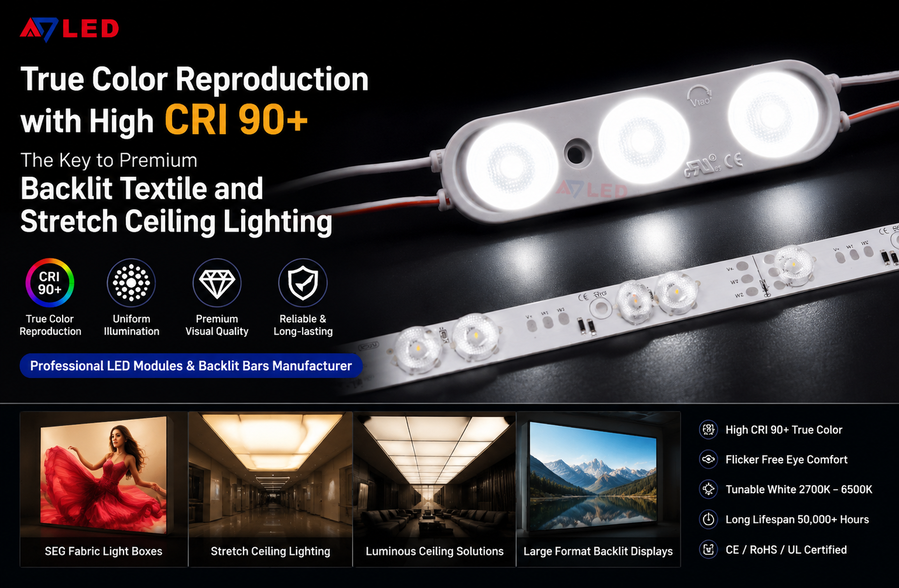
- High CRI 90 LED lightbox modules featuring 3000K warm white lightbox LED module, 4000K neutral white SEG backlight LED, and 6500K daylight white light box LED spectrums.
- Weatherproof solutions including IP65 waterproof LED module for lightboxes and IP67 outdoor tension fabric lightbox LED configurations for heavy duty outdoor SEG LED modules.
- Energy efficient constant voltage and constant current designs backed by long term factory warranties and complete UL Class 2 LED module for lightboxes compliance documentation.
Eliminate hotspots, reduce module counts, and optimize your next slim display project with proven backlight engineering. Contact our engineering team today to request a custom lighting layout, request samples, or obtain a competitive factory-direct volume price quote for your next commercial sign project.
Need Expert Assistance with Your Shallow Lightbox Layout?
Reach out to our technical team at Adled Lights for free optical layout assistance, thermal calculations, and custom LED module quotes tailored specifically to your extrusion profile:
- Website: https://www.adledlights.com/
- Services: Factory-Direct OEM/ODM, Custom Optical Lens Design, Free Photometric & Layout Simulation for Commercial Display Builders.

Frequently Asked Questions (FAQ) for Commercial Display & Lighting Engineers
Q1: How do I select the right optical lens for an ultra-thin SEG fabric lightbox under 40mm depth?
For Signage & SEG Fabric Lightbox Manufacturers: For depths below 40mm, traditional 120° or 160° optics will cause severe hotspots. You should specify a 175° TV Optical Lens with a batwing light distribution curve. This specialized PMMA optic pushes light laterally across the aluminum backplane, allowing a wider Pitch-to-Depth Ratio (P:D) of up to 3.5:1 while ensuring zero shadow lines on the 180g/m² tension fabric surface.
Q2: How can stretch ceiling and luminous ceiling installers eliminate color shift and voltage drop on large-scale installations?
For Stretch Ceiling & Large Architectural Ceiling Installers: Voltage drop across extended runs causes uneven CCT and dimming at the far end of the installation. We recommend deploying DC 24V Constant Current LED Modulesfeaturing integrated IC drivers and 2oz copper PCBs. Combining DC 24V systems with multi-point power injection ensures uniform lumen output and identical color appearance across large luminous ceiling panels up to 50 square meters.
Q3: What color consistency and CRI specs should lighting designers specify for high-end retail SEG displays?
For Architectural Lighting Designers & Specifiers: High-end retail graphics require precise chromatic accuracy. Specify High CRI 90+(with strong R9 values) to bring out true skin tones and vivid textile brand colors. Furthermore, insist on One-Bin Sorting within a McAdam 3-Step Ellipse protocol across all CCT options (3000K, 4000K, 6500K) to eliminate visible color variance between adjacent lightbox panels.