

2025-11-25
99% of People Get This Wrong! LED Strip 5V vs 12V vs 24V vs 220V: The Ultimate Voltage Guide
99% of People Get This Wrong! LED Strip 5V vs 12V vs 24V vs 220V: The Ultimate Voltage Guide
You bought 12 or 24V LED strip because your friend said they’re “easy to install.”
You ordered 230V LED tape from a marketplace because it was “plug-and-play.”
You tried 5V or 12V LED strip for your gaming setup—only to find the far end dim after 2 meters.
You ordered 230V LED tape from a marketplace because it was “plug-and-play.”
You tried 5V or 12V LED strip for your gaming setup—only to find the far end dim after 2 meters.
Sound familiar?
Here’s the hard truth: Voltage isn’t just a number on the box—it’s the foundation of your entire lighting project.
Choose wrong, and you’ll face flickering, uneven brightness, fire hazards, or dead strips in weeks.
Choose wrong, and you’ll face flickering, uneven brightness, fire hazards, or dead strips in weeks.
In this definitive guide, we’ll break down 5V, 12V, 24V, 48V, 110VAC, 220VAC, 230V, and 240V LED strips—so whether you’re installing COB LED strip 24V 4000K under kitchen cabinets or 240V LED tape lights for holiday decor, you’ll make the right, safe, and future-proof choice.
Don't Let the Wrong Voltage Ruin Your Renovation
What is LED Strip Voltage?
How to Choose Low Voltage and High Voltage LED Strip Lights?
110V or 220V LED strip -- How to Choose the Right Voltage?
How to choose the right voltage for LED Strips: 5V, 12V, or 24V?
Scenario Guide for LED Strip Selection: Follow These Steps to Get It Right
The Science of Quality: Why Professional Brands (Like ADLED) Perform Better
How to Calculate Power Supply for LED Strip?
Global Voltage Standards & Sourcing Guide
Troubleshooting & Maintenance
AC vs DC LED strip lights Conclusion: Choose Wisely, Light Brightly
5V vs 12V vs 24V vs 220V LED Strip Lights FAQ
Scenario Guide for LED Strip Selection: Follow These Steps to Get It Right
The Science of Quality: Why Professional Brands (Like ADLED) Perform Better
How to Calculate Power Supply for LED Strip?
Global Voltage Standards & Sourcing Guide
Troubleshooting & Maintenance
AC vs DC LED strip lights Conclusion: Choose Wisely, Light Brightly
5V vs 12V vs 24V vs 220V LED Strip Lights FAQ
Don't Let the Wrong Voltage Ruin Your Renovation
The Pain Point: Imagine this scenario: You have spent hours browsing online for the perfect lighting setup. You found a stunning 12 volt LED strip lights cool white that looks amazing in the photos. You buy it, wait for delivery, and unbox it, only to realize... you have nowhere to plug it in. Or worse, you plug a low-voltage strip into a standard wall outlet and poof—it burns out instantly in a cloud of smoke. Perhaps you installed a long run of 24V LED strip warm white, but by the time it reaches the end of the room, the light looks like a dying candle compared to the start.
The Reality Check: Voltage isn't just a boring technical specification on a sticker; it is the "blood pressure" of your lighting system. It dictates safety, lifespan, installation difficulty, and where you can actually use the light. Whether you are a DIY enthusiast looking for a 5v LED strip for your gaming PC, a homeowner needing 120V LED tape light for your patio, or a contractor planning a massive 240V LED tape installation for a commercial building exterior, choosing the wrong voltage is an expensive mistake.
Our Promise: By the end of this guide, you will master the differences between 5V, 12V, 24V, 48V, and high voltage 110V/220V options. We’ll help you navigate the confusion of 12V LED strip lights vs 24V, explain why strip LED 220V is fundamentally different from 120V LEDstrip lights, and ensure you never pay the "ignorance tax" again.

What is LED Strip Voltage?
Simply put, voltage is the electrical "push" that drives current through your LEDs. Understanding this "push" is key to selecting the right product, whether it's a 12 volt LED tape light or a high-power industrial solution.
DC (Direct Current) vs. AC (Alternating Current)
The first major fork in the road is between AC and DC.
-
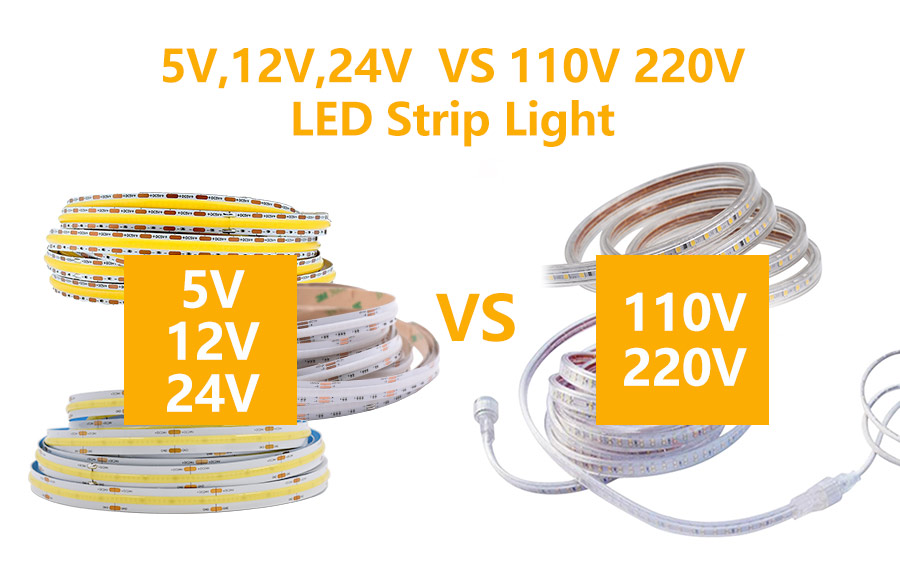
Low Voltage DC (5V, 12V, 24V, 48V): These are the safest and most common options for interior design. They require a power supply (also called a driver or transformer) to convert your home's dangerous high voltage down to a safe level. This is why 12 volt DC LED light strips are the gold standard for cabinetry, under-counter lighting, and intricate interiors.
-
Safety: You can touch a 12V LED strip while it's on without getting shocked.
-
Versatility: From 12V LED strip lights dimmable options to battery-powered setups.
-
-
High Voltage AC (110V, 120V, 220V, 230V, 240V): These connect directly to mains power using a simple rectifier cord. While convenient, an AC220V LED strip carries a significantly higher risk of shock and is generally less flexible.