

2026-05-28
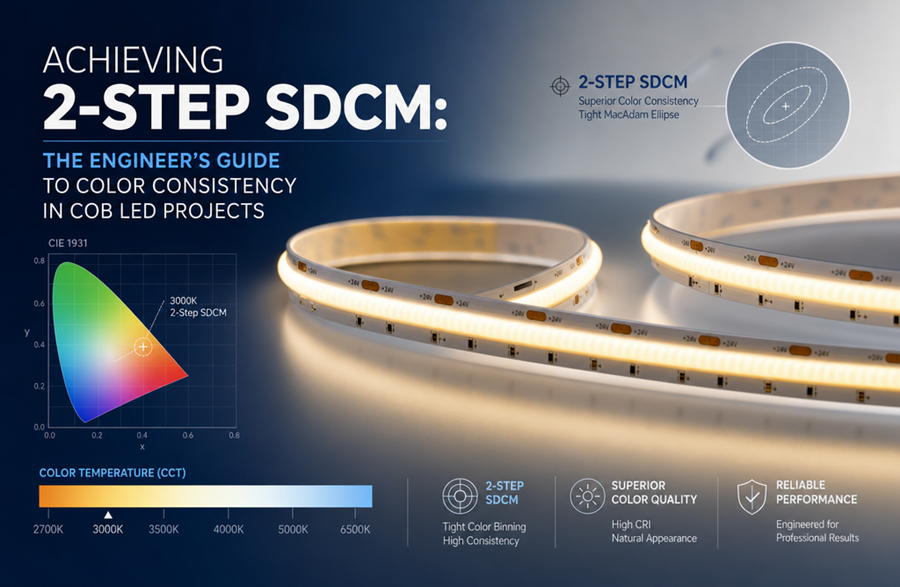
Achieving 2-Step SDCM The Engineers Guide to Color Consistency in COB LED Projects
Achieving 2-Step SDCM: The Engineer’s Guide to Color Consistency in COB LED Projects
In the sophisticated world of architectural, retail, and hospitality lighting, the difference between a project that merely "functions" and one that "inspires" often boils down to a single, critical technical metric: SDCM (Standard Deviation of Color Matching).
For lighting designers, electrical engineers, and high-end procurement managers, nothing disrupts a project schedule or compromises a client’s vision faster than "color drift." Whether you are outfitting a flagship luxury boutique, a five-star hotel lobby, or a precision-oriented museum installation, the expectation is absolute visual uniformity. Yet, the reality of the LED industry is often far grimmer. Many projects are plagued by visible batch-to-batch color inconsistencies, noticeable shifts in linear lighting, and the dreaded "patchwork" effect on illuminated surfaces.
If your project demands perfection, 2-Step SDCM is no longer a luxury—it is the baseline for professional-grade performance. This comprehensive guide explores the engineering behind color consistency and provides the technical tools you need to verify that your suppliers are delivering what they promise.
2-Step vs 3-Step SDCM: Why Color Consistency Matters in COB LED Projects
What is SDCM? Understanding COB LED Color Tolerance
Why Achieving 2-Step SDCM in COB LED Strips is Difficult
ADLED Engineering Approach: Achieving 2-Step Perfection
Technical Performance: Efficiency Meets Uniformity
Expert Tips for Contractors: How to Verify Your LED Strips
What is SDCM? Understanding COB LED Color Tolerance
Why Achieving 2-Step SDCM in COB LED Strips is Difficult
ADLED Engineering Approach: Achieving 2-Step Perfection
Technical Performance: Efficiency Meets Uniformity
Expert Tips for Contractors: How to Verify Your LED Strips
CRI vs SDCM: What Matters More in Professional Lighting?
Your Partner in Precision Lighting
Conclusion
FAQ
Your Partner in Precision Lighting
Conclusion
FAQ
2-Step vs 3-Step SDCM: Why Color Consistency Matters in COB LED Projects

When specifying lighting for professional environments, the difference between 2-Step and 3-Step SDCM is often the defining factor between a "good enough" installation and a "flawless" one. To understand why 2-Step is increasingly the required standard for high-end projects, we must look at the physics of color perception and the consequences of "color tolerance" in real-world applications.
The Threshold of Perception
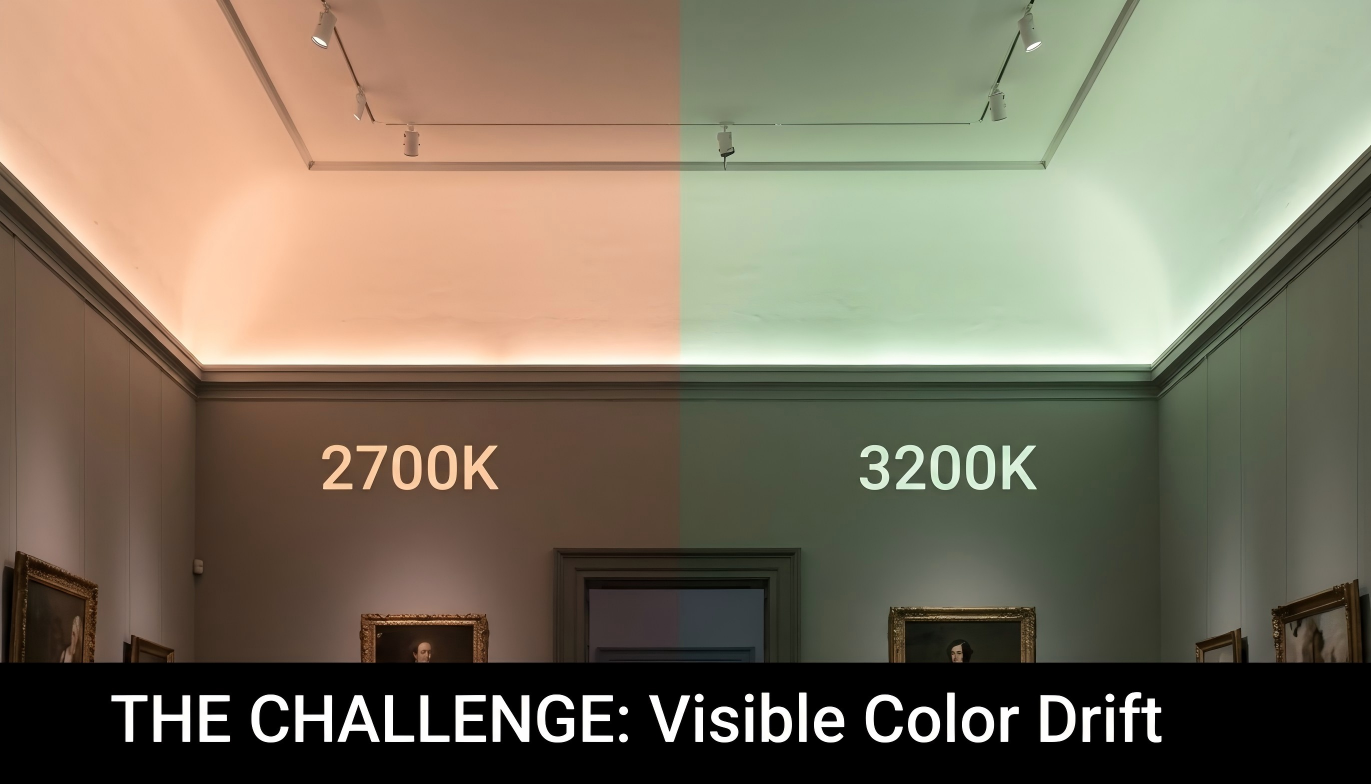
The human eye is an incredibly sensitive instrument. Under controlled laboratory conditions, the average person begins to detect a color shift at approximately 3-Step SDCM. However, in professional settings—such as luxury retail environments or museum galleries—our sensitivity is heightened.
3-Step SDCM (The Commercial Standard): In a standard office or warehouse, 3-Step SDCM is often acceptable. The light is "white," and the environment is functional. However, when installed in long linear runs, the cumulative variance can become apparent. One section of a light fixture might lean slightly toward a warm amber, while an adjacent section may appear neutral or slightly cool, creating a "checkered" or "segmented" look that ruins the architectural intent.
2-Step SDCM (The Professional Benchmark): By narrowing the tolerance to 2-Step, we ensure that the light output remains within a chromaticity region that is virtually invisible to the human eye, even under critical inspection. This is the "Gold Standard" for luxury retail and hospitality. It guarantees that whether you are lighting a singular display cabinet or a 50-meter cove, every inch of the space glows with identical color purity.
Why 3-Step is No Longer Enough
As architectural lighting design moves toward minimalism and "hidden" light sources, the light itself becomes the focal point. In these designs, the presence of color drift isn't just a minor annoyance; it is a failure of the design concept.
Reflective Surface Sensitivity: If your linear lighting is washing a white wall, a high-gloss marble floor, or a metallic display case, even a 3-Step shift will be reflected and amplified. The light will seem "muddy" or uneven.
Brand Uniformity: For global luxury brands, a signature light color is a key component of their brand identity. 3-Step SDCM allows for too much variance between batches, meaning a flagship store in Paris might look slightly different from one in New York. 2-Step SDCM locks in that identity, ensuring consistency regardless of production batch or project timeline.
The "Cost" of Consistency
There is a common misconception that 3-Step SDCM is the more "economical" choice. While the initial component cost may be lower, the project cost of 3-Step lighting is often higher. When an installation fails to meet the designer's expectations due to visible color drift, the result is costly site remediation, strip replacements, and significant downtime.
Choosing 2-Step SDCM is an investment in project reliability. It eliminates the risk of color mismatch at the source, allowing contractors and designers to deliver perfection on the first attempt, rather than struggling with the inconsistency of mass-market commercial-grade products.
Retail & Corporate Branding

Global retail chains and high-end luxury brands rely on a specific "house white." This color temperature and chromaticity are carefully curated parts of their visual identity. If one store or even one display case looks warmer or greener than the rest, the brand identity fractures. The inconsistency signals a lack of attention to detail that customers subconsciously associate with the quality of the products being sold. For a brand, uniformity is the ultimate indicator of operational excellence.
The Nightmare of Linear Lighting
COB (Chip-on-Board) LED strips are frequently used in cove lighting, linear extrusions, and architectural features that stretch tens of meters across a ceiling or wall. In these applications, the human eye is exceptionally sensitive to gradients. Even a minor variance in color becomes magnified over a long, continuous run. This leads to "segmented color," where sections of a run appear to have different CCTs, turning a high-end architectural feature into an obvious eyesore. This effect is most pronounced on white walls or near reflective surfaces, where the brain easily compares adjacent light patches.
The Professional Standard
From an installation perspective, "color mismatch" is the most frequent cause of client complaints. It forces contractors into costly, time-consuming remediation—replacing perfectly functional but "off-color" strips. For the engineer, it implies a failure in quality control; for the client, it represents a lack of professionalism. Achieving 2-Step SDCM is the most effective way to eliminate these variables and ensure a seamless, professional finish that stands the test of time.
What is SDCM? Understanding COB LED Color Tolerance
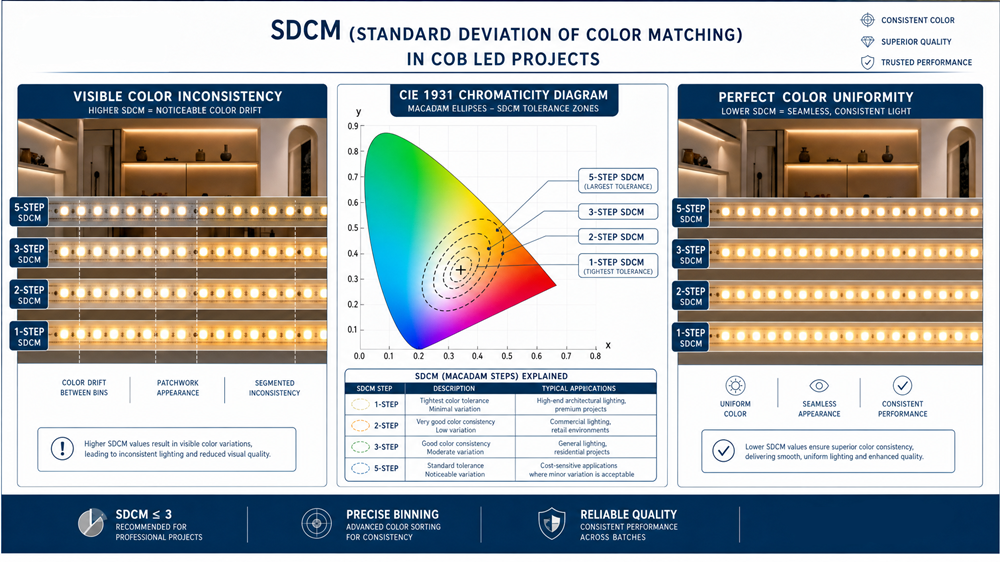
To solve the problem, we must first define the metric. SDCM, or the MacAdam Ellipse, is the industry-standard measurement for how much a light source’s color deviates from a target CCT (Correlated Color Temperature).
Developed by David MacAdam, the MacAdam Ellipse defines regions on the CIE 1931 chromaticity diagram where colors are indistinguishable to the human eye. The "steps" refer to the number of standard deviations from the center point of the ellipse.
1–2 Step SDCM (The Gold Standard): Within these boundaries, the human eye cannot perceive any color difference. This level of precision is mandatory for high-end retail, luxury residential, and art galleries where color rendering is the primary objective.
3 Step SDCM (The Commercial Baseline): This is the current standard for general office spaces, hospitals, and public buildings. While acceptable for general tasks, it often fails under the critical inspection of an interior designer or a high-end client.
5 Step SDCM (The Market Average): This is where most standard, low-cost LED products reside. In this range, the variance is easily detectable by the naked eye, particularly when different batches of the same product are installed in the same line of sight.
Why Achieving 2-Step SDCM in COB LED Strips is Difficult

If 2-Step SDCM is so desirable, why isn't it the default? The answer lies in the extreme complexity of semiconductor manufacturing and assembly processes.
The Binning Trap
Many suppliers market their products based on a single CCT (e.g., 3000K). However, "3000K" is a range, not a single point. Within that range, a chip can drift toward the green or the pink axis of the chromaticity diagram. True 2-Step consistency requires a supply chain that selects only the "top 1%" of the color bin spectrum. Most manufacturers lack the buying power or the technical discipline to force their chip suppliers to adhere to such narrow tolerances. They often mix bins to keep costs down, which is the primary driver of batch inconsistency.
The COB Packaging Variable
COB (Chip-on-Board) technology involves mounting multiple LED chips directly onto a substrate and covering them with a phosphor-filled silicone layer. This process is inherently volatile. Variables such as the precision of the phosphor concentration, the viscosity of the silicone, the uniformity of the coating thickness, and the curing temperature directly impact the light output. If these aren't tightly controlled at every second of the production run, the final light color will inevitably drift away from the chip’s native state.
Thermal and Electrical Sensitivity
Color drift is, more often than not, a function of heat. If the PCB (Printed Circuit Board) material has poor thermal conductivity, the LED junction temperature will rise rapidly, causing the chromaticity coordinates $(x,y)$ to shift. A 2-Step product requires advanced thermal management—including high-thermal-conductivity base materials—to ensure the light output remains stable even after hours of continuous operation.
ADLED Engineering Approach: Achieving 2-Step Perfection

At ADLED, we have moved beyond "batch testing" to a philosophy of "total process control." Our methodology for achieving 2-Step SDCM is built on four core pillars:
I. Elite Chip Selection & Management
We do not accept standard bins. Our procurement team works exclusively with world-class chip manufacturers to secure the elite 1% of the binning distribution. For CCTs below 5000K, we enforce a strict 2-Step threshold. For higher CCTs (5000K–6500K), we maintain a tight 3-Step threshold. We control the chips, yes, but more importantly, we control the resulting light at the finished strip level.
II. Material Science Upgrades
PCB Innovation: We utilize high-thermal-conductivity PCB materials that dramatically reduce thermal resistance. This ensures that heat is dissipated efficiently, preventing the long-term color degradation associated with overheating.
Phosphor Precision: We have transitioned from standard aluminum-based phosphors to sophisticated nitride and fluoride systems. These materials offer superior chemical stability, ensuring that our LEDs do not turn "greenish" or "yellowish" under the stresses of heat and humidity over time.
III. Automated Process Control
The human factor is the enemy of consistency. Our production lines use automated, high-precision phosphor dispensing systems to ensure the layer thickness is uniform across every single centimeter of the COB strip. This eliminates the variation often found in semi-manual production lines.
IV. The "Stress-Test" Quality System
We believe that a datasheet is only as good as the testing behind it. Our 100% Quality Control protocol includes:
Integrating Sphere Testing: Every single batch undergoes full-spectrum testing to ensure all samples fall within the 2-Step ellipse.
Aging & Stress Tests: We subject our products to extreme heat and humidity cycles to simulate years of service life, verifying that the color remains stable.
Technical Performance: Efficiency Meets Uniformity
We have achieved a breakthrough that defies the common myth that "high quality means lower efficiency." By optimizing our thermal paths and driving electronics, our 4000K COB strips now deliver 120 lm/W. Compared to standard products in the industry (which often sit around 100 lm/W), this 15–20% gain in efficiency means our clients save significantly on energy costs, all while achieving the highest possible standard of color fidelity.
Expert Tips for Contractors: How to Verify Your LED Strips
Do not simply trust the marketing brochure. As an engineer or contractor, you have a duty to verify. Here is how you can protect your project from inferior products:
Demand the Final Test Report: Most suppliers provide a chip datasheet. Demand the finished product test report. This should specifically mention the SDCM value of the assembled LED strip, not just the raw LED chip's data.
The "Ring Test" (On-Site): When you receive a sample, power it up and form a tight circle with the strip. If you can see a color difference where the two ends meet, the batch is not consistent. This is the fastest way to spot a sub-standard product.
Specify in the Contract: Never just order a "3000K LED Strip." Make it a contract requirement: "The product must maintain 2-Step SDCM throughout the entire length, and all batches supplied must be within 2-Step SDCM of the master sample."
CRI vs SDCM: What Matters More in Professional Lighting?

In the pursuit of perfect lighting, procurement managers and designers often find themselves balancing two critical metrics: CRI (Color Rendering Index) and SDCM (Standard Deviation of Color Matching). While both are essential for high-end COB LED projects, they serve fundamentally different purposes. Understanding the distinction is key to specifying the right product for your project.
CRI: The Quality of Light (Color Accuracy)
CRI measures a light source’s ability to reveal the true colors of objects compared to an ideal or natural light source.
Why it matters: A high CRI (e.g., CRI >90 or >95) is vital in retail and museum settings where the vibrancy of products or artwork must be accurately rendered. It ensures that reds look red, and textures appear natural rather than washed out.
The Limitation: CRI only tells you how well colors are rendered; it does not tell you if the light itself is consistent in its white point across multiple chips.
SDCM: The Consistency of Light (Color Uniformity)
While CRI focuses on "color accuracy," SDCM focuses on "color uniformity." It measures the deviation between light sources. Even if you have an LED strip with an incredible CRI of 98, if the batch-to-batch SDCM is high (e.g., 5-Step), your display will look like a patchy, inconsistent mess.
The Synergy: CRI is about what you see (the object), while SDCM is about how you see it (the environment). In a luxury interior, you need both: high CRI for product appeal and low SDCM for environmental harmony.
Which Matters More?
The answer depends on your project’s architectural intent:
For Retail & Display: If you are lighting jewelry or luxury garments, CRI is the priority—the product must look perfect. However, if your display involves long linear runs or backlit panels, SDCM becomes equally important. An inconsistent white point (high SDCM) will draw the customer’s eye away from the merchandise and toward the "faulty" lighting.
For Architectural & Linear Lighting: In cove, recessed, or linear extrusion applications, SDCM is the absolute priority. The human eye is incredibly sensitive to gradient shifts on walls or ceilings. In these spaces, a CRI of 90 is usually sufficient, but failing to meet a 2-Step SDCM will immediately signal a "low-quality" installation.
The ADLED Solution: Engineering for Both
At ADLED, we believe you shouldn't have to sacrifice one for the other. Our high-density COB solutions are engineered to deliver CRI >90 for exceptional color rendering, paired with 2-Step SDCM for flawless color uniformity. By controlling the entire manufacturing process—from elite chip selection to automated phosphor coating—we ensure that your projects benefit from both the vibrancy of high CRI and the seamless professional finish of 2-Step SDCM.
Pro-Tip for Specifiers: When writing your project specs, always list both. A common professional requirement reads: "All LED modules must provide a minimum CRI of 90 and be guaranteed to fall within a 2-Step MacAdam Ellipse (SDCM ≤ 2) for the finished product."
Your Partner in Precision Lighting
From luxury jewelry counters to large-scale hotel corridors, ADLED solutions are designed for those who cannot afford a second chance. We provide the stability that large-scale, continuous-installation projects demand. With our manufacturing capabilities and responsive global logistics—including our Toulouse warehouse—we bridge the gap between complex semiconductor engineering and the practical needs of the construction site.
Consistency is not just about the light you see today; it’s about the light you see three years from now.
You can also check our COB LED tape light on the website to get more information.

Conclusion
The move to 2-Step SDCM is the definitive mark of a professional. By eliminating color drift, you elevate the value of your work, reduce your maintenance burden, and ensure that your design intent is perfectly realized.
Ready to elevate your lighting standards? Don't let inconsistent color compromise your hard work.
[Contact our engineering team today for a technical consultation or to request a sample kit.] Our experts are ready to assist you in selecting the right COB solution for your next high-performance project.
Understanding the Technical Landscape: A Summary for Engineers
For those involved in the procurement and specification of high-end LED lighting, it is important to acknowledge that the industry is currently undergoing a "Quality Shift." As LED penetration increases, the differentiator between top-tier players and commodity manufacturers is shifting from raw brightness (lm/W) to color stability (SDCM).
The 2-Step Requirement: In spaces with reflective surfaces or white-on-white palettes, the human eye is unforgiving. 2-Step SDCM is the only way to guarantee that a 3000K light source in one corner of a room matches the light source in the other.
The Importance of Thermal Management: We cannot overstate this: a great chip is worthless if it is not cooled properly. By using copper-foil circuits and high-density substrates, we ensure that our LEDs do not suffer from the thermal-induced color shift that plagues lesser, budget-focused competitors.
Long-Term Reliability: Our commitment to 2-Step SDCM extends to the life of the product. Through rigorous testing, we ensure that our phosphor systems are robust enough to maintain their chromaticity coordinates for the rated life of the LED.
Choosing a lighting partner is not just about buying a component; it is about buying into a process of consistency. At ADLED, we have structured our entire operation around the specific, stringent demands of the 2-Step SDCM standard. When you choose our COB solutions, you are choosing a partner that understands the technical nuances of your project as well as you do. We welcome the opportunity to prove the difference through our technical data and sample testing.
FAQ
What is the real-world difference between 2-Step and 3-Step SDCM for my project?
In a controlled environment, 3-Step SDCM is often acceptable for general office or residential lighting. However, for applications involving continuous runs (like linear cove lighting) or highly reflective surfaces (like luxury display cases), 3-Step SDCM can result in visible color shifts. 2-Step SDCM provides near-perfect color uniformity that is indistinguishable to the human eye, ensuring that your architectural design intent remains intact from the first meter to the last.
Does "high efficiency" (lm/W) come at the cost of color stability?
Not necessarily, but it requires superior engineering. Many commodity-grade products achieve high efficiency by using low-quality phosphor or thinner coatings, which are prone to color drift under heat. At ADLED, we use advanced nitride-based phosphors and optimized thermal-conductive PCB designs to achieve 120 lm/W efficiency while maintaining strict 2-Step SDCM consistency.
How can I verify that the LED strips I purchase truly meet the 2-Step SDCM standard?
Do not rely solely on the chip supplier’s datasheet. Always request a finished product test report from an integrating sphere test. On-site, you can perform the "Ring Test": power up the strip and coil it into a tight circle; if the two ends show a color difference, the product is not
2-Step consistent. Clear specification in your purchase contract—requiring 2-Step SDCM for the finished assembly—is your best protection.
Why does color drift happen in linear lighting over time?
The primary culprit is thermal degradation. If an LED strip cannot effectively dissipate heat, the junction temperature rises, causing the phosphor to degrade and the chromaticity coordinates to shift (usually towards yellow or green). Our dual-layer, high-copper-content PCBs minimize thermal resistance, effectively "locking in" the color temperature over thousands of hours of operation.
Can ADLED customize the CCT and PCB dimensions for my specific architectural requirements?
Yes. We specialize in project-specific solutions. Beyond our standard 2-Step COB offerings, we provide custom PCB widths, specific CCT binning, and tailored power densities to meet the unique structural demands of high-end architectural and retail projects. Please [contact our engineering team] to discuss your project specifications.