2025-10-24
Do LED Lights Harm a Dog's Eyes
Do LED Lights Harm a Dog's Eyes?
Short Answer: The risk is low, but there are potential risks and factors of discomfort.
LED lights are ubiquitous in modern homes due to their energy efficiency and longevity. As responsible pet owners, it's crucial to understand how our artificial environment affects our non-verbal companions. Directly speaking, standard household LED lights are unlikely to cause immediate or physical damage to the eyes in the way we think of "harm." However, from a biological perspective of canine vision and lighting, there are some nuances that can cause discomfort or potential long-term effects.
1. Key Differences Between Canine and Human Vision
2. Potential Issues with LED Lights
3. How to Create an Eye-Friendly Environment for Your Dog
4.Other Potential Influencing Factors
5.Special Considerations for Specific Dogs
6.Positive Signals and Summarized Advice
7.FAQs
8.Conclusion
1. Key Differences Between Canine and Human Vision
To understand the impact, we must first understand how dogs see the world.
Humans are trichromats, possessing three types of cone cells for perceiving red, green, and blue light. Dogs are dichromats, with only two types of cones. Their world is composed primarily of blue and yellow hues, and they cannot distinguish between red and green. To them, red may appear as brown or dark yellow.
Dogs have poorer visual acuity than humans, around 20/75. This means what a human can see clearly at 75 feet, a dog would need to be at 20 feet to see with the same clarity. They are better at detecting motion than detail.
Dog eyes have a higher ratio of rod cells and possess a reflective layer called the tapetum lucidum, which greatly enhances their vision in low-light conditions. However, this also makes their eyes more sensitive to bright light. The tapetum acts like a mirror, reflecting light back and giving the photoreceptor cells a second chance to capture the light, which is why dogs' eyes glow in car headlights or camera flashes.
This is the point at which a flickering light source becomes so fast that it is perceived as continuous. Dogs have a higher CFF than humans (around 70-80 Hz compared to 50-60 Hz for humans). This means a rapidly flickering light that we cannot see, a dog might perceive as an irritating strobing effect.
2. Potential Issues with LED Lights
Given the differences above, here are the specific aspects of LED lights that could be of concern:
-
Flicker
Virtually all modern LEDs dim through Pulse-Width Modulation, which is rapid switching on and off. In low-cost or poorly designed LED lights, this modulation may not be fast enough and can fall within a frequency range that dogs might perceive. This invisible flicker can cause:
Eye Strain and Discomfort: Leading to squinting or avoidance of brightly lit rooms.
Neurological Effects: Potentially triggering headaches, anxiety, or stress, similar to how some humans react to fluorescent lighting.
-
Blue Light
LED lights, especially those emitting cool white light, have a high peak in the blue end of the spectrum. Blue light has higher energy and shorter wavelengths.
Potential Impact on Humans and Dogs: Studies show that excessive blue light exposure can damage the retinal photoreceptor cells, contributing to age-related macular degeneration in humans. While dog eyes are different, their retinas are similarly susceptible to photochemical damage.
Disruption of Circadian Rhythms: Blue light is key for regulating circadian rhythms (sleep-wake cycles). Excessive blue light exposure at night can suppress melatonin production and disrupt sleep. This is true for both dogs and humans. Your dog might find it harder to wind down and sleep at night if exposed to bright white LED lights in the evening.
-
Intensity and Glare
Because of the tapetum lucidum and their higher light sensitivity, a brightness level we find comfortable may be overly harsh and uncomfortable for them. Directional LED spotlights or bright, uncovered bulbs shining directly into a dog's eyes can be particularly bothersome, causing them to avoid certain areas of the home.
3. How to Create an Eye-Friendly Environment for Your Dog
You don't need to live in the dark. Just make a few smart choices.
-
Choose high-quality, flicker-free LEDs: Look for bulbs or fixtures labeled "flicker-free" or suitable for "PWM dimming." A simple test (though imperfect) is to point your smartphone camera at the light – if you see moving stripes or flicker on the screen, it's likely perceptible to your dog.
-
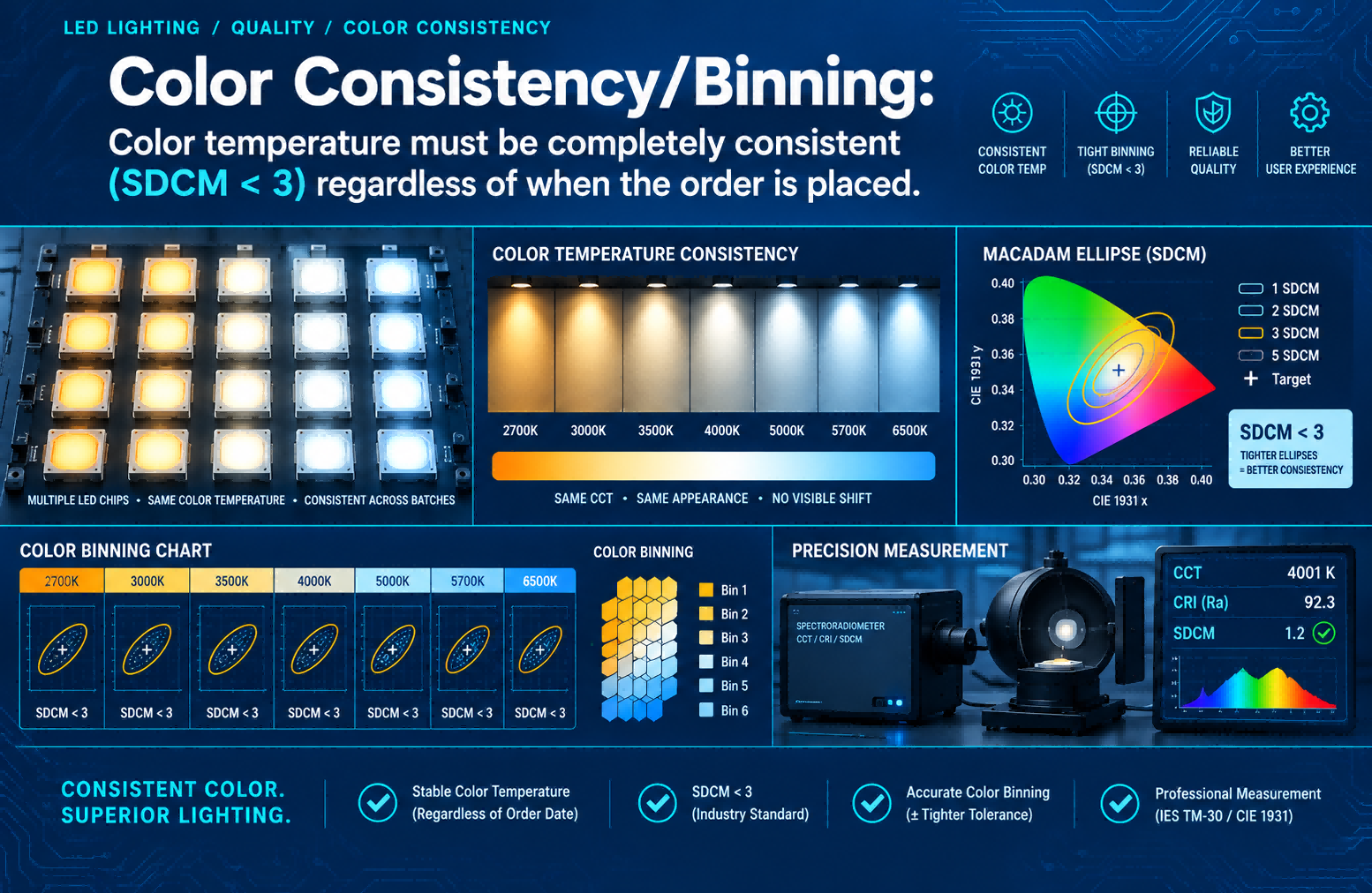
Prefer Warm White Tones: Choose LEDs with a lower color temperature (2700K-3000K), which emit a warm, yellowish-white light, rather than cool, bluish-white light (5000K-6500K). This reduces blue light exposure, especially in the evenings.
-
Avoid Glare, Use Diffused Light: Use lampshades, indirect lighting pointed towards the ceiling, or smart lighting systems to diffuse the light and avoid exposed bulbs. Ensure your dog has easy access to areas away from direct light sources.
-
Provide Darkness and Rest: Especially in the evening, dim the lights or use a small lamp instead of bright overhead lights. Provide your dog with a cozy space like a crate or a bed with a blanket where they can retreat to a darker area if needed.
-
Observe Your Dog: The most obvious signs will come from your pet itself. If your dog frequently squints, paws at their face, avoids a certain room, or seems restless under specific lighting, consider adjusting the lighting.
4. Other Potential Influencing Factors
-
Ultraviolet Radiation
Discussion: Ordinary household LEDs emit negligible ultraviolet radiation, which is a benefit. However, certain specialized LEDs, such as UVC lamps for disinfection, nail curing lamps, or some high-power commercial sources, do emit UV. The lens in a dog's eye is less effective at filtering UV than a human's, and prolonged or high-intensity exposure could potentially increase the risk of eye conditions like cataracts. Keep pets away from any light source labeled as "UV" or "germicidal."
-
Spatial and Behavioral Considerations
Discussion: The issue isn't just the light, but also the dog's behavior in relation to it. Dogs love to bask in sunny spots. If they choose to lie directly under a bright LED light for extended periods (e.g., a recessed downlight) and stare at it, the cumulative light energy could pose a theoretical risk. While dogs don't typically stare at bright lights, it might happen out of curiosity or boredom, especially in puppies.
-
Light-up Toys and Screens
Discussion: Many pet toys use blinking LEDs to attract attention. These lights are often very close to the dog's face. While the risk from a single short play session is low, repeated, direct, close-range exposure could be more likely to cause visual fatigue or discomfort. Similarly, television screens are sources of rapidly flickering light, and some dogs react to the images on screen.
5. Special Considerations for Specific Dogs
-
Senior Dogs: As they age, the lens in a dog's eye can become cloudy, leading to conditions like cataracts. They can become more sensitive to bright light and glare. Providing them with soft, diffused light is especially important.
- Dogs with Pre-existing Eye Conditions: For dogs with conditions like dry eye, corneal ulcers, or uveitis, their eyes are already inflamed or sensitive. Any bright or flickering light can significantly worsen their discomfort and pain. For these dogs, following the vet's advice and creating an extremely gentle lighting environment is crucial.
- Specific Breeds: While all dogs share a similar visual anatomy, some breeds (e.g., Corgis, Schnauzers) are predisposed to certain eye conditions like hereditary cataracts. For these breeds, proactive eye care, including avoiding unnecessary bright light stress, is a wise practice.
6. Positive Signals and Summarized Advice
On the positive side:Many modern LED systems allow you to easily adjust brightness, enabling you to set a comfortable, low level for your dog (and yourself) in the evening.
Smart Lighting:You can program smart bulbs to automatically switch to a warm tone and low intensity after sunset, which is excellent for maintaining a healthy circadian rhythm for both your dog and your family.

7. FAQs
Do LED lights emit radiation?
LED lights used for lighting basically do not emit ultraviolet rays, and their radiation is very low. The light-emitting mechanism of LEDs is different from that of fluorescent lamps. White LED light is produced by a blue LED chip emitting light of a fixed frequency that excites special phosphors to emit white light. Therefore, there is no need to worry about ultraviolet radiation, unless you specifically purchase a UV-blocking LED light.
What are the advantages and disadvantages of LED lights?
The advantages of LED lights include their small size, low power consumption, long lifespan, and being environmentally friendly and non-toxic. Initially, they were mainly used in outdoor decoration and engineering lighting. However, nowadays, their application has gradually expanded to the household lighting market. Nevertheless, LED lights also have some drawbacks, such as relatively high cost, the need for constant current driving, and potential light decay if heat dissipation is not properly managed.
Do LED lights generate heat?
Yes, but much less than traditional bulbs. LED bulbs are far more energy-efficient than incandescent bulbs, do not produce infrared radiation, and have heat sinks to dissipate any heat they generate.
Are red LED lights harmful to dogs?
No, red LED lights do not hurt dogs' eyes. Generally, these lights are safe for pets. However, in some cases, they might harm a dog's eyes, such as when the light flickers or the dog stays under the light for a long time. Nevertheless, red light is gentler on their eyes and has less impact on their sleep patterns.
8. Conclusion
Ultimately, the most comprehensive advice is:
Quality First: Invest in high-quality, flicker-free LED bulbs from reputable brands.For example: ADLED
Tone and Intensity: Use warm white (2700K-3000K) light for your main living areas and avoid exposed, harsh bulbs.
Observe and Respect: Pay attention to your dog's behavior. If it avoids an area or squints, that is the clearest signal that lighting needs to be adjusted
Provide Choice: Ensure your dog always has access to a rest area with dimmer or no direct light.
Consult an Expert: If you are concerned about your dog's eye health, or if it shows any signs of vision problems (e.g., frequently bumping into objects, red eyes, excessive tearing), consult your veterinarian promptly.