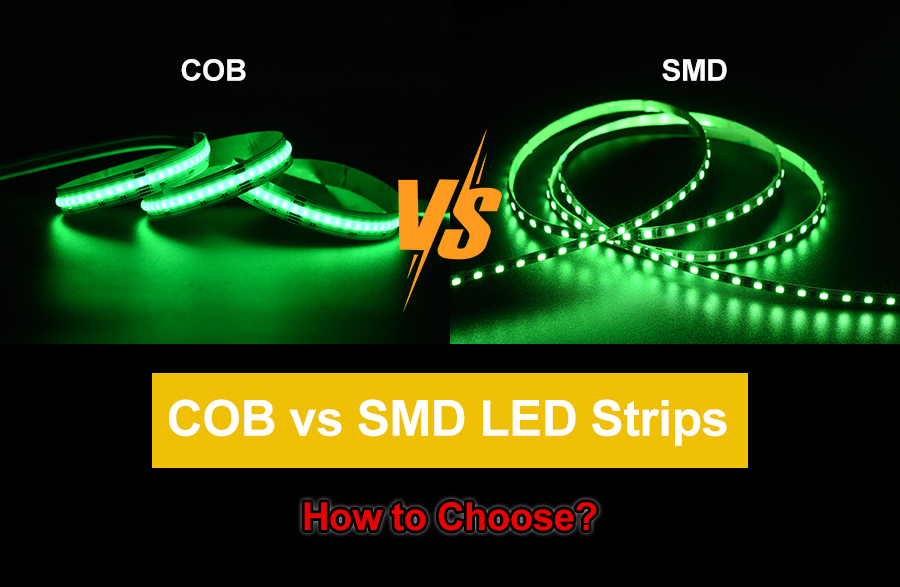
COB vs SMD LED Strips: Differences Between 5050, 2835, 3528, 5630, 5730 and How to Choose?
This guide cuts through the confusion. We’ll explore the different types of LED strips, compare performance, and help you choose the perfect solution—whether you’re installing outdoor COB LED strip lights, setting up 5050 RGB LED ribbon light strips, or selecting dimmable COB LED strip for ambient mood lighting.
COB vs SMD LED Strips: What’s the Difference?
What Does the Number Mean?
Common SMD LED Chip Types Compared
What Is a 5050 LED Strip?
What Is 2835 LED Strip?
What Is SMD 3528 LED Strip?
What Is 5630 LED Strip?
What Is SMD 5730 LED Strip?
2835 vs 5050 LED Strip: Which Is Better?
LED Strip 5050 vs 5630: Which Is Better?
LED Strip 5050 vs 3528: Which Is Better?
LED Strip 5630 vs 5730: Which Is Better?
LED Strip 3528 vs 2835: Which Is Better?
What Is The Difference Between 2835, 3528, 5050, 5630, 5730 LED Strips?
Do Bigger LED Chips Use More Electricity?
How to Choose the Right LED Strip for Your Project?
FAQ
What Is COB LED Strip?

Available as flexible COB LED strip, COB LED tape, or COB lighting strip, these come in widths like 3mm, 5mm, 8mm, and 10mm. You’ll find white COB LED strip, warm white COB LED strip (2700K, 3000K, 4000K), and even colour-changing COB LED strip options like RGB COB LED strip, RGBW COB LED strip, RGBWW COB LED strip, RGBCCT COB LED strip, and RGBIC COB LED strip.
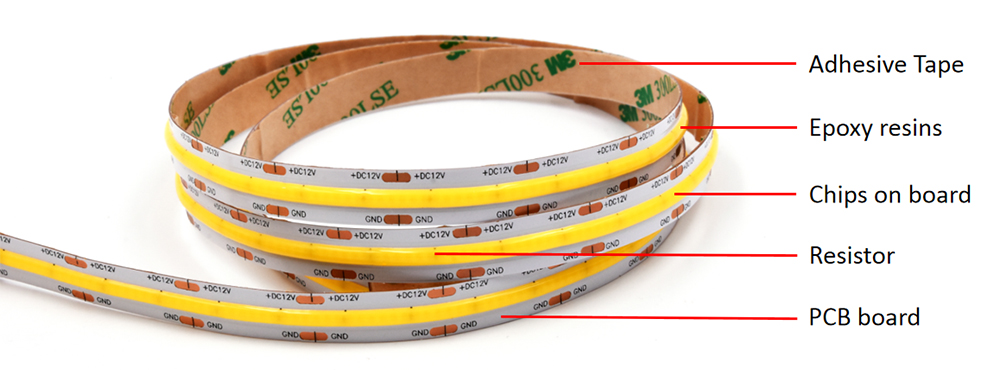
For durability, look for IP65, IP67, or IP68 COB LED strip—perfect for outdoor COB LED strip lights, bathrooms, or kitchens. They’re also available in 12V, 24V, and even 48V COB LED strip for commercial use. And yes—many are cuttable COB LED strip or free cut COB LED strip, with designated cut points for custom lengths. Smart COB LED strip versions support app or voice control, while side-emitting COB LED strip offers unique directional lighting.
COB LED Strip 5mm |
2mm LED Strip COB |
Free Cut COB LED Strip |
Brightest COB LED Strip |
Waterproof COB LED Strip Lights |
COB CCT LED Strip |
COB RGB LED Strip |
Side Emitting COB LED Strip |
RGB CCT LED Strip COB |
What Is SMD LED Strip?
SMD (Surface-Mount Device) LED strips use individual LED chips—such as 2835, 3528, 5050, 5630, or 5730—mounted on a flexible PCB. These are the backbone of the types of LED strip lights market, offering unmatched versatility.


SMD addressable LED strip for pixel-level control
Waterproof 5050 LED strip (IP65/IP67) for outdoor use
LED ribbon strip 5050, 5050 LED tape, LED stripe 5050, and 50 50 LED strip light
Whether you need 2835 LED light strips for task lighting, 5050 RGB LED strip 12V for parties, or 5630 LED strip lights for workshops, SMD technology delivers.

COB vs SMD LED Strips: What’s the Difference?
|
Feature
|
COB LED Strip
|
SMD LED Strip
|
|---|---|---|
| Light Quality | Seamless, dotless, uniform | Visible individual LEDs (without diffuser) |
|
LED Density
|
Very high (e.g., 180–1600 chips/m)
|
Lower (e.g., 30–796 LEDs/m)
|
| CRI | Excellent (typically ≥90, often 95+) | Good (70–90+), varies |
| Color Options | Single-color white, RGB, RGBW, CCT, RGBCCT, RGBIC etc. | Single-color white, RGB, RGBW, CCT, RGBCCT, RGBIC etc. |
|
Brightness
|
Medium to high
|
Ranges from low (3528) to very high (5630/5730)
|
|
Flexibility
|
Good (but avoid sharp bends)
|
Excellent (especially thin SMD strips)
|
| Heat Management | Better spread, but needs heatsinking at high power | Per-LED; denser strips run hotter |
|
Best For
|
Cove lighting, under cabinets, luxury interiors
|
DIY, color effects, task lighting
|

What Does the Number Mean?
Example:
5050 = 5.0 mm × 5.0 mm

Common SMD LED Chip Types Compared
|
Chip Type
|
Size(mm)
|
Typical Power
|
Lumen(White,~60MA)
|
Key Features
|
Common Uses
|
|---|---|---|---|---|---|
|
3528
|
3.5 × 2.8
|
0.06W
|
~6–8 lm
|
Low power, single diode, cost-effective
|
Low-brightness strips, indicator lights, decorative lighting
|
|
5050
|
5.0 × 5.0
|
0.2W
|
~18–22 lm
|
3 diodes in 1 package(can be RGB or white); high output
|
RGB strips, high-brightness single-color strips, signage
|
|
2835
|
2.8 × 3.5
|
0.1–0.2W
|
~20–24 lm
|
Modern standard– better heat dissipation, higher efficacy (~120–150 lm/W)
|
General lighting: strips, panels, downlights, retrofit bulbs
|
|
3030
|
3.0 × 3.0
|
0.2–0.5W
|
~25–50 lm
|
Square shape, good thermal pad, high CRI options
|
Architectural lighting, high-CRI task lighting
|
|
5730 / 5630
|
5.7 × 3.0 / 5.6 × 3.0
|
0.5W
|
~50–60 lm
|
High-power, large thermal pad, needs heatsinking
|
Spotlights, floodlights, high-output strips
|
|
7020 / 7030
|
7.0 × 2.0 / 7.0 × 3.0
|
0.5–1W
|
~80–110 lm
|
Ultra-high power, wide beam angle
|
Commercial lighting, high-bay fixtures, outdoor
|
|
2216
|
2.2 × 1.6
|
0.04–0.06W
|
~4–6 lm
|
Smallest mainstream chip– ultra-narrow strips
|
Tight-space applications (e.g., edge-lit panels, slim profiles)
|
What Is a 5050 LED Strip?
Key Features of 5050 LED Strips
RGB (Red, Green, Blue): Can produce millions of colors by mixing the three primary colors using a controller.
RGBW or RGBCCT: Include white or tunable white LEDs in addition to RGB for more lighting flexibility.
-
5050 RGB LED ribbon light strips
-
12V 5050 RGB LED strip or 24V smd 5050
-
5050 RGB 60 LED strip (60 LEDs per meter)
-
5050 warm white, cool white, or white 5050 LED strip
-
Waterproof 5050 LED strip (IP65), 5050 addressable LED strip, and 5V 5050 RGB LED strip
What Is 2835 LED Strip?
Key Features of SMD 2835 LED Strip
Compact and Efficient Design:
Despite their small size, 2835 LEDs offer higher luminous efficacy (more lumens per watt) compared to older types like 3528 or even 5050 in some cases. Their design allows for better heat dissipation due to a larger thermal pad on the PCB.
Brightness and Uniformity:
Typically brighter and more energy-efficient than 3528 LEDs.
LEDs are often placed closer together on the SMD LED flexible strips 2835, resulting in smoother, more uniform light with fewer visible "hot spots."
Single-color (e.g., warm white 2700K, neutral white 4000K, cool white 6500K)
Tunable white (CCT-adjustable, e.g., 2700K–6000K)
Less commonly in RGB (since 2835 isn’t optimized for multi-die color mixing like 5050)
Operates on standard 12V or 24V DC. 24V versions are preferred for longer runs to minimize voltage drop.
Common densities include 60, 120, 240, 280, 320, or even 792 LEDs per meter, making them ideal for applications requiring high uniformity (e.g., cove lighting, task lighting).
Recessed cove lighting
Under-cabinet kitchen lighting
Commercial and residential ambient lighting
Backlighting and architectural lighting
-
SMD 2835 LED strip, SMD LED flexible strips 2835
-
2835 LED strip wattage: ~7–15W/m
-
2835 LED strip width: ~8mm
-
Options: 2835 RGB LED strip, 2835 LED strip 240 (240 LEDs/m), 5m 12V 2835 LED light strip
What Is SMD 3528 LED Strip?
Key Features of SMD 3528 LED Strips
Compact Size & Lower Power:
TV backlighting
Cabinet or shelf edge lighting
Signage and low-level mood lighting
Single-color versions are most common (e.g., warm white, cool white, red, blue, green).
Not typically used for RGB because a single 3528 package can’t house red, green, and blue chips simultaneously (unlike 5050).
Common configurations include 30, 60, or 120 LEDs per meter. Higher densities help improve light uniformity.
Usually runs on 12V DC, though 24V versions exist.
Lower total power draw makes it suitable for battery-powered or low-load applications.
IP20: Basic, non-waterproof (for dry indoor use)
IP65/IP67/IP68: Silicone-coated or encapsulated for outdoor or wet environments
Less heat output than brighter strips, but also lower luminous efficacy (lumens per watt) compared to modern options like 2835 LEDs.
-
SMD3528 LED strip, SMD3528 LED light strip
-
3528 waterproof LED strip, 3528 warm white LED strip
-
12V 3528 RGB 5m LED strip light
-
3528 LED strip dimensions: 3.5×2.8mm; width: ~8mm
What Is 5630 LED Strip?
A 5630 LED strip is a type of flexible LED lighting that uses 5630-sized surface-mount (SMD) LEDs. The name "5630" refers to the LED package dimensions: 5.6 mm × 3.0 mm.
Compared to older or smaller LED types like 3528 or even 2835, the 5630 offers higher brightness and better thermal performance, making it suitable for applications where strong, efficient illumination is needed.
-
5630 LED strip wattage: ~20–24W per 5m
-
5630 LED strip power consumption: higher than 5050
-
5630 LED strip waterproof versions available
-
Often used as 5630 60D LED strip (60 LEDs/m)
What Is SMD 5730 LED Strip?
This type of LED is an evolution of the 5630 and is engineered for higher power handling, greater brightness, and improved thermal efficiency, making it suitable for demanding lighting applications.
-
5730 LED strip wattage: similar to 5630
-
5730 RGB LED strip exists but is rare
-
Used in high-demand commercial lighting
2835 vs 5050 LED Strip: Which Is Better?

|
Feature
|
2835 LED Strip
|
5050 LED Strip
|
|
Physical Size
|
2.8 mm × 3.5 mm
|
5.0 mm × 5.0 mm
|
|
LED Structure
|
Single-diode per LED (usually white)
|
Three diodes in one package (can be RGB or high-power white)
|
|
Typical Power
|
0.1–0.2W per LED
|
0.2–0.3W per LED (white); up to 0.5W+ in high-power versions
|
|
Luminous Efficacy
|
Higher (more lumens per watt)
|
Lower (less efficient, especially RGB)
|
|
Brightness (White)
|
Very bright and uniform
|
Bright, but less efficient per watt
|
|
Color Capabilities
|
Almost always single-color white (various color temperatures) or tunable white (CCT). Rarely used for RGB.
|
Commonly available as RGB, RGBW, or single-color white. Ideal for color-changing effects.
|
|
Light Uniformity
|
LEDs can be placed closer together (e.g., 120 or 240 LEDs/m), giving smooth, continuous light with minimal spotting—great for cove or under-cabinet lighting.
|
Larger size limits density (typically 30–120 LEDs/m), which can result in visible individual dots unless diffused.
|
|
Heat & Power Management
|
Runs cooler at similar brightness levels due to higher efficiency.
|
Generates more heat, especially in RGB mode or high-power white versions—requires good PCB design for long life.
|
|
Applications
|
Kitchen under-cabinet lighting, Cove or indirect ambient light, Energy-efficient white lighting, Architectural accent (white)
|
TV backlight / mood lighting, Party/decorative color effects, DIY color projects
|
LED Strip 5050 vs 5630: Which Is Better?

|
Feature
|
5050 LED Strip
|
5630 LED Strip
|
|
Size
|
5.0 mm × 5.0 mm (square) |
5.6 mm × 3.0 mm (rectangular) |
|
Diodes
|
3 chips in one package (RGB or 3x white) |
1 high-power chip (usually white) |
|
Primary Use
|
Color-changing (RGB) or general white |
High-output white lighting |
|
Power per LED
|
~0.2–0.3W (standard) |
0.5–1.0W |
|
Luminous Output
|
Moderate to high |
Very high (2–3× brighter per LED) |
|
Efficacy (lm/W)
|
Moderate |
Higher (better thermal design) |
|
Color Capabilities
|
Widely available as RGB, RGBW, RGB + CCT, etc.
Ideal for dynamic color effects, mood lighting, entertainment.
|
Almost exclusively single-color white (2700K–6500K).
Not suitable for RGB (single-die design).
|
|
Thermal Performance & Longevity
|
Features a large thermal pad for better heat dissipation.
Often used with thicker PCBs or aluminum channels—built for sustained high output.
|
Runs hotter in RGB mode (all 3 diodes on).
May degrade faster if poorly cooled or overdriven.
|
|
Applications
|
RGB party/decor lighting, Home theater accent (colors) |
Kitchen under-cabinet lighting, Retail display lighting, Office or workshop lighting, Cove lighting (white) |
LED Strip 5050 vs 3528: Which Is Better?

|
Feature
|
3528 LED Strip
|
5050 LED Strip
|
|
Size |
3.5 mm × 2.8 mm (smaller) |
5.0 mm × 5.0 mm (larger) |
|
Diodes per LED |
1 chip (single color) |
3 chips (RGB or 3× white) |
|
Typical Use |
Low-profile accent lighting |
Bright or color-changing lighting |
|
Power per LED
|
~0.06W |
~0.2–0.3W (up to 0.5W in high-power) |
|
Brightness |
Low to moderate |
2–3× brighter than 3528 |
Color Options |
Only single-color per strip (e.g., warm white, red, blue).
Cannot produce color-changing effects.
|
Available as RGB, RGBW, RGB + CCT, or single-color white.
Can create 16 million+ colors with a controller.
|
Light Uniformity & Density |
Smaller size allows higher LED density (e.g., 120 LEDs/m), creating smoother light with fewer visible dots—great for cove or edge lighting.
|
Larger size limits density (typically 30–60 LEDs/m), which can show individual "hot spots" unless diffused.
|
|
Power Efficiency & Heat
|
Very low power draw → ideal for battery-powered or low-heat applications.
|
Higher power consumption and heat output, especially in RGB mode.
Requires better thermal management for long life.
|
|
Applications
|
TV backlighting, Under-shelf mood lighting, Signage or logo lighting |
RGB party/decor lighting, Kitchen task lighting, DIY color projects |
LED Strip 5630 vs 5730: Which Is Better?

|
Feature
|
5630 LED Strip
|
5730 LED Strip
|
|
Size |
5.6 mm × 3.0 mm |
5.7 mm × 3.0 mm |
|
Typical Power |
0.5W – 1.0W per LED |
0.5W – 1.5W per LED |
|
Max Current |
Usually 150mA |
Often rated for up to 200–300mA |
|
Luminous Flux |
~50–70 lumens (at 150mA) |
~70–120+ lumens (at higher current) |
|
Thermal Pad |
Large |
Slightly larger or optimized |
Color Options |
Both are almost exclusively used for white light (2700K–6500K).
Neither is suitable for RGB (single-die design).
|
|
|
Applications
|
Kitchen under-cabinet lighting
Workshop/task lighting
Retail display lighting
Outdoor architectural highlights
|
|
LED Strip 3528 vs 2835: Which Is Better?

|
Feature
|
3528 LED Strip
|
2835 LED Strip
|
|
Size |
3.5 mm × 2.8 mm |
2.8 mm × 3.5 mm |
|
Profile |
Taller, bulkier |
Flatter, more compact |
|
Thermal Pad |
Small or none |
Large thermal pad for better heat dissipation |
|
Efficiency |
Moderate (~30–40 lm/W) |
High (~80–120+ lm/W) |
|
Power per LED |
~0.06W |
0.1–0.2W (sometimes higher) |
|
Luminous Output |
Low to moderate |
2–3× brighter at similar power |
|
Light Uniformity |
Can appear spotty at low density |
Smoother, more even glow—especially at 120–240 LEDs/m |
|
Applications
|
TV backlighting, Shelf or display accent, Battery-powered decor |
Under-cabinet kitchen light, Cove or ceiling indirect light, Recessed architectural lighting |
What Is The Difference Between 2835, 3528, 5050, 5630, 5730 LED Strips?
|
Feature
|
3528 LED Strip
|
2835 LED Strip
|
5050 LED Strip
|
5630 LED Strip
|
5730 LED Strip
|
|---|---|---|---|---|---|
|
Size
|
3.5 mm × 2.8 mm |
2.8 mm × 3.5 mm |
5.0 mm × 5.0 mm |
5.6 mm × 3.0 mm |
5.7 mm × 3.0 mm |
|
LED Chips per Unit
|
1
|
1
|
3 (RGB or 3× white)
|
1
|
1
|
|
Typical Use
|
Accent lighting
|
General white lighting
|
RGB/color or bright white
|
High-output white
|
Max-output white
|
|
Power per LED
|
~0.06W
|
~0.1–0.2W
|
~0.2–0.5W
|
~0.5–1.0W
|
~0.5–1.5W
|
|
Brightness
|
Low
|
Medium–High
|
High (esp. RGB)
|
Very High
|
Very High–Extreme
|
|
Efficiency (lm/W)
|
Low–Moderate
|
High
|
Moderate
|
High
|
Very High
|
|
Color Options
|
Single-color only
|
Mostly white (CCT)
|
RGB, RGBW, white
|
White only
|
White only
|
|
Heat Output
|
Very low
|
Low
|
Moderate–High
|
High (needs heatsink)
|
High (best with aluminum channel)
|
|
Uniformity
|
Moderate
|
Excellent (high density)
|
Fair (visible dots)
|
Good
|
Good
|
|
Best For
|
Mood lighting, TV backlights
|
Kitchen, cove, ambient lighting
|
Parties, color effects, signage
|
Task, retail, outdoor
|
Industrial, high-bay, premium task lighting
|

Do Bigger LED Chips Use More Electricity?
How to Choose the Right LED Strip for Your Project?
-
Need seamless light? → COB LED strip (e.g., thin COB LED strip, dimmable COB LED strip)
-
Want RGB? → 5050 RGB LED strip (e.g., 5050 RGBW LED strip, 5050 addressable LED strip)
-
Bright white needed? → 2835, 5630, or 5730
-
Outdoor/wet? → IP67 COB LED strip or LED strip lights waterproof 5050
-
Long run? → Use 24V (LED strip COB 24V, strip LED 5630 24V)


