

2026-03-26
Edge-lit LED vs Backlit LED: Which is Better for Lightboxes?
Edge-lit LED vs Backlit LED: Which is Better for Lightboxes?
In the high-stakes world of commercial signage and retail display, the difference between a high-end masterpiece and a mediocre project often comes down to one invisible factor: the internal light source.
Whether you are a professional signage manufacturer or a creative advertising agency, choosing the right illumination is the heartbeat of a successful lightbox project. But the question for professionals remains: Edge-lit LED vs. Backlit LED—which one delivers the best ROI and visual impact for your specific application?
At ADLED, we believe there is no absolute "best" technology, only the most optimized solution for your specific depth, budget, and uniformity requirements. In this ultimate guide, we dive deep into the physics of light distribution to help you make a data-driven decision.
What is Backlit LED Lighting and the Physics of the "1:1 Rule"?
When Should You Use Edge-lit LED Lighting for Ultra-Slim Designs?
How Does ADLED Solve the Hidden Costs of "Cheap" LEDs?
Which Lighting Technology Wins the Professional Comparison?
What are the Golden Rules for Choosing the Right Lightbox LED?
Partner with a Retail Lighting Solution Expert
Technical Solutions for Signage Pros
When Should You Use Edge-lit LED Lighting for Ultra-Slim Designs?
How Does ADLED Solve the Hidden Costs of "Cheap" LEDs?
Which Lighting Technology Wins the Professional Comparison?
What are the Golden Rules for Choosing the Right Lightbox LED?
Partner with a Retail Lighting Solution Expert
Technical Solutions for Signage Pros
What is Backlit LED Lighting and the Physics of the "1:1 Rule"?
The Mechanics of Direct-lit Systems
Backlit LED lighting (also known as direct-lit) involves a grid of LED modules or rigid bars mounted on the back panel of the lightbox. The light travels directly forward through the fabric or acrylic face.
Deep Insight: The Pitch-to-Depth Ratio (P:D)
Professional signage engineers live by the P:D Ratio to achieve Perfect Uniformity.
Professional signage engineers live by the P:D Ratio to achieve Perfect Uniformity.
The Challenge: If the distance between LEDs (Pitch) is too wide relative to the distance to the fabric (Depth), you get visible "hotspots" or "zebra stripes."
The ADLED Solution: While the industry standard is often a 1:1.5 ratio, ADLED’s 170° wide-angle optical lens allows for a 1:2.5 ratio.
The Benefit: You can use fewer LED bars to cover the same area, reducing both power consumption and labor costs without compromising on luminosity.
The ADLED Solution: While the industry standard is often a 1:1.5 ratio, ADLED’s 170° wide-angle optical lens allows for a 1:2.5 ratio.
The Benefit: You can use fewer LED bars to cover the same area, reducing both power consumption and labor costs without compromising on luminosity.

Why High-CRI Backlighting is Non-Negotiable
For luxury brands (e.g., cosmetics or automotive), color accuracy is everything. ADLED Backlit bars offer CRI >90 (Ra90). This ensures that the red in a Coca-Cola sign or the skin tones in a fashion ad look exactly as the designer intended, preventing the "grayish" tint common in low-quality LEDs.
When Should You Use Edge-lit LED Lighting for Ultra-Slim Designs?
The Art of Total Internal Reflection (TIR)
Edge-lit LED lighting relies on the principle of Total Internal Reflection within a Light Guide Plate (LGP). It is the "secret weapon" for high-end retail environments where a 10cm thick lightbox would look bulky and outdated.

Is Edge-lit Energy Efficient at Large Scales?
There is a common misconception that Edge-lit is always more efficient because it uses fewer LEDs.
The Truth: For small, ultra-slim boxes (under 1sqm), Edge-lit is superior.
The Technical Limitation: As the lightbox grows, light loss increases in the center of the LGP. For any display over 2 meters in width, the energy required to "push" light to the center often exceeds that of a Backlit grid.
Precision Side-lit LED Modules: Beyond 5 Meters
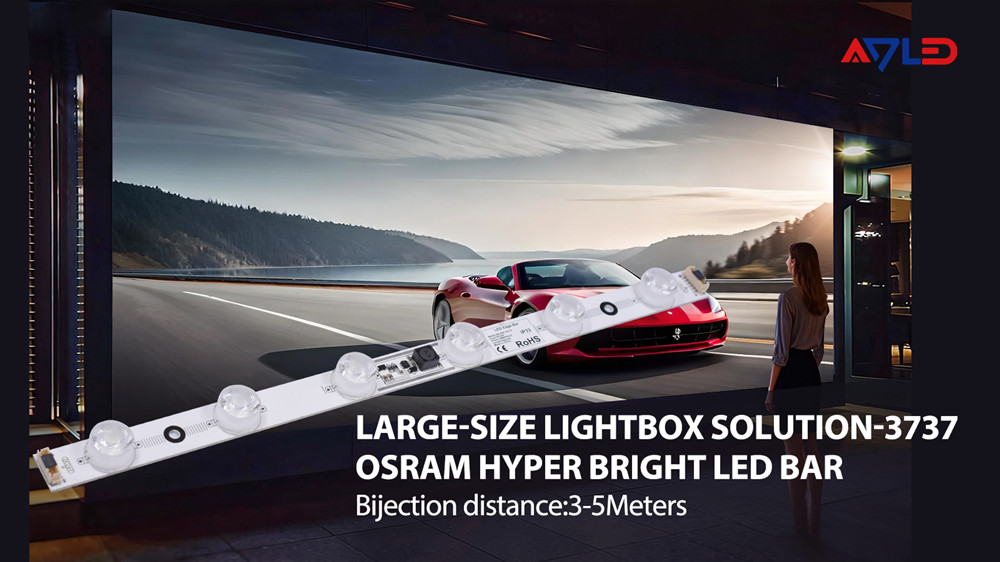
For large fabric lightboxes (SEG) where an LGP is too heavy, our Side-lit LED modules are the answer.
10°×60° Asymmetric Beam: This isn't just a light; it's a projector. By concentrating the beam, we can achieve uniform lighting over a 5-meter span in double-sided pylons—a feat standard LEDs cannot match.
10°×60° Asymmetric Beam: This isn't just a light; it's a projector. By concentrating the beam, we can achieve uniform lighting over a 5-meter span in double-sided pylons—a feat standard LEDs cannot match.
How Does ADLED Solve the Hidden Costs of "Cheap" LEDs?
Professional clients know that the purchase price is only 20% of the Total Cost of Ownership (TCO). The rest is maintenance and electricity.
Why 1.6mm Aluminum PCBs Matter?
Most suppliers use 1.0mm or even FR4 (fiberglass) PCBs to save costs.
The ADLED Standard: We use 1.6mm thick high-thermal conductivity aluminum PCBs.
Why? Heat is the #1 killer of LED brightness (Lumen Depreciation).
Our thicker boards dissipate heat 60% more effectively, ensuring your lightbox maintains 95% brightness even after 3 years of 24/7 operation.
Solving Voltage Drop and Heat Build-up
When running long sections of LEDs, the end is often dimmer. ADLED solves this with Constant Current (CC) IC technology and 2oz Copper traces. This ensures every single LED in a 50-meter airport installation pulls the exact same wattage, resulting in perfectly consistent Color Temperature (CCT).
Which Lighting Technology Wins the Professional Comparison?
Feature,Backlit (Direct-lit),Edge-lit (Side-lit),Professional Insight
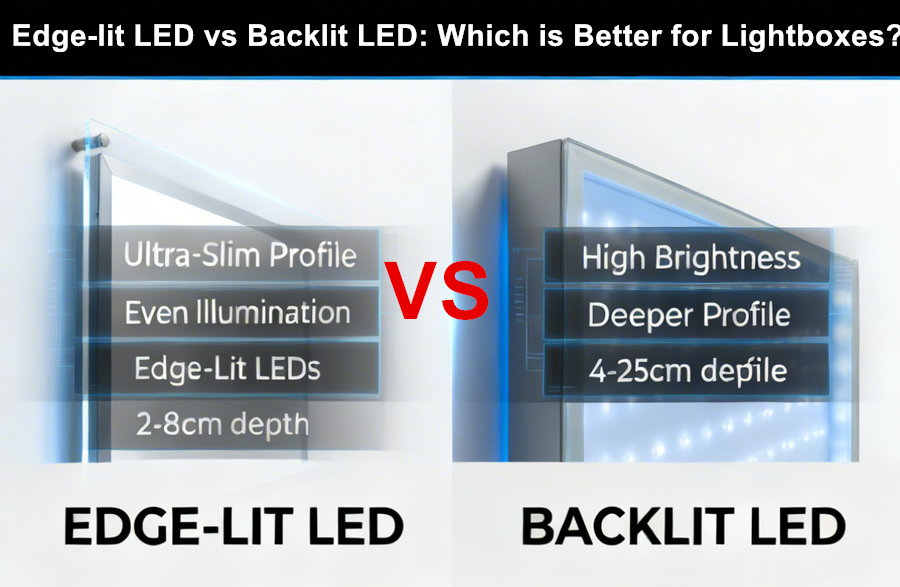
Optimal Depth,4cm - 25cm,2cm - 8cm,"Below 4cm, Edge-lit is mandatory for quality."
Luminous Efficacy,Up to 150 lm/W,100 - 120 lm/W,Backlit is ~20% more energy-efficient at scale.
Installation Time,Moderate (Grid layout),Fast (Perimeter only),Edge-lit saves ~30% on assembly labor.
Sustainability,High (LEED compatible),Moderate,"Backlit is preferred for ""Green"" building specs."

What are the Golden Rules for Choosing the Right Lightbox LED?
Rule 1: The Depth Dictates the Tech. If the design requires a profile thinner than 4cm, Edge-lit is your only choice. For 10cm or more, Backlit offers the best "bang for your buck."
Rule 2: Consider the "Sustainability" Factor. For government or large corporate contracts, focus on lm/W. Our 150 lm/W bars help projects meet LEED or BREEAM certifications.
Rule 3: Maintenance Access. In high-traffic areas like subways, Edge-lit frames allow technicians to swap LEDs from the side without removing the large, fragile graphic fabric.
Partner with a Retail Lighting Solution Expert
Choosing between Edge-lit and Backlit is an engineering decision that impacts your brand's reputation. At ADLED, we provide more than just LEDs; we provide DIALux simulations, thermal analysis, and custom PCB design.
Whether you are designing a 3cm slim menu board or a 50-meter airport spectacular, ADLED has the technical expertise to ensure your project shines brighter and lasts longer.
Ready to upgrade your lighting specs?
Contact the ADLED technical team for a free DIALux simulation and custom quote.
Ready to upgrade your lighting specs?
Contact the ADLED technical team for a free DIALux simulation and custom quote.
Technical Solutions for Signage Pros
How do I avoid "Zebra Stripes" in a 5cm deep lightbox?
Use ADLED’s 170° Wide Angle Lens Backlit Bars. The extreme beam spread allows for a smooth glow even at shallow depths.
Can Side-lit modules handle 5000K or 6500K CCT requirements?
Yes. We offer strict 1-step MacAdam Ellipse binning, ensuring every module has the exact same color temperature across the entire project.
Why use 24V instead of 12V?
For professional lightboxes, 24V is the standard. It halves the current, significantly reducing voltage drop and heat generation over long distances.
What is the difference between edge lit and backlit lightbox?
The difference between edge lit and backlit lightbox lies in how the light is distributed. Edge-lit systems use side lit LED modules for signage mounted along the frame, guiding light across a light guide plate, making them ideal for ultra thin LED lightbox lighting solutions. In contrast, backlit systems use backlit LED modules for lightboxes installed behind the panel, delivering stronger brightness and better performance for large formats and LED lighting for large format signage.
How does an edge lit vs backlit LED lighting comparison impact performance?
In an edge lit vs backlit LED lighting comparison, edge-lit solutions excel in slim designs like LED lighting for 3cm lightbox or other lighting solutions for thin lightbox, while backlit systems provide higher brightness and better uniformity over large areas. Backlit systems are the preferred LED backlight solution for large lightboxes, especially in commercial and advertising environments.
Should I choose edge lit or backlit LED for signage?
Choosing edge lit or backlit LED for signage depends on your application. For compact displays and uniform lighting for slim lightboxes, edge-lit is ideal. However, for LED lighting for retail lightboxes, LED solution for airport lightbox signage, or large advertising panels, LED modules for backlit signs offer superior brightness and scalability.
What are the best backlit LED modules for signage?
The best backlit LED modules for signage are those with high lumen output, wide beam angles (such as 170°), and stable performance. High-quality LED modules for backlit signs ensure consistent brightness, making them suitable for commercial lightbox LED solution applications and LED lightbox solution for advertising signs.
How do you achieve uniform backlit LED lighting design?
A proper uniform backlit LED lighting design requires balancing LED spacing, depth, and beam angle. Using optimized LED modules spacing for backlit lightbox and wide-angle lenses helps distribute light evenly, which is essential for avoiding defects and achieving uniform lighting for slim lightboxes.
How to light a slim lightbox evenly?
To understand how to light a slim lightbox evenly, you can use high-density side lit LED modules for signage or advanced backlit solutions with optimized optics. Selecting the right lighting solution for thin lightbox ensures consistent brightness even with limited depth.
How to avoid hot spots in lightbox?
If you want to know how to avoid hot spots in lightbox, the key is proper LED spacing and sufficient depth. Using wide-angle backlit LED modules for lightboxes and following correct LED modules spacing for backlit lightbox guidelines will effectively eliminate hotspots.
How to get uniform light in LED lightbox?
To achieve how to get uniform light in LED lightbox, you need the right combination of LED layout, diffusion materials, and optical design. High-performance LED modules for backlit signs and proper installation techniques ensure smooth, even illumination.
What is the solution for LED lightbox uneven lighting?
The best LED lightbox uneven lighting solution is to optimize module spacing, improve diffusion, or upgrade to higher-quality best backlit LED modules for signage. This also helps solve common issues like the lightbox dark area problem solution.
What LED solutions are best for retail and commercial lightboxes?
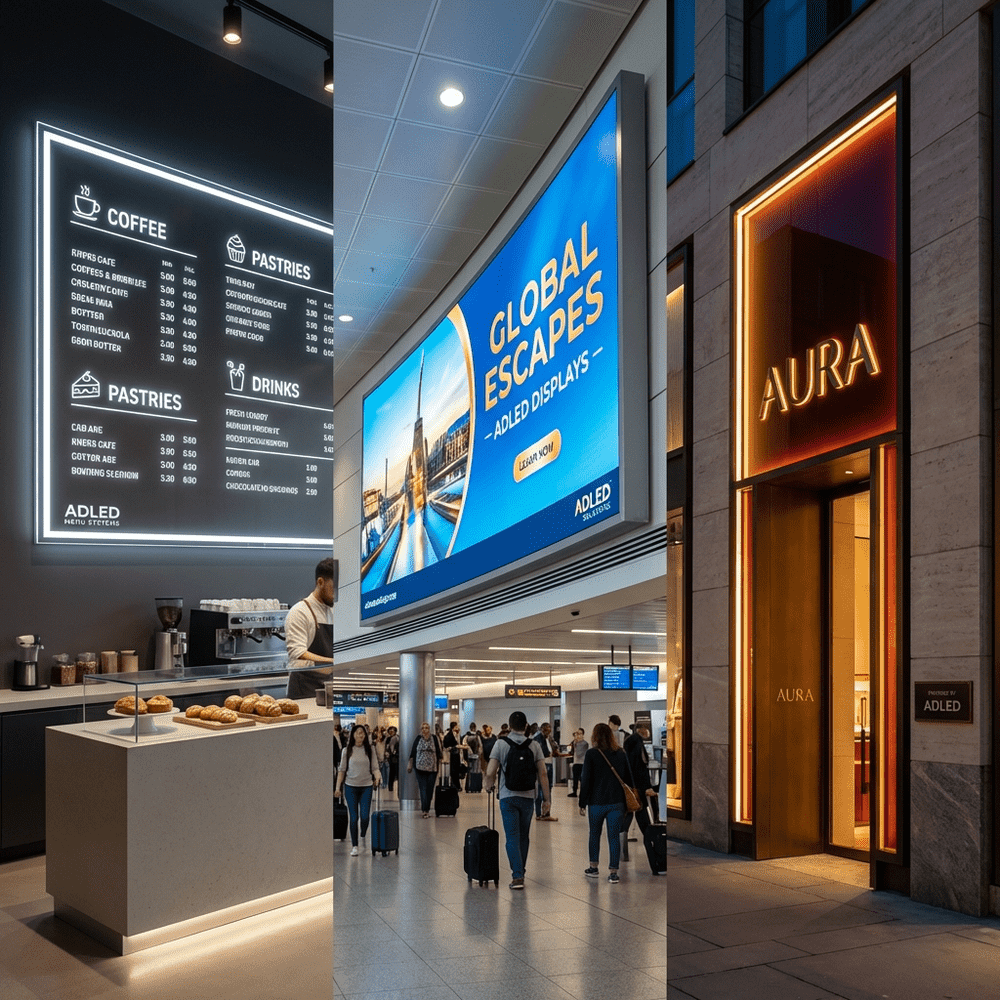
For LED lighting for retail lightboxes, LED lighting for shop display lightbox, and LED solution for shopping mall lightbox, both edge-lit and backlit systems are used depending on size and depth. Backlit systems are preferred for brightness, while edge-lit works well for slim profiles.
What is the best LED solution for large advertising and fabric lightboxes?
For large-scale applications like LED lighting for fabric frame lightbox and LED lighting for large format signage, backlit systems provide the most reliable results. A professional LED lightbox solution for advertising signs ensures durability, brightness, and visual impact.
Can backlit systems be used for double-sided lightboxes?
Yes, LED modules for double sided lightbox are commonly used in backlit designs, especially for large displays. They are widely applied in airports, malls, and retail environments as part of a commercial lightbox LED solution.
Who should I choose as a supplier?
Working with a professional LED lightbox manufacturer ensures you get optimized solutions, whether you need side lit LED modules for signage or backlit LED modules for lightboxes, along with proper technical guidance for your project.