2026-05-19
Ensuring Color Consistency Why Binning Matters for National Brand Rollouts
Ensuring Color Consistency: Why Binning Matters for National Brand Rollouts
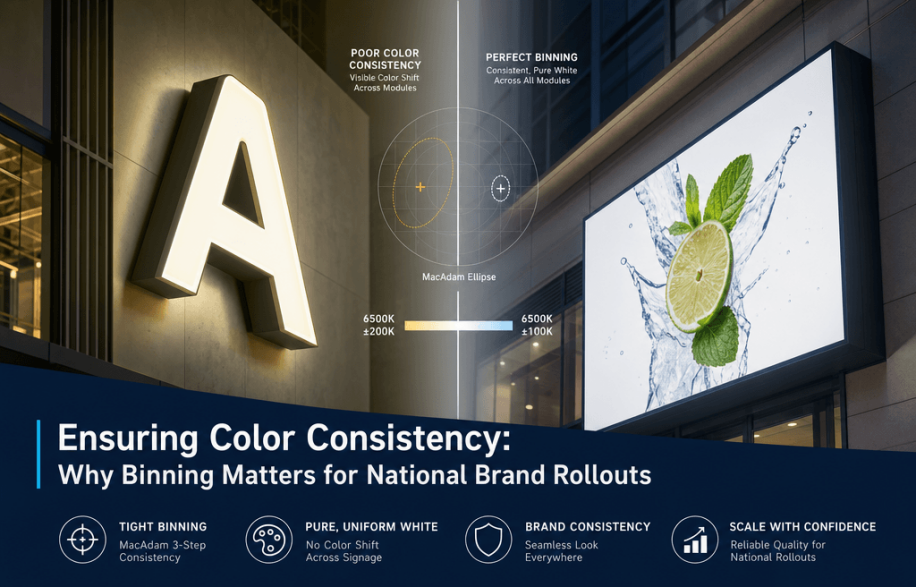
When global retail giants, luxury hospitality chains, or automotive companies execute large-scale, multi-location rollouts, their corporate identity signage is their most visible handshake with the customer. Maintaining flawless brand image protection lighting across thousands of sites is a massive undertaking. For sign makers and engineering firms, there is a silent profit killer hidden in the bill of materials: color deviation.
If a prominent brand signboard in New York shows a crisp cool white while its franchise twin in Los Angeles emits a noticeable yellowish tint, the brand consistency is fractured. This issue highlights the vital importance of color-consistent LED lighting. For commercial backlit LED solutions, the secret to achieving zero visible color deviation lies in a precise, highly technical process known as LED binning.
Understanding how an industrial grade LED modules manufacturer manages chromaticity coordinates is not just an exercise in technical specifications. It is a critical strategy for lighting project procurement that directly impacts the commercial lighting ROI, maintenance costs, and total project success.
1. The Cost of Color Shift: Why Global Brands Demand Absolute LED Module Color Consistency
2. Decoding MacAdam Ellipse LED Binning: What 2-Step and 3-Step SDCM Mean for Premium Projects
3. Why Selecting a "One Bin Only" LED Supplier is Critical for Mass Signage Production
4. Anatomy of High Quality Backlit LED Modules for Luxury Commercial Lightboxes
5. Engineered for Durability: Combining Strict Binning with IP68 Rated Waterproof Performance
6. Mitigating Risk in Supply Chain: Factory-Direct QA and Batch-to-Batch Traceability
7. Elevate Your Next Project: Partner with Adled Light for Premium Brand Signage Solutions
8. Technical FAQ: Resolving Color Consistency & LED Binning Challenges
2. Decoding MacAdam Ellipse LED Binning: What 2-Step and 3-Step SDCM Mean for Premium Projects
3. Why Selecting a "One Bin Only" LED Supplier is Critical for Mass Signage Production
4. Anatomy of High Quality Backlit LED Modules for Luxury Commercial Lightboxes
5. Engineered for Durability: Combining Strict Binning with IP68 Rated Waterproof Performance
6. Mitigating Risk in Supply Chain: Factory-Direct QA and Batch-to-Batch Traceability
7. Elevate Your Next Project: Partner with Adled Light for Premium Brand Signage Solutions
8. Technical FAQ: Resolving Color Consistency & LED Binning Challenges
1. The Cost of Color Shift: Why Global Brands Demand Absolute LED Module Color Consistency
For high-end retail backlit signs, luxury retail signage, and airport signage lighting, consistent white balance is non-negotiable. Global corporations spend millions establishing their exact corporate identity signage color palettes. When these colors are backlit via commercial lightboxes or transit hub lightboxes, any variation in color temperature consistency becomes immediately apparent to the human eye.
This variation, known as color shift, can happen for two reasons: poor initial sorting at the factory or rapid degradation due to inadequate thermal management LED design. When multiple subcontractors procure LED sign lights from different batches without strict oversight, the resulting unevenness ruins the visual impact of premium display lighting.
The financial consequences for an architectural LED module manufacturer or sign installer can be severe:
-
Expensive Warranty Claims: Fixing installed signs requires field technicians, bucket trucks, and replacement components, which quickly erodes project margins.
-
Delayed Project Sign-Offs: Strict corporate inspectors will reject handovers if they detect a no yellowish edge LED failure or uneven color uniformity in signage.
-
Total Cost of Ownership (TCO) in Lighting: High-quality signage components might require a larger premium lighting investment upfront, but they significantly reduce service calls LED over a long lifespan backlit LED lifecycle.
By purchasing value-engineered LED modules that prioritize strict CCT binning, buyers avoid the logistical nightmare of post-installation troubleshooting. This approach secures a lower Total Cost of Ownership (TCO) in lighting and ensures maintenance-free LED modules perform reliably over the long term.

2. Decoding MacAdam Ellipse LED Binning: What 2-Step and 3-Step SDCM Mean for Premium Projects
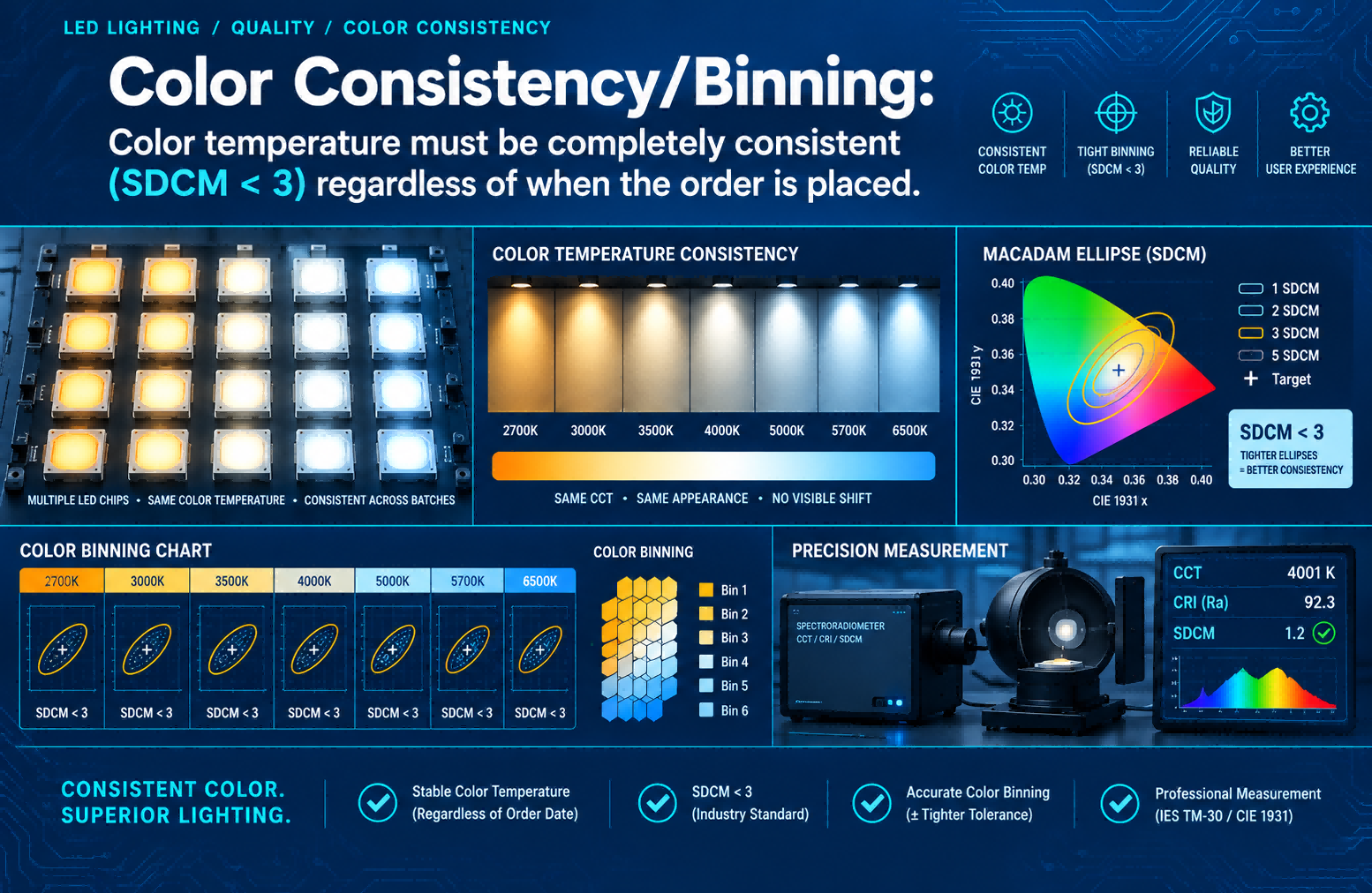
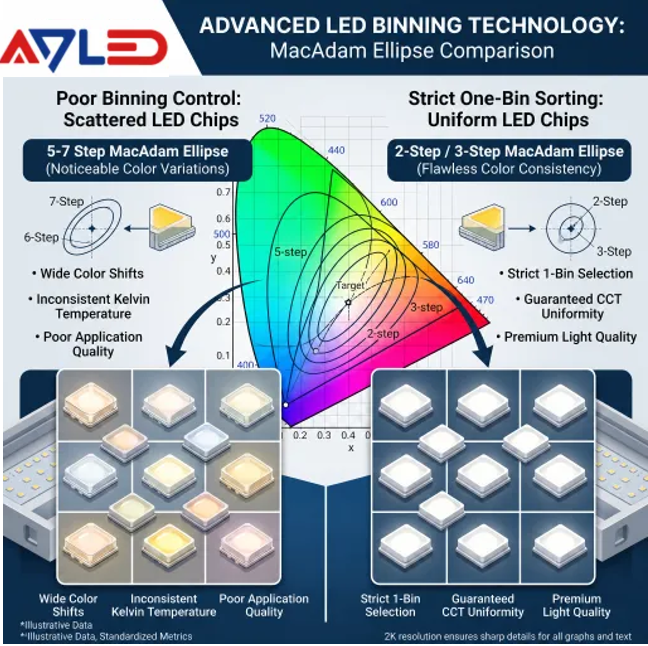
To avoid color inconsistencies, engineers rely on the Standard Deviation of Color Matching (SDCM) system, which is based on the MacAdam Ellipse LED binning standard. Named after engineer David MacAdam, these ellipses are mapped around specific chromaticity coordinates on the CIE color space diagram to define acceptable margins of color variation.
The size of the ellipse determines the sorting tightness. A MacAdam step sorting system measures how far an LED chip deviates from the target color temperature:
-
MacAdam 1-Step Ellipse: The deviation is imperceptible to the human eye. This level requires highly advanced LED packaging factory sorting capabilities.
-
MacAdam 2-Step Ellipse (SDCM 2 LED modules): The variation is virtually unnoticeable, making it the premier choice for demanding museum showcase lighting, high-end millwork lighting, and gallery display backlit modules.
-
MacAdam 3-Step Ellipse (SDCM 3 LED modules): This is the industry standard for high-performance LED modules used in commercial architecture and professional grade LED modules. The differences are barely visible under normal viewing distances.
-
MacAdam 5-Step to 7-Step Ellipse: Noticeable variations occur, resulting in mixed warm white and cool white hues on a single uniform white light distribution plane. These lower-tier chips should be avoided for national brand rollouts.
When specifying components for an architectural contour lighting project or exhibition booth design lighting, engineers must ask for precise Kelvin matching documentation. High CRI 90 LED modules backed by stable color output chips ensure colors look vibrant and accurate under critical review.
Whether utilizing an Osram chip backlit LED, an Epistar LED chip modules architecture, or a Sanan high efficiency chip option, understanding how your supplier manages Correlated Color Temperature (CCT) sorting safeguards your projects from unexpected color variations.

3. Why Selecting a "One Bin Only" LED Supplier is Critical for Mass Signage Production
For international OEM factories/ODM buyers for first-line lighting brands and volume purchasing LED modules distributors, scaling production without sacrificing quality is a major challenge. In mass production LED modules environments, components are often sourced over several months. If your contract lighting supplier draws components from random bins, batch-to-batch traceability becomes impossible.
Partnering with a dedicated one bin only LED supplier solves this supply chain risk. A one bin only LED supplier guarantees that every single chip supplied for a rollout originates from the exact same microscopic coordinate section of the wafer run.
This strict discipline is critical when buying wholesale LED sign modules or mass-producing high-volume LED manufacturing components. The benefits of choosing a reliable Chinese LED manufacturer committed to single-bin deliveries include:
-
Seamless Integration: Linear accent lighting elements match perfectly with neighboring heavy-duty LED backlit signs, regardless of production scheduling gaps.
-
Simplified Inventory Control: Procurement teams don't need to segregate bulk LED module supply batches during factory assembly or job site staging.
-
True Wholesale Commercial LED Reliability: Buying direct-from-factory LED supply under single-bin agreements ensures consistent color matching across long-term signage programs.
When submitting a commercial lighting inquiry or issuing an RFQ for LED modules, companies should verify that their partner has the advanced testing equipment needed to maintain single-bin consistency over high-volume shipments.

4. Anatomy of High Quality Backlit LED Modules for Luxury Commercial Lightboxes
High-quality backlit LED modules require precise engineering that goes beyond standard chip sorting. To create uniform brightness LED modules for deep or ultra-thin commercial lightboxes, multiple internal components must work together seamlessly.
Advanced Optical Lenses
Premium modules feature a wide viewing angle 170 degree batwing beam lens LED design. This unique shape spreads light outward rather than straight ahead, allowing for a uniform diffusion lens effect. This eliminates dark shadows and hot spots, even in shallow custom trade show exhibits.
Optimized Circuit Layout
High-end modules balance input voltage DC12V DC24V power configurations across long distances. Incorporating a constant current driver design prevents low voltage drop LED strip issues, keeping the first module on a circuit identical in brightness and color to the last.
Efficient Thermal Management
High luminous efficacy LM/W chips generate heat that must be dissipated to prevent premature lumen maintenance L70 drop-off. Utilizing a thick, heat dissipation aluminum PCB ensures excellent thermal conductivity, keeping the module running cool and protecting its long-term color stability.
For custom LED module engineering projects, choosing components built with these structural advantages protects the investment in luxury retail signage and keeps energy consumption low via sustainable signage lighting design.
5. Engineered for Durability: Combining Strict Binning with IP68 Rated Waterproof Performance
Outdoor signage LED modules and architectural facade lighting must withstand harsh environmental conditions. Rain, dust, extreme temperature shifts, and UV exposure can accelerate yellowing and degrade materials if components are poorly protected.
To maintain perfect color-consistent LED lighting outside, robust protection is essential. Specifying IP67 waterproof LED modules or IP68 rated LED sign modules provides the necessary weather-resistant backlit LED defense against water and moisture infiltration.
Using a durable exterior sign lighting module built with a silicone injection LED modules process provides an airtight seal around the optical lens and PCB. Unlike cheap epoxy alternatives that crack and turn yellow under sunlight, UV-resistant encapsulation materials protect the underlying chip coordinates from shifting over time.
For demanding applications like outdoor billboard lighting, cove lighting projects, or public transit hubs, choosing dustproof LED lighting components ensures long-term outdoor stability. Incorporating features like over-current protection LED circuits guarantees that power fluctuations will not damage the modules or cause color shifts in harsh environment LED modules.

6. Mitigating Risk in Supply Chain: Factory-Direct QA and Batch-to-Batch Traceability
For procurement managers overseeing national brand rollouts or sourcing components for an OEM LED module factory, supply chain reliability is just as important as technical performance. Dealing with fragmented assembly operations introduces significant product consistency risks.
Partnering with an experienced China LED module manufacturer that operates an integrated Shenzhen LED module factory streamlines quality control and ensures clear accountability.
A premier China high-end LED supplier maintains clear production oversight through rigorous internal processes:
-
Strict Quality Control Systems: Operating within an ISO9001 certified LED factory guarantees that every step of assembly—from solder paste application to lens placement—follows documented procedures.

-
Comprehensive In-House Laboratories: Utilizing an in-house LED testing lab equipped with integrating spheres and goniophotometers allows for continuous, real-time monitoring of batch-to-batch traceability.

-
Compliance with Industry Standards: Reliable manufacturers verify their performance through trusted compliance metrics, including LM-79 testing standard data and LM-80 certified LED chips documentation.
This rigorous quality control ensures that whether you buy LED modules in bulk today or place a reorder next year, the light output, color bin, and electrical performance will remain perfectly matched.
7. Elevate Your Next Project: Partner with Adled Light for Premium Brand Signage Solutions
Achieving perfect color consistency across a national brand rollout requires an experienced manufacturing partner. Adled Light Limited brings 13 years of LED manufacturing experience to the industry, providing reliable, high-capacity LED factory production tailored for demanding B2B applications.
We design and manufacture reliable sign lighting components that meet strict global regulatory and safety standards, including:
-
North American Sign Regulations: Full UL listed LED modules and cUL approved sign lighting compliance for Class 2 power unit installations.
-
European Market Access: Complete CE certified LED modules, UKCA certified LED documentation, and RoHS compliant sign lighting builds.
-
Global Safety Standards: Full compliance with EN62471 photobiological safety standards and FCC compliant LED modules criteria.
Whether you are a wholesale sign lighting components distributor, a lighting engineer managing a complex hospitality linear lighting project, or an international OEM brand buyer seeking an expert LED manufacturing services partner, Adled Light provides the technical expertise and manufacturing scale your projects require.
Don't let color inconsistencies compromise your next commercial installation. Contact our engineering team today to discuss your project requirements, request an LED sample, or submit your specific RFQ for LED modules. Discover how our single-bin manufacturing process can protect your clients' brand identities and improve your project margins.

8. Technical FAQ: Resolving Color Consistency & LED Binning Challenges
What is the difference between MacAdam 2-Step and 3-Step SDCM in premium architectural signage?
SDCM stands for Standard Deviation of Color Matching. It measures how much color variation exists between different batches of LED chips. A MacAdam 2-Step Ellipse (SDCM 2) produces a color variation that is virtually imperceptible to the human eye, making it the premier choice for luxury retail display and close-up museum showcase lighting. A MacAdam 3-Step Ellipse (SDCM 3) is the professional standard for commercial lightboxes and architectural facade lighting, ensuring absolute color consistency at normal viewing distances. Anything above SDCM5 will introduce visible color deviation, creating a mixed warm or cool white hue that can damage corporate identity signage during a national brand rollout.
Why should procurement managers partner with a ONE BIN ONLY LED SUPPLIER for high-volume manufacturing?
When executing large-scale project lighting procurement, ordering components from general distributors often means receiving chips from multiple distinct production runs. A dedicated ONE BIN ONLY LED SUPPLIER guarantees that 100% of the LED modules shipped for your contract manufacturing program originate from the exact same microscopic chromaticity coordinates on the wafer run. This strict sorting discipline eliminates batch-to-batch color shifts, simplifies assembly inventory, prevents costly post-installation warranty claims, and maximizes the Total Cost of Ownership (TCO) for international ODM buyers.
How do constant current drivers protect the LUMEN MAINTENANCE (L70) and color stability of backlit LED modules?
Voltage drop is a major cause of uneven brightness and color shifting across long linear installations. Backlit LED modules engineered with a CONSTANT CURRENT DRIVER design ensure that every single module—from the first to the last in a series run—receives identical electrical current. This constant regulation prevents over-driven chips from overheating, which causes rapid phosphor degradation and yellowing edges. Combined with a heavy-duty aluminum PCB for optimal thermal conductivity, this circuit design maintains high luminous efficacy (LM/W) and protects the L70 lifespan for maintenance-free LED installations.
What mandatory compliance certificates should I look for when sourcing LED sign modules for the North American and European markets?
For premium brand signage and building safety regulations, international buyers must verify that the LED components hold valid safety and compliance credentials. For North America, modules must be UL Listed or cUL Approved, complying with Class 2 Power Unit standards to pass local building code inspections. For European rollouts, components must carry CE Certification, UKCA Compliance, and be strictly RoHS Compliant. Furthermore, reputable factories must provide LM-79 testing standard data and utilize LM-80 Certified LED Chips to prove long-term performance stability and photobiological safety (EN62471).
Can IP68 rated injection molded LED modules prevent color shifting in harsh outdoor billboard environments?
Yes. Moisture infiltration and ultraviolet (UV) exposure are prime catalysts for premature color shifting in outdoor applications. High-quality IP68 rated LED sign modules utilize an automated silicone injection molding encapsulation process. Unlike cheap epoxy materials that yellow and crack under intense sunlight, UV-Resistant silicone provides an airtight, dustproof seal that protects the delicate die coordinates. This robust structural engineering guarantees long-term outdoor stability and color uniformity under extreme ambient temperatures.