Commercial Submersible LED Lighting & IP68 LED Strip
2026-05-18

From IP65 to IP68 : Choosing True Underwater-Grade LED Strips for Fountains and Water Features

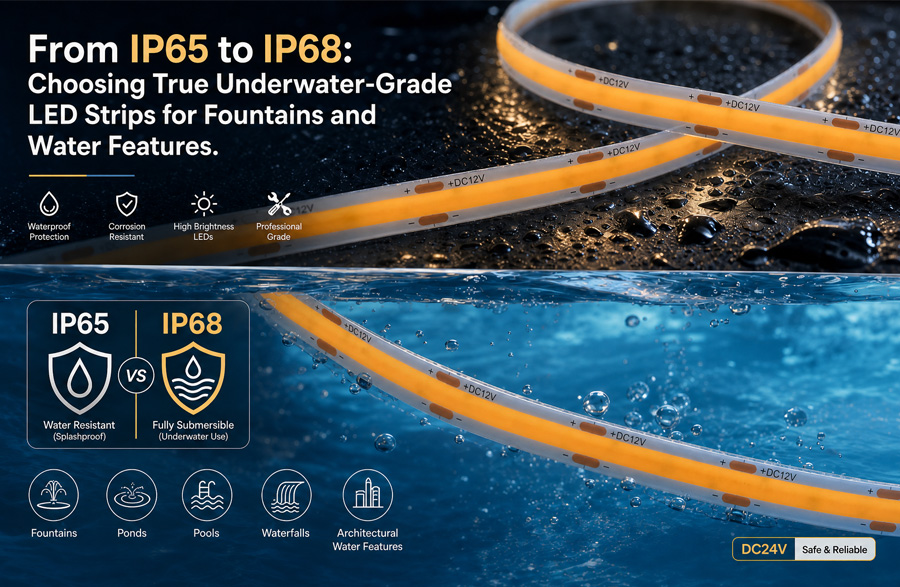
From IP65 to IP68: Choosing True Underwater-Grade LED Strips for Fountains and Water Features

Water features are among the most visually demanding environments in landscape and architectural lighting. A poorly chosen LED strip doesn’t just flicker out—it ruins a design, triggers electrical hazards, and forces costly replacements. After thirteen years manufacturing LED strips for commercial, municipal, and high-end residential projects, I’ve seen the same failure pattern repeat: buyers assume “waterproof” means “submersible,” trust marketing labels over engineering specs, and install IP65 or IP67 strips in fully submerged fountains. The result is condensation inside the sleeve, adhesive delamination, voltage leakage, and premature failure.
1. Understanding IP Ratings: Why IP65 Fails Underwater
2. What Makes an LED Strip Truly IP68?
3. Critical Components of Submersible LED Strips
4. Common Mistakes & How to Avoid Them
5. Installation & Maintenance Best Practices
6. How to Verify Manufacturer Claims
7. Real-World Applications & Design Tips
8. Summary
9. FAQ

1. Understanding IP Ratings: Why IP65 Fails Underwater

The IP (Ingress Protection) rating system, defined by IEC 60529, is a two-digit code indicating resistance to solids and liquids. The first digit covers particle ingress; the second covers water exposure. IP65 means dust-tight and resistant to low-pressure water jets from any direction. It does not mean submersible. It does not mean waterproof under pressure. It means the product can handle splashes, rain, and cleaning sprays—not continuous immersion.
Many suppliers label IP65 strips as “fountain-ready” or “splash-proof for water features.” That phrasing is technically accurate but commercially misleading. Fountains, reflecting pools, and immersive water installations operate under dynamic hydrostatic pressure. Water penetrates micro-gaps through capillary action, thermal expansion, and adhesive fatigue. IP65 silicone sleeves or epoxy coatings lack the structural integrity to seal against constant immersion. Within weeks, moisture migrates along the PCB, corrodes solder joints, and creates electrical shorts. Even if the strip initially lights up underwater, condensation forms inside the sleeve, diffusing light output and accelerating LED degradation.

The failure mechanism is predictable:

  • Adhesive breakdown: Double-sided tape or acrylic adhesives soften in water, especially with temperature fluctuations or chemical exposure.
  • Micro-permeation: Standard silicone or PU potting allows slow moisture diffusion over time, particularly at connector joints.
  • Thermal mismatch: Water conducts heat differently than air. Without proper thermal design, localized hotspots stress encapsulation layers.
  • Current leakage: Compromised insulation turns the water feature into a conductive path, tripping GFCI breakers or creating shock hazards.
The failure mechanism is predictable:
IP65 strips belong on canopy edges, fountain walls above the waterline, or splash zones where direct submersion never occurs. Once the light source crosses the water surface continuously, IP65 is a liability. The jump to IP67 or IP68 isn’t a minor upgrade—it’s a complete redesign of materials, sealing methods, and testing protocols.

2. What Makes an LED Strip Truly IP68?

IP68 indicates protection against continuous immersion in water beyond one meter. However, IEC 60529 leaves depth and duration to manufacturer specification. One brand may certify IP68 at 1 meter for 30 days; another may test at 3 meters for 1,000 hours. Without explicit parameters, “IP68” is meaningless.
True IP68 LED strips are engineered from the ground up for submersion. They don’t rely on a thicker silicone sleeve or a marketing sticker. They integrate:
  • Full encapsulation: Entire assembly, including LEDs, resistors, and copper traces, is sealed in a homogeneous, non-porous compound.
  • Pressure-rated sealing: Designed to withstand hydrostatic pressure at specified depths without delamination or micro-cracking.
  • Chemical resistance: Potting materials formulated to resist chlorine, bromine, salt, pH fluctuations, and UV degradation.
  • Long-term stability: Tested for thermal cycling, accelerated aging, and continuous operation under water, not just a one-time dip test.
​​​​​​Waterproof LED Strips
The industry standard for verification is third-party testing under IEC 60529, with documented depth, duration, temperature, and water composition. Reputable manufacturers provide test reports, not just datasheet claims. Look for explicit statements like “IP68 rated at 2 meters continuous submersion for 1,000 hours at 25°C in fresh water.” If the spec sheet omits parameters, assume it’s marketing language.
Another critical distinction is static vs. dynamic environments. A still reflecting pool places constant pressure on the strip. A fountain with jets, pumps, or wave generators introduces vibration, pressure spikes, and water turbulence. True IP68 strips account for mechanical stress through flexible potting compounds, strain-relief connectors, and reinforced PCB anchoring. If the strip will face movement, standard IP68 may still fail without additional mounting hardware.
Water chemistry matters equally. Chlorinated pools, saltwater features, and alkaline fountains accelerate material degradation. Silicone-based potting resists UV and temperature swings but can absorb certain chemicals over time. Polyurethane offers excellent chemical resistance but yellows under prolonged UV exposure. High-end underwater strips use hybrid formulations or add protective topcoats to balance flexibility, clarity, and longevity. Always match the potting material to your water environment.

3. Critical Components of Submersible LED Strips

An LED strip is only as strong as its weakest link. In underwater applications, that link is rarely the LED chip itself. It’s the sealing method, connector design, PCB construction, or thermal management system.

PCB Architecture

Submersible strips use thicker copper layers (typically 2oz or 3oz) to reduce resistance and heat buildup. The solder mask is corrosion-resistant, often rated for marine environments. Standard FR4 boards swell and delaminate underwater. High-quality strips use polyimide or modified epoxy substrates with hydrophobic coatings. Trace spacing is optimized to prevent current leakage when moisture penetrates micro-gaps.

LED Chip Encapsulation

Standard SMD LEDs use epoxy lenses that crack under thermal stress or water pressure. Underwater-grade strips use silicone-encapsulated chips with higher refractive indices and flexible bonding. Binning is tighter to maintain color consistency underwater, where light refraction and water clarity alter perceived output. Some manufacturers use reverse-mount designs to direct light through a sealed diffuser rather than exposing the chip directly to water pressure.

Potting & Sleeve Materials

The encapsulation compound defines IP68 performance. Medical-grade or industrial silicone offers flexibility and optical clarity. Polyurethane provides hardness and chemical resistance but sacrifices flexibility. Some manufacturers inject potting material under vacuum to eliminate air pockets, which become condensation traps under water. The curing process must be controlled: incomplete curing leaves micro-channels for moisture migration. Batch testing for hardness, elongation, and water absorption is non-negotiable for true IP68 strips.

Connectors & Joints

Over 70% of underwater LED failures originate at connection points. Standard Molex or JST connectors cannot withstand submersion. True underwater strips use:
  • Marine-grade waterproof connectors with double O-ring seals
  • Overmolded cable joints with strain relief
  • Heat-shrink tubing with adhesive lining for secondary sealing
  • Remote driver placement to keep high-voltage components dry
  • Low-voltage DC distribution (12V/24V) to minimize shock risk
Even a single unsealed joint compromises the entire run. Installers must treat connectors as critical failure points, not afterthoughts.

Thermal Management

Water conducts heat 25 times faster than air, but submerged strips don’t benefit from convection cooling. Heat dissipates through conduction into the surrounding water and mounting surface. Without proper thermal design, localized hotspots degrade LEDs and potting materials. Aluminum backing strips improve heat transfer but require waterproof anodization. Silicone sleeves act as thermal insulators if too thick. The optimal design balances potting thickness, PCB copper weight, and mounting conductivity to maintain junction temperatures below 85°C during continuous operation.

4. Common Mistakes & How to Avoid Them

Even with IP68-rated strips, poor selection or installation leads to failure. Here are the most frequent errors and how to prevent them.

Mistake 1:

Assuming IP67 Equals IP68 IP67 covers temporary immersion up to 1 meter for 30 minutes. It’s designed for accidental submersion, not continuous operation. Many fountains run pumps 12–24 hours daily. IP67 strips lack the structural sealing for long-term hydrostatic pressure. Always specify IP68 with documented depth and duration.

Mistake 2:

Ignoring Water Chemistry Chlorine, salt, algaecides, and pH stabilizers attack silicone, PU, and metal components. A strip rated for fresh water will fail in a saltwater feature within months. Request chemical resistance data from the manufacturer. For pools or marine environments, specify halogen-resistant potting and stainless-steel or titanium mounting hardware.

Mistake 3:

Relying on Adhesive Mounting Double-sided tape fails underwater. Water penetrates the adhesive layer, causing delamination and stress on solder joints. True submersible strips use mechanical fastening: stainless steel clips, UV-resistant zip ties, aluminum channels with drainage holes, or custom mounting brackets. Adhesive should only supplement mechanical fixation, never replace it.

Mistake 4:

Placing Drivers Underwater Power supplies and controllers are rarely rated for submersion. Even IP68 drivers degrade when exposed to constant moisture and temperature swings. Remote mounting in waterproof enclosures above grade or in dry vaults is mandatory. Use low-voltage DC distribution to the strip, keeping high-voltage components isolated from water contact.

Mistake 5:

Skipping Pre-Installation Testing Never assume factory sealing survived shipping and handling. Submerge the strip in a test tank for 24–48 hours before installation. Check for bubbles, discoloration, or voltage drop. Test connectors under flex. Verify dimming performance underwater. A brief pre-test prevents costly post-installation failures.

Mistake 6:

Overlooking Cable Routing Sharp bends, tension on connectors, and exposed cable runs create stress points. Use flexible conduit, secure cables every 1–2 meters, and leave service loops for future maintenance. Avoid routing cables over fountain edges where debris or foot traffic can damage insulation.

5. Installation & Maintenance Best Practices

Proper installation extends strip life by 3–5 years. Poor installation voids warranties and guarantees early failure. Follow these protocols for reliable underwater performance.

Pre-Installation Preparation

  • Verify IP68 certification with third-party test reports
  • Inspect packaging for damage, moisture, or compromised seals
  • Perform a dry-run power test to confirm functionality
  • Submerge test strips for 24 hours in water matching your feature’s chemistry
  • Prepare mounting hardware, sealants, and strain-relief components

Mounting Techniques

  • Use stainless steel or UV-resistant plastic clips at 30–50 cm intervals
  • Avoid sharp bends; maintain a minimum radius of 5 cm
  • Secure cable exits with waterproof glands or overmolded boots
  • Route cables away from pump intakes, jets, or high-turbulence zones
  • Use non-conductive spacers if mounting to metal surfaces to prevent galvanic corrosion

Sealing & Joint Protection

  • Apply marine-grade silicone sealant at all cable entries and exit points
  • Use heat-shrink tubing with adhesive lining for secondary protection
  • Never leave connectors exposed; route them to dry junction boxes
  • Label all runs for future troubleshooting and replacement

Electrical Safety

  • Use Class 2 low-voltage DC power supplies (12V/24V)
  • Install GFCI or RCD protection on all circuits
  • Ground metal mounting hardware separately from lighting circuits
  • Keep all transformers, controllers, and drivers in IP65+ enclosures above water level
  • Follow local electrical codes for wet and submerged locations

Maintenance Protocols

  • Inspect strips quarterly for discoloration, swelling, or connector wear
  • Clean surfaces with soft brushes and neutral pH cleaners; avoid abrasives
  • Check voltage drop across long runs; replace if output drops below 90%
  • Monitor water chemistry; adjust pH and chemical levels to manufacturer recommendations
  • Document installation dates, test results, and replacement cycles for warranty claims
Underwater LED strips aren’t “install and forget” components. They require planned maintenance, chemical monitoring, and electrical oversight. Facilities that implement quarterly inspection schedules report 60% fewer failures and 40% lower lifetime costs.

6. How to Verify Manufacturer Claims

The LED strip market is saturated with rebranded products and inflated IP ratings. Verification separates reliable suppliers from opportunistic sellers.

Request Documentation

  • IEC 60529 IP68 test report with depth, duration, temperature, and water type
  • LM-79 photometric test for lumen output, efficacy, and color accuracy
  • RoHS, CE, UL, or FCC compliance certificates
  • Material safety data sheets (MSDS) for potting compounds and adhesives
  • Batch testing logs and quality control procedures
RoHS, CE, UL, or FCC compliance certificates

Ask Technical Questions

  • What is the exact potting material and curing process?
  • How are connectors sealed and strain-relieved?
  • What is the maximum continuous submersion depth and duration?
  • How does the strip handle thermal cycling and pump vibration?
  • What is the warranty coverage for submersion-related failures?

Evaluate Factory Capabilities

  • Transparent supply chain and component traceability
  • In-house testing lab with submersion tanks, thermal chambers, and spectrometers
  • Engineering support for custom lengths, voltages, or mounting configurations
  • Clear warranty terms with defined exclusions and claim procedures
  • Willingness to provide sample batches for third-party verification
Evaluate Factory Capabilities

Red Flags to Avoid

  • “IP68 equivalent” or “waterproof up to IP68” without test data
  • No third-party certification or vague compliance statements
  • Warranty voided by submersion or chemical exposure
  • Refusal to share potting material specifications or curing methods
  • Prices significantly below market average for IP68 strips
True IP68 manufacturers welcome scrutiny. They provide documentation, offer pre-production samples, and stand behind their engineering. If a supplier deflects technical questions or relies on marketing language alone, assume the product isn’t rated for continuous submersion.

7. Real-World Applications & Design Tips

Underwater LED strips transform static water features into dynamic visual experiences. Proper design enhances aesthetics while preserving functionality.
Real-World Applications & Design Tips

Fountain Lighting

  • Position strips along basin walls, nozzle bases, or underwater platforms
  • Use tunable white or RGBW strips to match water movement and seasonal themes
  • Avoid direct glare; angle strips downward or behind architectural elements
  • Sync lighting with pump cycles using DMX or DALI controllers
  • Maintain 15–20 cm clearance from pump intakes to prevent debris accumulation

Immersive Water Features

  • Embed strips in false bottoms, trench drains, or stepped cascades
  • Use diffused silicone sleeves to create seamless, glow-from-below effects
  • Coordinate color temperature with surrounding materials (stone, glass, metal)
  • Program slow fades rather than rapid transitions to reduce thermal stress
  • Integrate waterproof sensors for automatic dimming based on ambient light

Commercial vs. Residential

  • Commercial installations require higher lumen output, redundant power paths, and commercial-grade controllers
  • Residential projects prioritize low-voltage safety, ease of maintenance, and aesthetic integration
  • Municipal fountains must meet public safety codes, including emergency shut-off protocols
  • High-end residential features often use custom lengths, specialized mounting, and smart control integration

Future-Proofing

  • Specify 24V DC over 12V for longer runs with reduced voltage drop
  • Choose strips with replaceable connectors and modular mounting
  • Reserve 10–15% extra length for future repairs or design changes
  • Document wiring diagrams, controller settings, and maintenance schedules
  • Partner with manufacturers offering technical support, not just product catalogs
Underwater lighting isn’t just about illumination. It’s about engineering reliability into every component, from PCB trace width to connector sealing. When designed correctly, IP68 LED strips deliver consistent performance, enhance architectural intent, and operate safely for years without intervention.

8. Summary

  • IP65 is splash-resistant, not submersible. Continuous immersion requires true IP68 certification with documented depth and duration.
  • True IP68 strips use full encapsulation, corrosion-resistant PCBs, marine-grade connectors, and chemically stable potting materials.
  • Connectors, mounting methods, and driver placement cause most underwater failures. Always seal joints mechanically, route cables safely, and keep power supplies dry.
  • Verify manufacturer claims with third-party test reports, material specifications, and transparent warranty terms.
  • Pre-installation submersion testing, mechanical fastening, GFCI protection, and quarterly maintenance extend strip life and prevent costly replacements.
  • Match potting chemistry to water environment, use low-voltage DC distribution, and integrate professional controls for dynamic, long-lasting fountain lighting.
  • Partner with manufacturers that provide engineering documentation, batch testing, and technical support—not just marketing labels.
Selecting underwater LED strips isn’t about choosing the highest IP number. It’s about understanding material science, sealing integrity, electrical safety, and real-world operating conditions. When engineered correctly, IP68 strips deliver reliable, safe, and visually stunning illumination for fountains, pools, and immersive water features.

9. FAQ

Can I use an IP67 LED strip in a fountain that runs daily?

No. IP67 is rated for temporary immersion up to 1 meter for 30 minutes. Daily operation creates continuous hydrostatic pressure and thermal cycling that IP67 sealing cannot withstand. Always specify IP68 with documented continuous submersion parameters.

How deep can IP68 LED strips be installed underwater?

Depth varies by manufacturer. True IP68 ratings specify exact depth and duration (e.g., 2 meters for 1,000 hours). Never assume depth capability without verified test data. Exceeding rated depth compromises sealing and voids warranties.

Do underwater LED strips require special power supplies?

Yes. Use low-voltage DC (12V/24V) Class 2 power supplies rated for wet locations. Keep all drivers, transformers, and controllers in dry, IP65+ enclosures above water level. Never submerge power components unless explicitly rated for continuous immersion.

How do I prevent LED strips from floating or detaching underwater?

Avoid relying on adhesive alone. Use stainless steel clips, UV-resistant zip ties, aluminum channels, or custom mounting brackets at 30–50 cm intervals. Secure cable exits with strain relief and waterproof glands to prevent pull-out.

What water chemicals damage underwater LED strips?

Chlorine, bromine, salt, high pH, and algaecides degrade silicone, polyurethane, and metal components over time. Request chemical resistance data from the manufacturer. For pools or marine features, specify halogen-resistant potting and corrosion-resistant hardware.

How often should underwater LED strips be inspected?

Quarterly inspections are recommended. Check for discoloration, swelling, connector wear, voltage drop, and cable damage. Clean surfaces with soft brushes and neutral pH cleaners. Document findings for warranty claims and predictive maintenance.

Can I cut or splice IP68 LED strips on-site?

Factory-sealed IP68 strips cannot be reliably cut or spliced in the field without compromising the rating. Order pre-cut lengths or use manufacturer-approved splice kits with vacuum potting and overmolded connectors. Field modifications void IP68 certification.
Contact ADLED for Waterproof LED Strip Light