

2025-06-30
Low Voltage Vs High Voltage LED Strips When to Choose and Why?
Low Voltage Vs High Voltage LED Strips When to Choose and Why?
LED strip lights have become an essential tool for modern lighting and decoration, widely used in residential, commercial, and industrial settings. When selecting LED strip lights, voltage is a critical consideration, with options mainly divided into low-voltage (typically 12V or 24V) and high-voltage (typically 110V or 220V) categories. This article provides a comprehensive analysis of the characteristics, advantages, disadvantages, and suitable applications of low-voltage and high-voltage LED strip lights to help you make an informed decision.
1. What Are Low-Voltage LED Strip Lights?
2. What Are High-Voltage LED Strip Lights?
3. Key Comparisons and Selection Criteria
4. Installation Tips
5. Debunking Myths
6. FAQs
2. What Are High-Voltage LED Strip Lights?
3. Key Comparisons and Selection Criteria
4. Installation Tips
5. Debunking Myths
6. FAQs
1. What Are Low-Voltage LED Strip Lights?
Definition and Basic Features
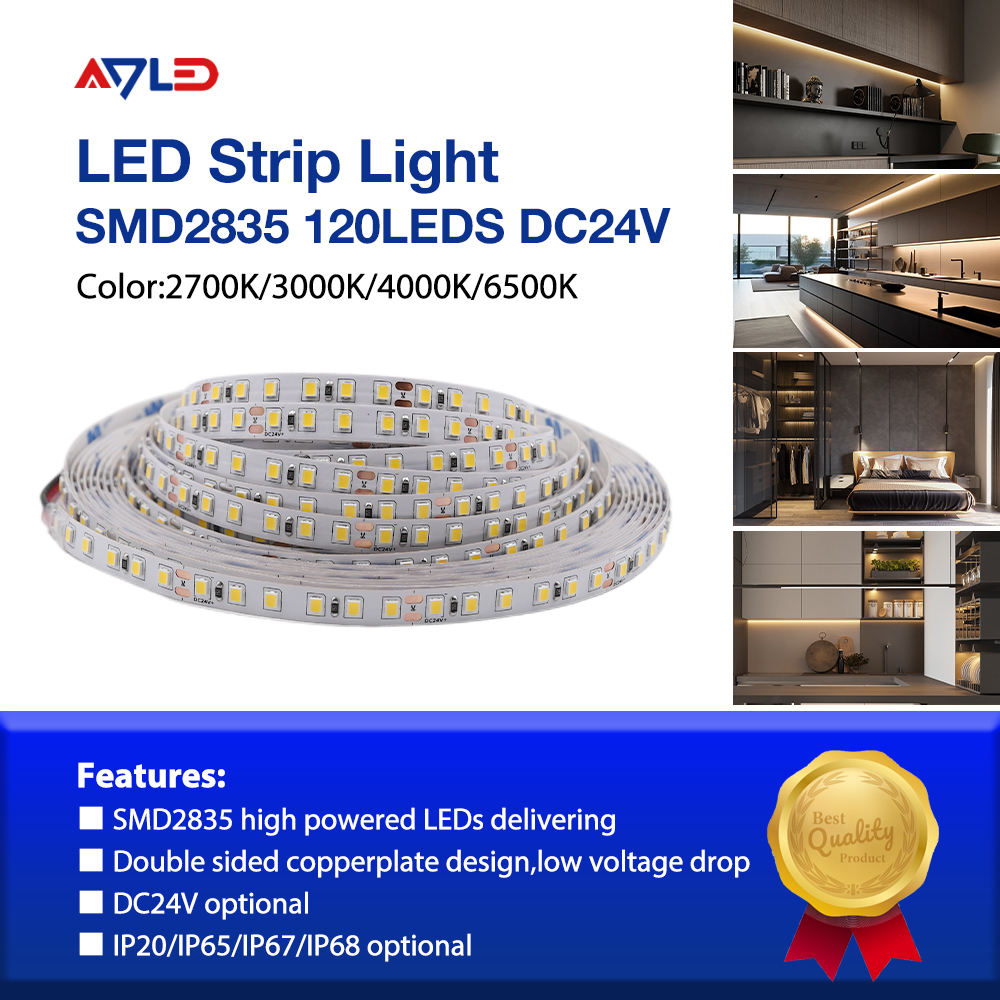
Low-voltage LED strip lights typically operate at 12V or 24V and require a transformer or driver to convert mains electricity to low-voltage DC power. Key features include:
Safety: Operates below 50V, classified as Safety Extra-Low Voltage (SELV).
Requires additional power supply: A compatible transformer or driver is necessary.
Flexible segmentation: Can often be cut every 3 LEDs (for 12V) or 6 LEDs (for 24V).
Easy installation: Compact and lightweight, suitable for various installations.
Advantages of Low-Voltage LED Strips
High safety: Low risk of electric shock, ideal for homes with children or pets, and damp environments like bathrooms or kitchens.
Flexibility: Precise cutting points and small bending radius allow for creative designs and tight spaces.
Stable light quality: DC power eliminates flickering, making it eye-friendly and suitable for dimming (e.g., PWM dimming).
Long lifespan: Lower voltage reduces stress on components, extending longevity when paired with quality drivers.
Disadvantages of Low-Voltage LED Strips
Higher initial cost: Requires additional transformers, with costs scaling for large installations.
Voltage drop: Brightness may decrease over long runs (max. 5m for 12V, 10m for 24V unless using multi-point power injection).
Complex installation: Proper power supply placement and heat management are crucial.
Typical Applications
Residential: Cabinet lighting, stair treads, bedroom ambiance.
Commercial: Jewelry displays, retail showcases, museum exhibits.
Damp areas: Bathroom mirrors, kitchen countertops, pool surrounds.
Creative projects: DIY designs, artistic installations.
Vehicles: Car interiors, marine lighting.
Why Choose Low-Voltage?
Prioritize safety in accessible or wet locations, or when high light quality (e.g., photography, reading) and design flexibility are needed.