{当前产品的产品关键词轮巡使用}
2026-06-25

The Specification Checklist : 10 Questions to Ask Your LED Strip Manufacturer Before Ordering

The Specification Checklist: 10 Questions to Ask Your LED Strip Manufacturer Before Ordering

As a B2B buyer, sourcing LED strip lights can feel like navigating a minefield. On the surface, two LED strips might look identical in a catalog, but in reality, their performance, lifespan, and profitability could not be more different. With over 13 years of hands-on manufacturing experience and a decade of analyzing B2B search intent as an SEO specialist, I have seen countless buyers lose money due to vague specifications, hidden compromises, and poor communication with their suppliers.
The secret to securing high-quality, high-margin LED strip lights lies in the details. You cannot simply ask for a "good quality LED strip." You must speak the technical language. This comprehensive, highly detailed specification checklist is designed to cut through the marketing fluff. It provides you with the exact technical questions you need to ask, the red flags to watch out for, and insider secrets from the factory floor.
Question 1: What is the exact LED chip brand, and what is your binning process?
Question 2: What is the PCB thickness, and what is the exact copper weight?
Question 3: What is the true IP rating, and what is the specific waterproofing method?
Question 4: What is the actual lumen output, and what is the system efficacy (lm/W)?
Question 5: What is the CRI and TLCI, and how is color quality guaranteed?
Question 6: What type of adhesive backing is used, and what is its lifespan?
Question 7: What is the voltage drop tolerance, and what is the maximum run length?
Question 8: What are the bending radius, cutting specifications, and flexibility options?
Question 9: What certifications do the products hold, and can you provide test reports?
Question 10: What is your warranty policy, and what is your defect rate protocol?
Final Thoughts on Sourcing LED Strips
Summary
FAQ


Question 1: What is the exact LED chip brand, and what is your binning process?

Why This Matters (The Summary)

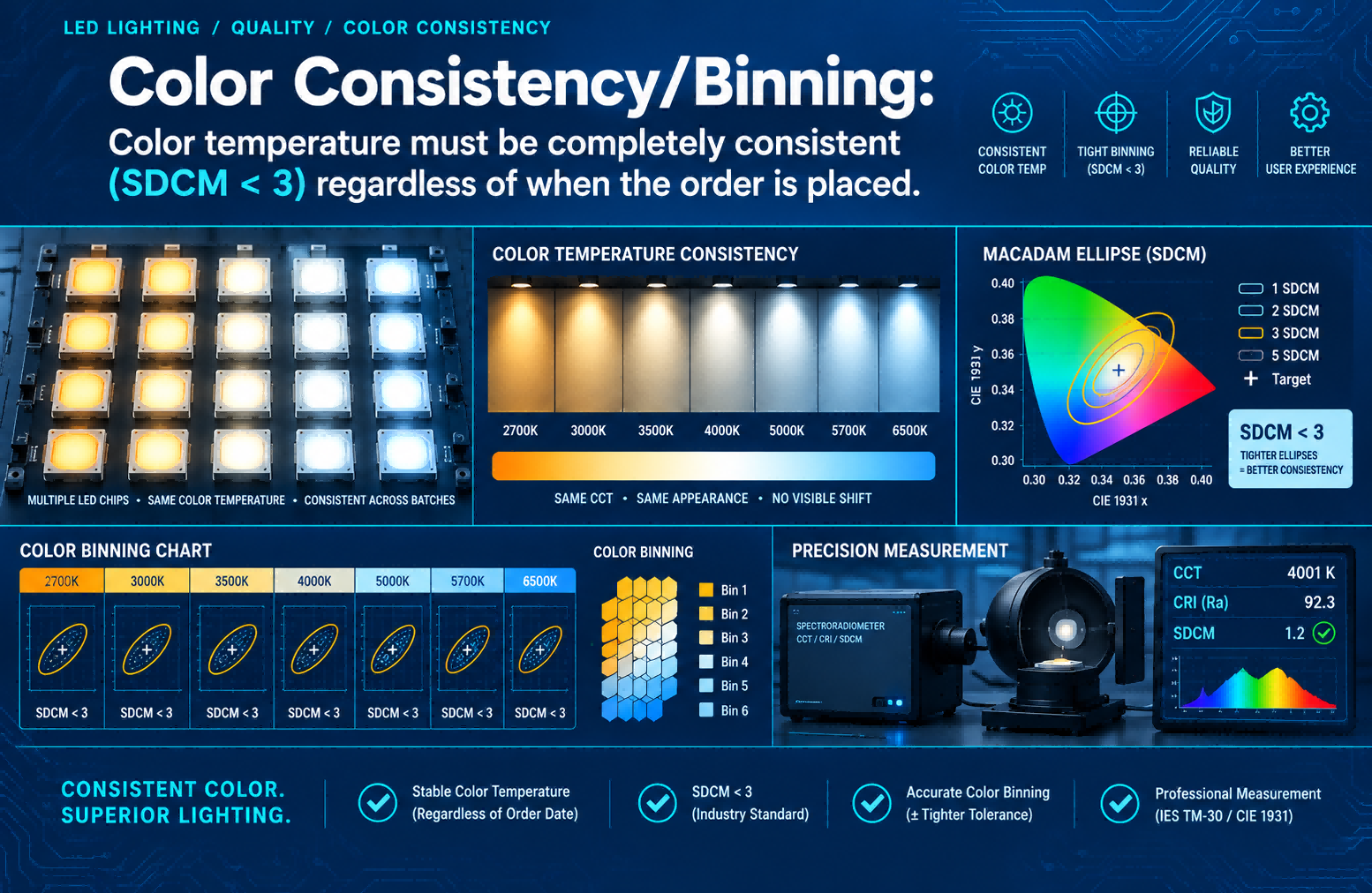
The LED chip is the heart of your LED strip. The brand dictates the baseline efficiency and reliability, while the "binning" process determines color consistency and brightness uniformity. If a manufacturer cannot clearly answer this, they are likely using recycled, unbranded, or "mixed bin" chips, which will result in severe color variation and premature failure.
Technical Deep Dive
  • Chip Brands: Top-tier manufacturers use Lumileds (Philippines/USA), Samsung (South Korea), or Epistar (Taiwan). Mid-tier might use Sanan or Huga. Unbranded chips should be an immediate red flag.
  • Binning (The "Bin" Code): LEDs are sorted into "bins" based on luminous flux (brightness), forward voltage (Vf), and chromaticity (color temperature).
  • MacAdam Ellipse (SDCM): This is the most critical metric for color consistency. It measures how noticeable a color difference is to the human eye.
    • 7-Step MacAdam: Noticeable color difference (Standard commercial).
    • 5-Step MacAdam: Slight difference (Good retail).
    • 3-Step MacAdam: Virtually indistinguishable (Premium architectural/museum).
    • 2-Step MacAdam: Perfect consistency (Ultra-premium).

The "Red Flags" Checklist

  • The supplier says, "We use high-quality chips" without naming the brand.
  • They cannot provide the specific "Bin Code" for the batch you are ordering.
  • They claim "uniform color" but cannot provide an SDCM (MacAdam) step rating.

Insider Secret from a 13-Year Manufacturer

Many factories will tell you they use Epistar chips, but they will buy the cheapest "C-bin" or mixed bins from the secondary market. True quality control means buying directly from the authorized distributors and strictly enforcing a single-bin policy for every production run. Always ask for the LM-80 test report for the specific chip bin they are using.

Real-World Application & ADLED Lights Solution

When sourcing for high-end retail or architectural projects, color consistency is non-negotiable. At ADLED Lights, we strictly utilize premium chips from top-tier brands like Samsung and Epistar. For our premium architectural lines, we enforce strict 3-step MacAdam ellipse binning. This ensures that when you install 100 meters of our LED strips across a large commercial ceiling, there is zero visible color shift from one end to the other. You can explore our consistent, high-quality chip solutions on our official website at //www.adledlights.com/.

Question 2: What is the PCB thickness, and what is the exact copper weight?

Question 2: What is the PCB thickness, and what is the exact copper weight?

Why This Matters (The Summary)

The Printed Circuit Board (PCB) is the skeletal and nervous system of the LED strip. It dissipates the heat generated by the LED chips. Heat is the number one enemy of LEDs; if the PCB cannot dissipate heat efficiently, the LEDs will degrade rapidly, shift in color, and burn out. The thickness of the PCB and the weight of the copper directly dictate thermal management.

Technical Deep Dive

  • Copper Weight: Measured in ounces per square foot (oz/ft²).
    • 1.0 oz: Standard for low-power strips.
    • 2.0 oz: Standard for mid-to-high power strips (SMD 2835, 5050).
    • 3.0 oz to 4.0 oz: Required for high-power, high-lumen strips (e.g., 14W/m to 20W/m).
  • PCB Thickness: Usually ranges from 0.15mm to 0.30mm. Thicker boards (0.20mm+) are more rigid, which is great for straight runs and heat dissipation, but less flexible for tight curves.
  • Material: The base material should be high-quality flexible polyimide (FPC) or fiberglass (FR4) for rigid strips, with a high thermal conductivity rating.

The "Red Flags" Checklist

  • The supplier only mentions "double-layer FPCB" without specifying copper weight.
  • The PCB feels flimsy or excessively thin when you request a sample.
  • They recommend a 2oz copper PCB for a strip that draws 20W per meter (a massive fire and degradation risk).

Insider Secret from a 13-Year Manufacturer

Factories cut costs by using 1.5oz copper instead of 2oz, or by using a 0.15mm thick PCB instead of 0.20mm. To the naked eye, the difference is invisible. However, under a thermal camera, a 1.5oz PCB will run 15°C to 20°C hotter than a 2oz PCB under the same load. That extra heat cuts the LED's lifespan in half. Always demand the copper weight in your purchase contract.

Real-World Application & ADLED Lights Solution

For high-output applications like main lighting or cove lighting where aluminum channels are not deep enough, the PCB must do the heavy lifting. ADLED Lights utilizes 2oz pure copper for our standard high-density SMD 2835 and 5050 strips, and upgrades to 3oz or 4oz copper for our ultra-high-power series. Furthermore, our PCBs are manufactured with a thickness of 0.20mm to 0.25mm, ensuring optimal heat dissipation and structural integrity. Check out our high-power LED strip series at https://www.adledlights.com/ to see how proper PCB engineering extends product life.

Question 3: What is the true IP rating, and what is the specific waterproofing method?

Why This Matters (The Summary)

IP (Ingress Protection) ratings define how well the strip resists dust and water. However, "IP65" means very different things to different factories. The method used to achieve the waterproof rating drastically affects the strip's flexibility, heat dissipation, light output, and lifespan. Using the wrong waterproofing method for your environment will lead to catastrophic failure.

Technical Deep Dive

  • IP20: Non-waterproof. Best for indoor, dry locations inside aluminum profiles.
  • IP65 (Epoxy/PU Coating): A layer of resin is poured over the strip. Risk: Yellowing over time under UV light, poor heat dissipation, and cracking in cold weather.
  • IP65 (Nano-Spray Coating): A microscopic hydrophobic layer is sprayed on. Benefit: Does not affect light output or heat dissipation. Risk: Not truly submersible, only splash-proof.
  • IP67 (Silicone Sleeving): The strip is pushed into a hollow silicone tube. Risk: The silicone tube can trap heat, and the ends can leak if not sealed perfectly.
  • IP68 (Extruded Solid Silicone): The strip is completely encased in solid silicone. Benefit: Fully submersible, highly durable, UV resistant. Risk: Slightly reduced flexibility and higher cost.

The "Red Flags" Checklist

  • The supplier quotes an IP65 price but uses cheap epoxy resin that will yellow in 6 months.
  • They claim IP68 but use a hollow silicone tube with open ends (which is actually IP67).
  • They cannot explain the difference between their nano-coating and their silicone sleeve options.

Insider Secret from a 13-Year Manufacturer

The biggest lie in the industry is the "IP65 Epoxy" strip. Epoxy traps heat and yellows. If a client wants IP65 for an outdoor under-cabinet application, always push for Nano-coating. It repels water without altering the beam angle or trapping heat. For true underwater applications (pools, fountains), only solid extruded IP68 silicone should be used, and the end caps must be sealed with specialized waterproof glue and heat shrink, not just standard silicone.

Real-World Application & ADLED Lights Solution

Waterproofing requires precision. At ADLED Lights, we have phased out traditional yellowing epoxy coatings. For our IP65 outdoor strips, we utilize advanced Nano-spray technology, which provides excellent splash resistance while maintaining perfect heat dissipation and light transmission. For harsh environments, pools, and landscape lighting, we offer our premium IP67/IP68 extruded silicone series, which guarantees 100% waterproof integrity and UV resistance. You can view our comprehensive waterproof LED strip solutions at //www.adledlights.com/.

Question 4: What is the actual lumen output, and what is the system efficacy (lm/W)?

Why This Matters (The Summary)

Brightness is usually the first thing buyers look at, but "lumens" can be manipulated. Manufacturers can claim high lumens by overdriving the LEDs, which destroys their lifespan. The true measure of a high-quality LED strip is its efficacy (lumens per watt, lm/W). High efficacy means you get more light for less electricity, resulting in lower power bills, less heat generation, and a longer lifespan.

Technical Deep Dive

  • Initial Lumens vs. System Lumens: Initial lumens measure the chip in a lab. System lumens measure the actual strip after accounting for PCB losses and optics. Always ask for system lumens.
  • Efficacy Targets:
    • Standard efficiency: 80 - 100 lm/W.
    • High efficiency: 120 - 140 lm/W.
    • Ultra-high efficiency: 150 - 180+ lm/W.
  • Overdriving: If a 2835 chip is rated for 0.2W but the factory pushes 0.5W through it to get higher lumens, the strip will burn out in months.

The "Red Flags" Checklist

  • The supplier claims 2000 lumens per meter for a 10W/m strip (200 lm/W is highly unlikely for standard strips without premium, expensive chips).
  • They only provide "chip lumens" and refuse to provide "system lumens" or actual wattage draw.
  • The strip gets excessively hot to the touch within 5 minutes of being turned on at room temperature.

Insider Secret from a 13-Year Manufacturer

Buyers often chase the highest lumen number, not realizing they are buying a product that is being overdriven. A 120 lm/W strip running at its rated power will outlast and outperform a 150 lm/W strip that is being overdriven to achieve that number. Always calculate the efficacy: Total Lumens / Total Wattage. If the number looks too good to be true, they are overdriving the chips.

Real-World Application & ADLED Lights Solution

Energy efficiency is critical for commercial projects to meet building codes and reduce HVAC loads. ADLED Lights focuses heavily on high-efficacy engineering. Our premium SMD 2835 LED strips achieve an industry-leading efficacy of 140 to 160 lm/W. By optimizing the circuit design and using top-bin chips, we deliver maximum brightness without overdriving the LEDs, ensuring a cool-running, highly efficient, and long-lasting product. Discover our high-efficacy LED strips at //www.adledlights.com/.

Question 5: What is the CRI and TLCI, and how is color quality guaranteed?

Why This Matters (The Summary)

Color Rendering Index (CRI) measures how accurately a light source reveals the true colors of objects compared to natural sunlight. In retail, hospitality, and residential spaces, low CRI makes spaces look dull and colors look "off." For film and photography, TLCI (Television Lighting Consistency Index) is equally critical. High CRI is a major selling point for premium lighting projects.

Technical Deep Dive

  • CRI (Ra): The general average of 8 color samples.
    • CRI > 80: Standard commercial.
    • CRI > 90: High quality (Retail, hospitality).
    • CRI > 95: Ultra-premium (Museums, high-end residential, art galleries).
  • R9 Value: This measures the rendering of saturated reds. A strip can have a CRI of 90 but an R9 of 10 (terrible for skin tones and food). Always demand an R9 > 50 for high CRI strips.
  • TLCI: Crucial for film/TV. A TLCI > 95 ensures color accuracy on camera sensors.
  • Spectral Tuning: Premium manufacturers adjust the phosphor blend to boost specific wavelengths (like deep red or cyan) to improve both CRI and human-centric lighting metrics.

The "Red Flags" Checklist

  • The supplier claims "CRI 90+" but cannot provide the R9 value.
  • They provide a CRI test report, but it is for the raw LED chip, not the finished LED strip.
  • They cannot explain the difference between CRI and TLCI.

Insider Secret from a 13-Year Manufacturer

Achieving a high CRI is easy if you just add more red phosphor, but this drops the overall lumen output and shifts the color temperature. The real engineering challenge is maintaining high lumens AND high CRI. Furthermore, many factories test the CRI of the raw LED reel before it is soldered onto the PCB. The heat from soldering can slightly alter the phosphor. Always ask for a spectrometer report of the finished, cut piece of the LED strip.

Real-World Application & ADLED Lights Solution

Lighting is about emotion, and color quality dictates that emotion. ADLED Lights specializes in high-fidelity lighting. Our High CRI series guarantees Ra > 95 and R9 > 90, ensuring that retail merchandise, restaurant food, and residential interiors look vibrant and true to life. For the film and broadcasting industry, we also offer specialized TLCI > 95 strips. We provide full IES files and spectrometer test reports for every batch. Elevate your projects with our high CRI LED solutions at //www.adledlights.com/.

Question 6: What type of adhesive backing is used, and what is its lifespan?

Why This Matters (The Summary)

The adhesive tape is the most common point of failure in LED strip installations. A strip can have perfect electronics, but if it peels off the mounting surface after three months, the client will blame the entire product. The adhesive must be matched to the surface energy of the mounting material and the environmental temperature.

Technical Deep Dive

  • 3M 300LSE: The industry standard for most indoor and mild outdoor applications. Excellent adhesion to high surface energy materials (metal, glass, painted drywall). Performs well in temperatures up to 100°C.
  • 3M 9495MP: A step up from 300LSE. Better resistance to plasticizers (prevents the tape from turning into goo when stuck to certain plastics or vinyl). Higher shear strength.
  • Nitto Denko / Soken: Japanese brands often used in ultra-high-temperature or specialized automotive applications.
  • Generic "Red/White Film" Tape: Cheap, unbranded acrylic tape. Loses adhesion rapidly when heated. Never use this for LED strips.
3M 300LSE:

The "Red Flags" Checklist

  • The supplier uses unbranded adhesive tape to cut costs.
  • They recommend standard 3M 300LSE for installation on PVC or vinyl profiles (which will cause the adhesive to fail due to plasticizer migration).
  • They do not provide instructions on surface preparation (cleaning with isopropyl alcohol).

Insider Secret from a 13-Year Manufacturer

Even the best 3M tape will fail if installed incorrectly. The number one reason for adhesive failure is installing the strip on a dusty, oily, or cold surface. Furthermore, LED strips generate heat. If the adhesive is applied to a surface that gets hotter than the tape's rating, it will melt and slide. Always advise your clients to clean the surface with 50/50 IPA (Isopropyl Alcohol) and water, let it dry, and apply the strip at room temperature. For plastic profiles, always specify 3M 9495MP.

Real-World Application & ADLED Lights Solution

We refuse to let peeling tape ruin our reputation. ADLED Lights exclusively uses genuine, imported 3M adhesive tape (300LSE for standard applications and 9495MP for high-heat or plastic surfaces). We verify the authenticity of our 3M tape through strict supply chain audits. Additionally, our technical support team provides comprehensive installation guides to ensure our clients achieve maximum bond strength. Experience the difference of secure, long-lasting mounting with our products at //www.adledlights.com/.

Question 7: What is the voltage drop tolerance, and what is the maximum run length?

Question 7: What is the voltage drop tolerance, and what is the maximum run length?

Why This Matters (The Summary)

Voltage drop occurs because the copper traces on the PCB have electrical resistance. As electricity travels down the strip, the voltage decreases, causing the LEDs at the end of the run to be dimmer and shift in color temperature compared to the LEDs at the beginning. Understanding voltage drop is critical for designing large installations and avoiding a "gradient" lighting effect.

Technical Deep Dive

  • 12V vs. 24V vs. 48V:
    • 12V: Maximum run length is usually 5 meters. High current causes rapid voltage drop.
    • 24V: Maximum run length is usually 10 meters. The industry standard for most commercial runs.
    • 48V: Maximum run length can reach 15 to 20 meters. Ideal for long, continuous runs without injection points.
  • Constant Voltage (CV) vs. Constant Current (CC):
    • CV: Standard strips. Brightness decreases as voltage drops.
    • CC: Strips with built-in IC (Integrated Circuit) chips. They regulate the current, ensuring the LEDs remain at 100% brightness even if the voltage drops significantly at the end of the run.

The "Red Flags" Checklist

  • The supplier sells 12V strips and claims they can be run for 10 meters in series.
  • They cannot explain the difference between Constant Voltage and Constant Current.
  • They do not provide a voltage drop calculation chart for their specific PCB design.

Insider Secret from a 13-Year Manufacturer

To save on copper, some factories make the copper traces narrower or thinner than they should be. This increases the electrical resistance, causing a massive voltage drop over a short distance. Always ask the manufacturer for their voltage drop data sheet. If they are using a Constant Current (CC) design, ask them at what voltage the IC cuts off. A good CC strip will maintain uniform brightness down to 80% of the input voltage.

Real-World Application & ADLED Lights Solution

Long, continuous runs without dark spots or dim ends are a hallmark of professional lighting design. ADLED Lights offers a comprehensive range of 24V and 48V LED strips to minimize voltage drop. For ultra-long runs, we have engineered advanced Constant Current (CC) LED strips equipped with high-performance ICs. These strips guarantee uniform brightness from the first inch to the last meter, even on runs up to 20 meters. Simplify your installations with our long-run solutions at //www.adledlights.com/.

Question 8: What are the bending radius, cutting specifications, and flexibility options?

Why This Matters (The Summary)

LED strips are often used in complex architectural features, curves, and tight corners. If a strip is bent beyond its minimum radius, the copper traces will crack, or the solder joints will break, causing dead sections. Furthermore, the cutting interval dictates how precisely you can fit the strip into a specific space. The rise of COB (Chip on Board) technology has revolutionized flexibility and dot-free lighting.

Technical Deep Dive

  • Minimum Bending Radius: Usually 30mm to 50mm for standard SMD strips. Bending it tighter requires specialized 90-degree corner pieces or flexible PCB designs.
  • Cutting Interval:
    • Standard SMD 3528/5050: Cuttable every 3 or 6 LEDs (approx. 50mm - 100mm).
    • High-density SMD 2835: Cuttable every 6 or 12 LEDs (approx. 25mm - 50mm).
    • COB LED Strips: Cuttable every 10mm to 20mm, allowing for millimeter-perfect sizing.
  • SMD vs. COB: SMD strips have visible "dots" and distinct shadowing if used without a deep aluminum diffuser. COB strips feature a continuous, phosphor-coated line that is 100% dot-free and can be bent around much tighter radii without dark spots.

The "Red Flags" Checklist

  • The supplier claims their standard SMD strip can be bent at a 10mm radius (it will break).
  • The cutting interval is too long (e.g., every 100mm), making it impossible to fit into tight cabinetry.
  • They sell "COB" strips, but when you look closely, you can still see individual dots (fake COB).

Insider Secret from a 13-Year Manufacturer

When cutting an LED strip, you must cut exactly on the designated scissor mark (the copper pad). If you cut even one millimeter off, you will sever the circuit for the next section. For COB strips, because the cutting interval is so small (e.g., every 10mm), the precision required is higher. Furthermore, bending a strip vertically (against the plane of the PCB) is much more stressful than bending it horizontally. Always use proper mounting channels for tight curves.

Real-World Application & ADLED Lights Solution

Modern architectural lighting demands seamless, continuous lines of light. ADLED Lights is a pioneer in COB (Chip on Board) LED strip technology. Our COB strips provide a completely dot-free, neon-like illumination with a wide 180-degree beam angle. They feature an ultra-tight cutting interval of just 10mm to 20mm and can withstand a much smaller bending radius than traditional SMD strips, making them perfect for tight curves, coves, and furniture integration. Experience the future of seamless lighting with our COB series at //www.adledlights.com/.

Question 9: What certifications do the products hold, and can you provide test reports?

Question 9: What certifications do the products hold, and can you provide test reports?

Why This Matters (The Summary)

Certifications are not just pieces of paper; they are legal and safety requirements. In North America, UL or ETL listing is mandatory for commercial and residential inspections. In Europe, CE and RoHS are required. Furthermore, certifications like DLC (DesignLights Consortium) allow your clients to claim significant energy rebates. Buying non-certified products can result in failed inspections, voided insurance, and massive liability.

Technical Deep Dive

  • Safety Certifications:
    • UL/ETL (US/Canada): The gold standard. Ensure the specific LED strip model is "Listed," not just the power supply.
    • CE (Europe): Mandatory, but ensure it includes the relevant directives (LVD, EMC, RoHS).
  • Performance & Rebates:
    • DLC / DLC Premium (US): Required for commercial energy rebates. Premium tier offers higher rebates but requires higher efficacy and stricter lumen maintenance.
    • LM-80 & TM-21: LM-80 is the test for LED chip lumen depreciation over 6,000 to 10,000 hours. TM-21 is the mathematical projection used to calculate the L70 or L90 lifespan (e.g., 50,000 hours).
  • Environmental: RoHS, REACH, and Proposition 65 compliance.

The "Red Flags" Checklist

  • The supplier says "Our factory is UL certified" (This means the factory is registered, NOT that the specific LED strip product is UL Listed).
  • They provide a CE certificate that is 10 years old or issued by a shady, unrecognized third-party lab.
  • They claim DLC approval but cannot provide the DLC product ID number on the official DLC website.

Insider Secret from a 13-Year Manufacturer

The counterfeit certification market is huge. Factories will Photoshop a UL logo onto a box, or buy a cheap, fake CE certificate online. Always verify the certification. For UL/ETL, ask for the File Number (e.g., E472300) and verify it on the UL Product iQ database. For DLC, ask for the DLC Product ID and check it on the DLC Qualified Products List. If they hesitate or make excuses, walk away immediately.

Real-World Application & ADLED Lights Solution

Compliance and safety are the foundation of our business. ADLED Lights ensures that our core product lines are fully certified for global markets. Our LED strips are UL/ETL Listed for the North American market, ensuring smooth inspections and total peace of mind. We also hold CE, RoHS, and REACH certifications for Europe. Many of our high-efficacy commercial strips are DLC Listed, helping your clients secure valuable energy rebates. We provide all necessary IES files, LM-80 reports, and certification documents upon request. Source with confidence at //www.adledlights.com/.

Question 10: What is your warranty policy, and what is your defect rate protocol?

Why This Matters (The Summary)

A warranty is a manufacturer's financial commitment to their own quality. A factory that offers a 5-year warranty but uses cheap components will go bankrupt paying for replacements. Understanding the exact terms of the warranty, the expected defect rate, and the RMA (Return Merchandise Authorization) process is crucial for calculating your total cost of ownership and protecting your brand's reputation.

Technical Deep Dive

  • Lifespan Claims (L70 vs. L90):
    • L70: The time it takes for the light output to drop to 70% of its original brightness. (Standard 50,000 hours claim).
    • L90: The time it takes to drop to 90%. (Premium claim, requires top-tier chips and excellent thermal management).
  • Warranty Duration: Standard is 3 years. Premium is 5 years. Anything beyond 5 years for LED strips is usually a marketing gimmick.
  • Defect Rate Tolerance: In the LED industry, a defect rate of < 0.1% (1 in 1000) is considered excellent.
  • RMA Process: How does the factory handle defects? Do they require you to ship the defective strips back to China (expensive and slow), or do they offer credit on the next order based on video/photo proof?

The "Red Flags" Checklist

  • The supplier offers a "10-year warranty" (Highly suspicious for LED strips).
  • The warranty is voided if the strip is installed in an aluminum profile (which is actually required for heat dissipation).
  • They refuse to define the acceptable defect rate in the purchase contract.
  • The RMA process requires the buyer to pay return shipping to the origin country for defective goods.

Insider Secret from a 13-Year Manufacturer

A warranty is only as good as the factory's quality control (QC) process. Before asking about the warranty, ask about their QC. Do they do 100% aging testing (burn-in testing) before packing? Do they inspect every reel? A factory with strict QC will have a very low defect rate and won't mind offering a solid 3-to-5-year warranty. Always include a clause in your contract stating: "If the batch defect rate exceeds 0.5%, the manufacturer will provide 1% free spare parts in the next order or issue a full credit for the defective reels."

Real-World Application & ADLED Lights Solution

We stand behind every meter of LED strip we produce. ADLED Lights offers a robust 3 to 5-year warranty on our standard and premium lines, backed by our rigorous internal quality control. Every single reel undergoes a 100% aging test and strict optical inspection before packaging to ensure our defect rate remains well below 0.1%. In the rare event of a defect, our streamlined RMA process ensures rapid resolution—either through immediate replacement in your next shipment or direct credit—without burdensome return shipping logistics. Partner with a manufacturer who honors their promises at //www.adledlights.com/.

Final Thoughts on Sourcing LED Strips

Sourcing LED strip lights is not just about finding the lowest price per meter; it is about finding the highest value per dollar. By asking these 10 detailed, technical questions, you immediately separate yourself from amateur buyers. You signal to the manufacturer that you understand the product deeply, which forces them to give you their best components, their strictest quality control, and their most honest pricing.
Whether you are lighting a high-end retail store, a sprawling architectural facade, or a residential kitchen, the specifications matter. The difference between a 2oz and a 1.5oz PCB, or a 3-step and a 7-step MacAdam ellipse, is the difference between a lighting installation that lasts for a decade and one that becomes a costly headache in six months.
Use this checklist as your ultimate weapon in negotiations. Demand transparency, verify certifications, and partner with manufacturers who prioritize engineering over cutting corners. By aligning yourself with top-tier manufacturers like ADLED Lights (//www.adledlights.com/), who are willing to answer these questions with confidence and back them up with premium products, you ensure that your projects shine brightly, efficiently, and reliably for years to come.

Summary

Sourcing high-quality LED strip lights requires moving beyond basic specifications and demanding deep technical transparency. This comprehensive checklist outlines the 10 critical questions every B2B buyer must ask their manufacturer to ensure product reliability, safety, and performance.
  1. Chip Brand & Binning: Ensure top-tier brands (Samsung, Epistar, Lumileds) and strict MacAdam Ellipse (SDCM) binning for color consistency.
  2. PCB & Copper Weight: Demand at least 2oz copper for high-power strips to ensure proper heat dissipation and longevity.
  3. IP Rating & Waterproofing: Understand the difference between Nano-coating, silicone sleeves, and extruded silicone to match the exact environmental needs.
  4. Lumen Output & Efficacy: Focus on system efficacy (lm/W) rather than just raw lumens to avoid overdriven, short-lived LEDs.
  5. CRI & Color Quality: Require CRI >90 with an R9 value >50 for true color rendering, and demand TLCI >95 for film applications.
  6. Adhesive Backing: Insist on genuine 3M tape (300LSE or 9495MP) to prevent peeling and ensure long-term bond strength.
  7. Voltage Drop & Run Length: Choose the correct voltage (12V/24V/48V) and consider Constant Current (CC) strips for long, uniform runs.
  8. Flexibility & Cutting: Understand minimum bending radii and cutting intervals, leveraging COB technology for dot-free, tight-curve applications.
  9. Certifications & Compliance: Verify UL/ETL, CE, and DLC listings through official databases to ensure safety and rebate eligibility.
  10. Warranty & Defect Protocol: Secure a 3-to-5-year warranty, ensure a <0.1% defect rate through 100% aging tests, and establish a clear, fair RMA process.
By applying this checklist, buyers can avoid common industry pitfalls, reduce total cost of ownership, and partner with reliable manufacturers like ADLED Lights who prioritize engineering excellence and transparency.

FAQ 

Q1: What is the most important specification to look for when buying LED strips?

A: While brightness (lumens) is important, the most critical specifications for longevity are the PCB copper weight (minimum 2oz) and the LED chip binning. If the strip cannot dissipate heat properly, or if the chips are inconsistent, the product will fail or look terrible regardless of how bright it is initially.

Q2: What is the difference between SMD and COB LED strips?

A: SMD (Surface Mount Device) strips feature individual, visible LED chips that can create a "dotted" effect if not properly diffused. COB (Chip on Board) strips have hundreds of tiny chips packed densely and covered in a continuous phosphor layer, creating a seamless, 100% dot-free line of light. COB strips are also more flexible and have a wider beam angle.

Q3: Can I cut LED strips anywhere?

A: No. LED strips can only be cut at designated cut marks, which are usually indicated by a scissor icon or a copper pad. Cutting anywhere else will break the circuit and ruin the strip. COB strips typically have very short cutting intervals (e.g., every 10mm), while standard SMD strips may only be cuttable every 50mm to 100mm.

Q4: Why do my LED strips keep peeling off the wall?

A: This is usually caused by using cheap, unbranded adhesive tape, or improper surface preparation. The surface must be completely clean, dry, and free of dust or oil. Wiping the surface with isopropyl alcohol before application is highly recommended. For difficult surfaces like plastics, ensure the manufacturer is using 3M 9495MP tape.

Q5: What does "MacAdam Ellipse" or "SDCM" mean?

A: It is a measure of color consistency. SDCM stands for Standard Deviation of Color Matching. A lower number means tighter color consistency. A 7-step MacAdam ellipse means the color variation is barely noticeable, while a 3-step MacAdam ellipse means the color variation is virtually invisible to the human eye. Premium architectural projects should always specify 3-step or 5-step.

Q6: How do I verify if a manufacturer's UL certification is real?

A: Ask the manufacturer for their UL File Number (usually starts with an 'E' followed by numbers). You can then take this number and search for it on the official UL Product iQ online database. If the specific LED strip model number is not listed under that file number, the product is not actually UL Listed, even if the factory claims it is.

Q7: What is the difference between IP65, IP67, and IP68?

A:
  • IP65: Protected against low-pressure water jets (splashes). Usually achieved via nano-coating or a thin silicone sleeve.
  • IP67: Protected against temporary immersion in water. Usually achieved by encasing the strip in a hollow silicone tube.
  • IP68: Protected against continuous immersion in water. Achieved by fully encasing the strip in solid, extruded silicone.

Q8: Why should I use a 24V LED strip instead of a 12V strip?

A: 24V strips are more efficient for longer runs. Because they operate at a higher voltage and lower current, they experience less voltage drop over distance. A 12V strip should generally not be run for more than 5 meters in series, whereas a 24V strip can be run up to 10 meters without noticeable dimming at the end.

Q9: What is CRI, and why does the R9 value matter?

A: CRI (Color Rendering Index) measures how accurately a light source shows true colors, scaled from 0 to 100. R9 is a specific metric within the CRI test that measures the rendering of saturated reds. A light can have a high overall CRI (e.g., 90) but a terrible R9 value (e.g., 10), which will make reds, skin tones, and food look dull and gray. Always look for CRI >90 AND R9 >50.

Q10: How can ADLED Lights help me with my custom LED strip project?

A: ADLED Lights (//www.adledlights.com/) offers extensive customization options, including custom lengths, specific color temperatures, high-CRI phosphor tuning, and specialized IP waterproofing. With 13 years of manufacturing experience, their engineering team can help you select the exact PCB, chip, and adhesive specifications needed for your unique application, ensuring optimal performance and compliance.