

2026-03-20
The Ultimate Guide to Achieving Perfect Uniform Lighting for Large Stretch Ceilings
The Ultimate Guide to Perfect Uniform Lighting for Large Stretch Ceilings
The architectural allure of a large-format stretch ceiling lies in its ability to mimic a natural, boundless sky. In modern commercial lobbies, high-end retail showrooms, and luxury residential projects, these luminous surfaces serve as the primary source of ambient light. However, the gap between a stunning 3D architectural render and the final physical installation is often a frustrating journey of visible shadows, "zebra stripes," and disappointing hotspots.
If you’ve ever wondered why your large-scale backlit project doesn't look like the flawless glow in the brochure, you aren’t alone. Achieving Uniform LED Lighting for Large Stretch Ceilings isn’t just about "adding more LEDs"—it is a precise science involving optics, thermal management, and geometric ratios. In this comprehensive guide, we will break down the standardized solutions for lighting large stretch ceilings perfectly.
Why Large Stretch Ceiling Lighting Fails: The Gap Between Design and Reality
Pain Points of Large-Scale LED Backlighting for Stretch Ceilings
3 Keys to Achieving Uniform Lighting for Stretch Ceilings
4 Key Factors for Perfect LED Lighting in Stretch Ceilings
Pro Tips for Stretch Ceiling Lighting: Avoid Common Installation Mistakes
Best LED Backlighting Solutions for Stretch Ceilings: Which One Fits Your Project?
5 Common Stretch Ceiling Lighting Mistakes You Must Avoid
Case Study: LED Lighting for a Large Stretch Ceiling in Auto Showroom
How to Choose the Right LED Lighting Solution for Stretch Ceilings
Stretch Ceiling LED Lighting FAQ
Pain Points of Large-Scale LED Backlighting for Stretch Ceilings
3 Keys to Achieving Uniform Lighting for Stretch Ceilings
4 Key Factors for Perfect LED Lighting in Stretch Ceilings
Pro Tips for Stretch Ceiling Lighting: Avoid Common Installation Mistakes
Best LED Backlighting Solutions for Stretch Ceilings: Which One Fits Your Project?
5 Common Stretch Ceiling Lighting Mistakes You Must Avoid
Case Study: LED Lighting for a Large Stretch Ceiling in Auto Showroom
How to Choose the Right LED Lighting Solution for Stretch Ceilings
Stretch Ceiling LED Lighting FAQ
Why Large Stretch Ceiling Lighting Fails: The Gap Between Design and Reality

In small lightboxes or signage, lighting is relatively straightforward. But as the surface area grows to 20, 50, or 100 square meters, the margin for error shrinks to zero. Many contractors fall into the trap of using "standard" lighting products for "extraordinary" spans.
The "Zebra Effect" and Pixelation
The most common failure is the visible striping effect. This occurs when the light source has a narrow beam angle (typically $120^{\circ}$ or less), creating concentrated cones of light that hit the fabric before they have a chance to overlap. The result is a series of bright lines separated by dark valleys.
The Voltage Drop Dilemma
In expansive installations, power often has to travel long distances. If you are using 12V LED systems, the LEDs at the far end of the circuit will inevitably be dimmer than those near the power supply. This creates a visible brightness gradient across the ceiling that ruins the "seamless" illusion.
The Depth Trap
Architects often want to maximize ceiling height by minimizing the plenum depth (the cavity between the structural ceiling and the membrane). If the cavity is too shallow—say, only 50mm—and you use standard LED spacing, hotspots are guaranteed.
Maintenance and "Black Teeth"
Large stretch ceilings are not easy to open. If you use low-quality LEDs that fail individually over 12–18 months, your ceiling will eventually look like it has "black teeth." Replacing a single failed module often requires professional crews to heat and remove the entire membrane, which is costly and risky.

Pain Points of Large-Scale LED Backlighting for Stretch Ceilings
When we talk about Large-Scale Backlit Ceiling Installation, the technical demands escalate. Here is why projects often go wrong:
LED Pitch Mismatch: Installers often guess the spacing. In large areas, a 2cm error in pitch is magnified across the entire surface.
Thermal Management: Thousands of LEDs in a sealed, airtight cavity generate significant heat. Without proper heat dissipation, the LEDs' lifespan drops, and the membrane may even sag or discolor.
The "Dirty" Interior: Large ceilings act as a giant filter. If the interior isn't dust-proofed, every speck of debris or dead insect will be silhouetted against the light, looking like a permanent blemish.
3 Keys to Achieving Uniform Lighting for Stretch Ceilings

To achieve the "perfect glow," you must balance three technical variables known as the Trinity of Uniformity.
Plenum Depth (The Mixing Box)
Think of the cavity as a "light mixing chamber." The deeper the cavity, the more space the photons have to bounce and scatter before hitting the diffuser.
Standard Depth: 100mm to 200mm is the "comfort zone" for most projects.
Ultra-Thin Depth: 50mm or less requires specialized Secondary Optics (lenses).
The Golden Formula: LED Pitch to Depth Ratio Calculation
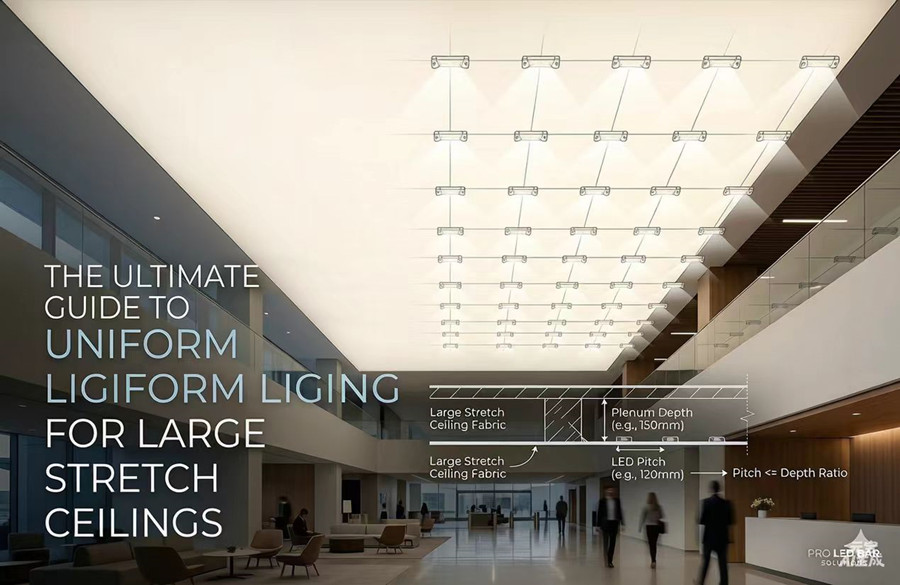
This is the most important calculation in the industry. To ensure zero hotspots, you must adhere to the LED Pitch to Depth Ratio:
Pitch (the distance between LED centers) should always be less than or equal to Depth (the distance from the LED to the fabric).
If your depth is 10cm, your LEDs should be no more than 10cm apart. However, using a high-efficiency Backlit LED Bar Solution with specialized wide lenses (160°) allows you to increase this ratio to Pitch = 1.5 X Depth, significantly reducing the number of components needed.
Translucency & Diffusion Coefficient
Not all membranes are created equal. A high-quality translucent PVC membrane usually has a light transmission rate of about 75%.
PVC Membranes: Offer excellent diffusion but are sensitive to heat.
Textile/Fabric Membranes: Often provide a more "matte" look and can be used in larger spans without seams, but they may require more powerful LEDs due to lower transmission rates.
4 Key Factors for Perfect LED Lighting in Stretch Ceilings
Choosing the Right Light Source
Your choice of LED determines 90% of your success.
LED Modules: Best for organic or irregular shapes. Look for modules with integrated wide-angle lenses (160 or more).
LED Strips (Tape): Generally too fragile for large ceilings. Only use high-density (120+ LEDs/m) strips for very thin edge-lighting or perimeter highlights.
Rigid Backlit LED Bar Solution: This is the professional choice for large commercial projects. Rigid bars (like our Osram-powered LED Bars) provide better thermal paths and ensure that the LEDs remain perfectly aligned over long distances.

Proper LED Spacing (The Technical Grid)
Different depths require different layouts. Here is a quick cheat sheet for Standard $120^{\circ}$ LEDs:
5cm Depth: Pitch should be 4-5cm (Extremely dense).
10cm Depth: Pitch should be 8-10cm.
20cm Depth: Pitch can be 15-18cm.
Pro Tip: If you use Wide-Beam Lenses (160°), you can often increase the pitch to 1.5 x or even 2.0x the depth, significantly reducing your hardware costs.
Beam Angle & Lens Design (The Game Changer)
This is where Premium vs. Budget lighting diverges. A standard LED spreads light at a $120^{\circ}$ angle. A specialized Backlighting Lens reshapes that light into a "batwing" or ultra-wide distribution (160°).
Using lenses allows the light to travel "sideways" rather than just "up," which fills in the dark gaps between the rows of lights. This is the secret to Uniform LED Lighting for Large Stretch Ceilings in shallow cavities.
Voltage and Power Architecture
For large ceilings, 24V DC is the absolute minimum standard.
Why 24V over 12V? 24V systems can carry more power over longer distances with half the current, which minimizes Voltage Drop.
Constant Current Drivers: For the most professional results, use constant current LED bars. This ensures that every single LED, from the first to the five-hundredth, receives the exact same milliamps of power.

Pro Tips for Stretch Ceiling Lighting: Avoid Common Installation Mistakes
The Edge Shadow (The "C" Frame Problem)
Light often dies at the perimeter where the mounting track is located.
The Fix: Install an additional perimeter row of LEDs about 5cm from the wall, or use L-brackets to tilt the perimeter LEDs toward the corners to "wash" the edges with light.
Color Consistency and SDCM
In a 50-meter ceiling, a slight color shift between LED batches is glaringly obvious. One section might look slightly yellow while the other looks blue.
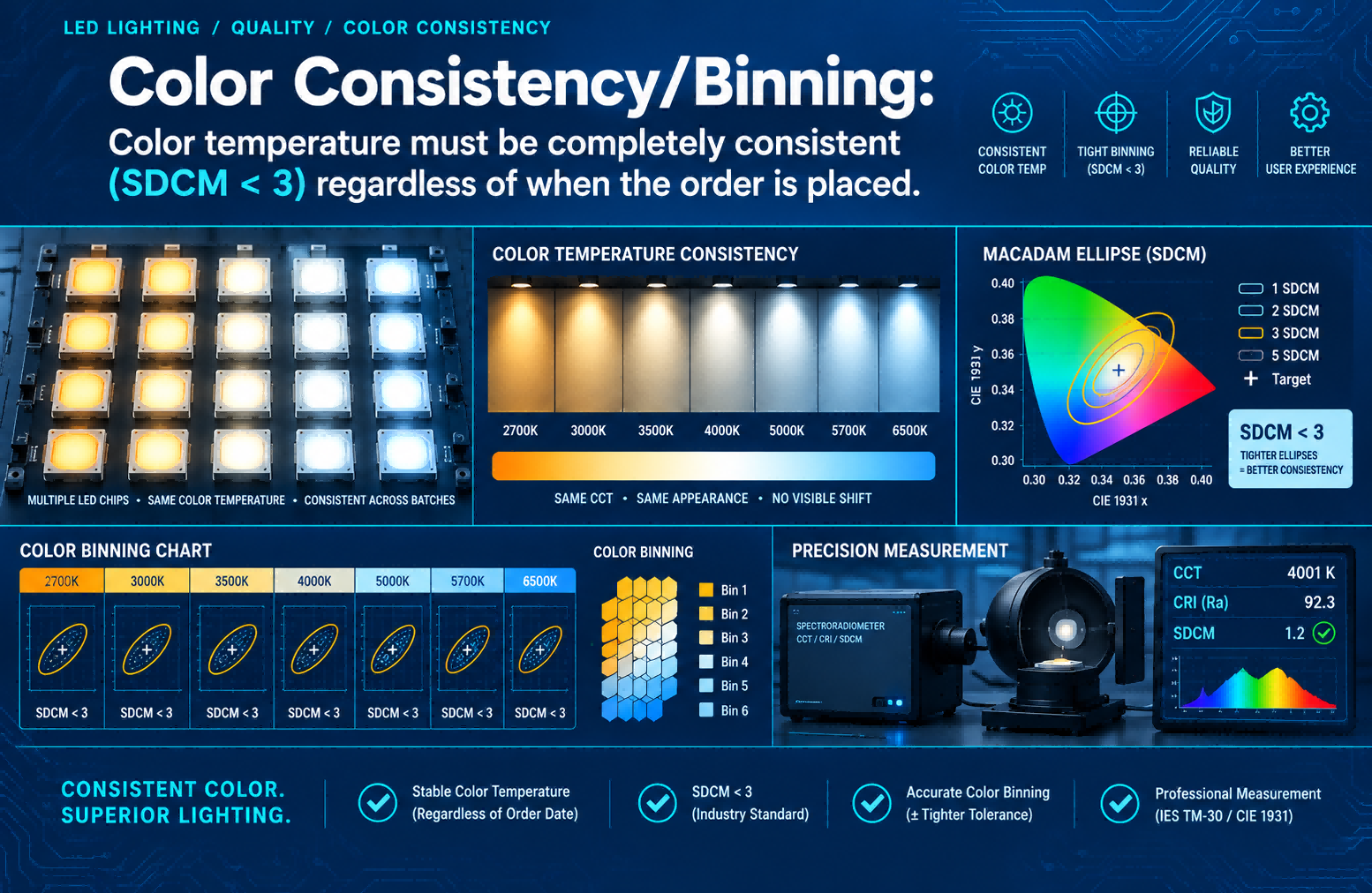
The Solution: Always specify 3-Step MacAdam Ellipse (SDCM <3). This ensures that the binning of the LEDs is so tight that the human eye cannot perceive a color difference.
Dust-Proofing and Longevity
Before the membrane is snapped into place, the "plenum" must be clinical-grade clean.
The Fix: Vacuum the structural ceiling, seal any concrete dust with a primer, and ensure the cavity is airtight to prevent spiders and dust from entering over time.
Best LED Backlighting Solutions for Stretch Ceilings: Which One Fits Your Project?
Residential/Small Areas (<10 sqm)
Focus: Aesthetics and Dimming.
Recommendation: High-density LED strips or COB (Chip on Board) strips for a smooth look at close range.
Medium Commercial (10–50 sqm)
Focus: Balance of Cost and Performance.
Recommendation: Wide-angle LED Modules. These allow for flexible placement around fire sprinklers, vents, and speakers.
Large Infrastructure / Airports / Malls (50 sqm+)
Focus: Reliability, Speed of Install, and Uniformity.
Recommendation: Backlit LED Bar Solution (e.g., Osram LED Bar solutions).
Why? You can cover 100sqm in a fraction of the time it takes to stick individual modules. They are designed for 50,000+ hours of continuous operation.
5 Common Stretch Ceiling Lighting Mistakes You Must Avoid
Over-spacing to save money: You will spend more money fixing the "stripes" later than you saved on the LEDs.
Ignoring High CRI: Cheap LEDs have a low Color Rendering Index (CRI <80), making people look sickly and colors look "muddy" under the ceiling. Aim for CRI 90+.
Using Indoor-grade Power Supplies in Sealed Cavities: The heat will kill them. Always use high-quality, fanless, over-spec'd drivers.
Forgetting Dimming Synchronization: If using multiple drivers, ensure they are all on the same DALI or 0-10V loop so they dim at the exact same rate.
No Access Hatch: Always have a plan for how to reach the drivers (usually by placing them in a remote, accessible cabinet).
Case Study: LED Lighting for a Large Stretch Ceiling in Auto Showroom
The Challenge: A 150sqm ceiling with a depth of only 120mm. The client wanted a "Daylight" effect to reflect off the cars' metallic paint without showing any "dots" in the reflection.
Our Solution: * We utilized Rigid LED Bars with 160° Optics.
We spaced the bars at 150mm intervals.
We used 24V Constant Current Drivers located in a central rack 10 meters away.
The Result: A perfectly flat, 5000K luminous surface. The cars looked like they were parked under an open sky, and the installation took only two days for two people.

How to Choose the Right LED Lighting Solution for Stretch Ceilings
Don't gamble with your project's reputation. To provide a professional Lighting Layout Design, we ask our clients three simple questions:
Dimensions: What is the total length and width?
Plenum Depth: How much "clearance" do we have between the structure and the membrane?
Application: Is this for general lighting (High Lumens) or purely decorative (Low Lumens/RGBW)?
"Ready to eliminate shadows forever?
Consult with our lighting engineers today for a custom Backlit LED Bar Solution layout."
Consult with our lighting engineers today for a custom Backlit LED Bar Solution layout."
Stretch Ceiling LED Lighting FAQ
Can I use RGBW in large stretch ceilings?
Yes, but uniformity is even harder with RGBW. We recommend using 4-in-1 LED chips to ensure color mixing happens at the source rather than on the fabric.
How do I handle fire sprinklers?
You must use "reinforcement rings." Your LED layout must be designed to "skip" these areas while maintaining enough peripheral light to prevent a dark ring around the sprinkler.
What is the best color temperature (CCT) for stretch ceilings?
4000K (Neutral White) is the most popular for offices, while 5000K-6000K mimics natural daylight best.
What is the minimum depth for a stretch ceiling?
Ideally 100mm. With specialized 160° lenses, we can achieve uniformity at 60mm.
Can I use RGBW in large stretch ceilings?
Yes, but use 4-in-1 chips to ensure color mixing happens at the source to avoid rainbow-colored edges.
How do I calculate the power load?
We provide a full LED Pitch to Depth Ratio Calculation and power map for every project to ensure your breakers never trip.