
2026 Home Theater Lighting: Pro Bias & Smart Ambient Guide
2025-12-19

What is the Ultimate Home Theater Lighting Setup for 2026?

The Ultimate Home Theater Lighting Guide for 2026: Craft Your Perfect Cinematic Escape

Poor lighting can wash out your screen, ruin your night vision, and break the spell of cinematic immersion. Conversely, a meticulously designed lighting scheme can elevate your viewing experience from “pretty good” to “truly transcendent.” As we step into 2026, lighting technology has matured in astonishing ways, offering unprecedented control, customization, and intelligence. This guide is your definitive roadmap to mastering home theater lighting in 2026, covering everything from fundamental principles to the latest smart integrations, and helping you build a system that’s both functional and magical.
Part 1: The Foundational Pillars of Home Theater Lighting
Part 2: Your Lighting Toolkit – The Essential Fixtures & Technologies of 2026
Part 3: The 2026 Smart Ecosystem – Control is King
Part 4: Your Step-by-Step 2026 Implementation Plan
Part 5: Pro Tips & Common Pitfalls to Avoid
Conclusion
FAQ

Part 1: The Foundational Pillars of Home Theater Lighting

Before you start shopping for smart bulbs, it’s essential to understand the core goals and principles that govern all great home theater lighting. These are timeless truths that will anchor your decisions, regardless of the tech you choose.

1. The Holy Grail: Zero Screen Glare

The absolute, non-negotiable priority is to eliminate any light that can reflect off your screen. This includes direct light from fixtures, indirect light bouncing off walls or ceilings, and even the glow from electronic displays on your equipment. A single source of glare can destroy contrast, wash out blacks, and make your expensive display look flat and lifeless. Your lighting plan must be designed with the screen as the absolute focal point, and everything else must serve to keep it pristine.

2. Preserving Your Night Vision

Our eyes adapt to darkness over time, a process that can take 20-30 minutes to fully complete. A sudden, bright light—like flipping on a standard overhead fixture—resets this adaptation, making the screen appear dimmer and less vibrant until your eyes readjust. Home theater lighting should use very low levels of warm, dimmable light that won’t compromise this hard-earned dark adaptation.

3. Functional Illumination Without Compromise

While you want darkness for viewing, you absolutely need light for navigating the space safely—entering the room, finding your seat, reaching for a remote, or getting a drink during an intermission. The key is to provide this functional light in a way that is completely independent of your screen-viewing experience. It should be easy to control, non-intrusive, and ideally, automated.

4. Setting the Mood and Enhancing Immersion

Beyond the technical necessities, lighting is a powerful storytelling tool. The right ambient glow can deepen your emotional connection to the film, extend the on-screen environment into your physical space, and create a sense of occasion. This is where the “wow” factor comes in, transforming your room from a simple viewing area into a true cinematic environment.

Part 2: Your Lighting Toolkit – The Essential Fixtures & Technologies of 2026

Now that we understand the “why,” let’s explore the “what.” Here are the key lighting elements you’ll want to consider for a complete 2026 home theater setup.

1. Bias Lighting: The Secret Weapon for Image Quality

Bias Lighting: The Secret Weapon for Image Quality
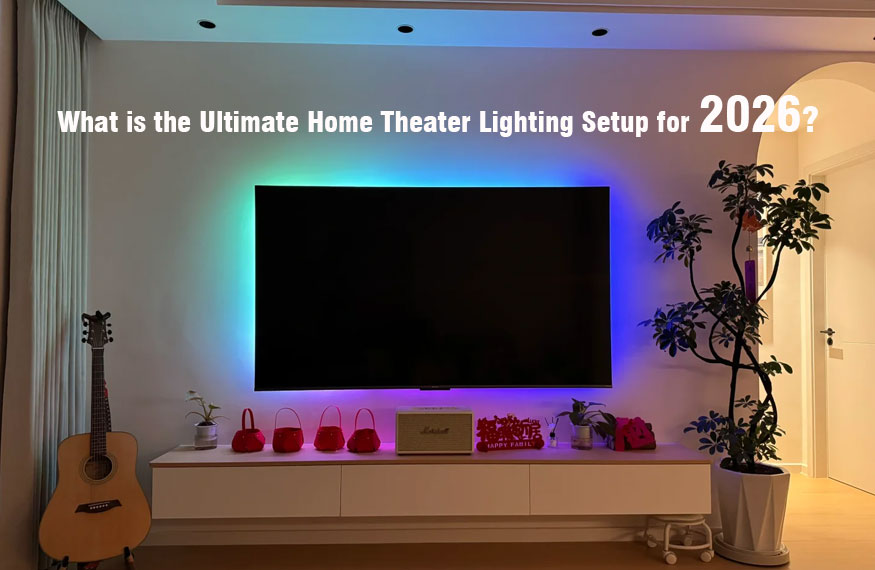
  • What it is: Bias lighting is a soft, uniform, and diffuse light source placed behind your TV or projector screen. It’s not for illuminating the room; it’s for your eyes and your display.
  • Why it works: Your eyes perceive contrast relative to their surroundings. In a pitch-black room, your display’s black levels look deeper. However, a completely black void behind the screen can create an unnatural and fatiguing viewing condition. A properly calibrated bias light (typically around 6500K, the same color temperature as most video content) provides a neutral reference point.
  • The 2026 Advantage: Modern bias lighting has moved far beyond simple LED strips. Today’s premium solutions like the MediaLight Pro or Govee’s Cinema Pro series offer exceptional color accuracy (well over 95% DCI-P3 coverage), flicker-free operation, and precise dimming down to imperceptible levels. Many are now integrated directly into high-end TV stands or projector baffles for a seamless, professional look. This is the single most impactful lighting upgrade for perceived image quality and viewer comfort.

2. Step & Path Lighting: Safety Meets Subtlety

  • What it is: Low-level, downward-facing lighting that outlines the floor, stairs, or seating aisles to prevent trips and falls.
  • Implementation: The gold standard is recessed linear LED cove lighting installed at the base of your walls or under your tiered seating. It provides a soft, even glow that’s just enough to see the floor’s texture without creating a distracting point source of light. For a more accessible solution, discreet LED step lights can be installed into the risers of your platform or stairs.
  • 2026 Features: In 2026, these fixtures are almost universally dimmable to 1% or lower and often feature motion sensors with intelligent “fade-on/fade-off” logic. They can stay on at an ultra-low level throughout the movie for constant, safe navigation or activate only when you move. They are also designed to be completely shielded, so their light never shines upward into the viewing area.

3. Cove & Recessed Ambient Lighting: The Cinematic Atmosphere

Cove & Recessed Ambient Lighting: The Cinematic Atmosphere
  • What it is: Indirect lighting that washes the ceiling or upper walls with a soft, diffuse glow. This is the primary source for creating a mood and filling the room with a gentle luminance that doesn't compete with the screen.
  • Implementation: LED tape light installed in a cove at the top of your walls is the professional’s choice, offering complete flexibility and a seamless wash of light. For a more DIY approach, upward-facing, baffled recessed fixtures can achieve a similar, though less perfect, effect.
  • 2026 Intelligence: This is where 2026’s smart lighting shines. Your ambient lighting can now be part of a scene-based ecosystem. With a simple voice command (“Hey Google, start movie”) or a single button press on a universal remote, the system can simultaneously lower the blackout shades, power on your A/V gear, and dim your cove lights to a pre-set “Cinema” level of 10% warm white (2700K). The key is that the light source is indirect, so it never creates a visible bulb or fixture that can distract from the screen.

4. Smart Accent & Architectural Lighting: Personalization & Wow Factor

  • What it is: This is the layer for personal expression and advanced immersion. It includes lighting behind acoustic panels, under shelves, or within display cabinets to highlight your theater’s architecture or memorabilia.
  • Implementation: RGBWW (Red, Green, Blue, White, Warm White) LED strips are the go-to technology. The dedicated white channels ensure you have high-quality, accurate white light for your movie scenes, while the RGB channels are there for parties, gaming, or themed events.
  • The 2026 Immersion Play: The most exciting development is content-synced lighting. Systems like Nanoleaf’s Lines or Skylight panels, when paired with a compatible media server like Plex or a high-end AVR with built-in processing, can analyze the on-screen content in real-time and extend its color palette to your room’s walls. A fiery battle scene casts an orange glow, while a moonlit forest bathes your room in cool blue. This technology has become far more affordable and accessible in 2026, offering a genuine “4D” cinematic extension.

Part 3: The 2026 Smart Ecosystem – Control is King

The hardware is only half the story. The true power of 2026’s home theater lighting lies in its seamless, invisible control. The best system is the one you don’t have to think about.

1. The Central Nervous System: Your Control Hub

Gone are the days of a dozen different apps. The modern home theater integrates with a central control system:
  • Dedicated Home Automation (High-End): Systems like Control4, Savant, or Crestron offer the ultimate in reliability and customization. A single, elegant touch panel or remote can manage every light, shade, and A/V component with a single press of a “Movie Time” or “Intermission” button.
  • Smart Home Platforms (Mid-Range): Apple HomeKit, Google Home, and Amazon Alexa have matured to a point where they can handle complex multi-device scenes reliably. A simple voice command can trigger a full theater sequence. The key is to ensure all your lighting products are on the same platform for a cohesive experience.
  • AV Receiver Integration (Budget-Conscious): Many high-end AVRs from Denon, Marantz, and Yamaha now feature HDMI-CEC and IP control that can directly trigger smart plugs or compatible lighting systems. Pressing “Play” on your remote can simultaneously dim your lights.

2. The Magic of Scenes and Automation

The concept of a “scene” is fundamental to 2026 lighting. You don’t control individual bulbs; you control the state of your entire room.
  • Cinema Scene: All overheads off, bias light on at 30%, step lights at 5%, cove lights off.
  • Intermission Scene: Cove lights dimmed to 40% warm white, step lights at 20%, bias light remains on. Perfect for stretching your legs without fully killing your night vision.
  • Cleaning Scene: All functional lights (cove, step, recessed) at 100% for maximum visibility.

3. The Rise of Presence & Context Awareness

The smartest 2026 systems go beyond simple triggers. They use presence detection (from smart door sensors, motion detectors, or even your phone’s location) to automate lighting intelligently.
  • If you pause your movie for more than 5 minutes, the system can automatically trigger a soft “Intermission” scene.
  • If a door sensor detects someone entering the room during a movie, a gentle path of step lights can illuminate their way to a seat without blasting everyone with light.
  • In the morning, if a “late night movie” was watched, the system can gradually fade in warm white light to help you wake up gently.

Part 4: Your Step-by-Step 2026 Implementation Plan

Now, let’s build your dream system. Follow this practical roadmap.

Step 1: The Audit & Planning

  • Map your room. Note the location of your screen, seating, doors, and any walkways or stairs.
  • Identify glare sources. Turn on all your current lights and sit in your main seat. What fixtures or reflections can you see on the screen? These must be eliminated or fully controllable.
  • Set your budget. Lighting can range from a few hundred to several thousand dollars. Prioritize: Bias lighting and step/path lighting are your functional essentials. Ambient and accent lighting are for mood and luxury.

Step 2: The Wiring (Do it Right the First Time)

If you are building or renovating, run low-voltage wiring (typically 12V or 24V) to all your planned lighting locations—behind the screen, along the baseboards, in the ceiling cove, and under shelves. This future-proofs your installation, provides cleaner power for your LEDs (reducing flicker), and allows for centralized, high-quality drivers. This is the single best “behind-the-walls” investment you can make.

Step 3: The Core Installation

  1. Install your bias lighting first. This is your foundation for image quality. Mount it so the light is evenly diffused across the entire back of the screen.
  2. Install your safety lighting. Get your step and path lights in place. Ensure they are shielded and point only at the floor.
  3. Install your ambient system. Whether it’s cove lighting or baffled uplights, position them to wash the ceiling, not the screen or the audience.

Step 4: The Smart Integration

  • Choose your ecosystem. Pick your control hub (Control4, HomeKit, etc.) and ensure all your lighting products are compatible.
  • Create your scenes. This is where the magic happens. Spend time dialing in the perfect brightness and color temperature for your “Cinema” and “Intermission” scenes. The ideal “Cinema” light is often so dim you can barely see it, but it’s enough to prevent your eyes from being overwhelmed by the contrast between the bright screen and total blackness.
  • Test and refine. Watch a movie. Is there any glare? Is the path lighting bright enough to be safe but dim enough to be unobtrusive? Tweak your scenes until it’s perfect.

Step 5: The Advanced Touch (Optional but Recommended)

For the ultimate 2026 experience, explore content-synced lighting. It requires a bit more setup—often a USB camera pointed at your screen or a direct HDMI feed to a processing box—but the result is a breathtaking expansion of the cinematic canvas into your physical space.

Part 5: Pro Tips & Common Pitfalls to Avoid

Even with the best plan, it’s easy to stumble. Here are the top mistakes and how to avoid them in 2026.
  • Mistake: Using the Wrong Color Temperature.

      Cool, blue-white light (5000K+) is energizing and harsh. It’s the enemy of a relaxing movie night. Always use warm white light (2700K-3000K) for your ambient and path lighting. Reserve your 6500K light for your bias                lighting, where its neutrality is a feature, not a bug.
  • Mistake: Over-lighting. More light is not better.

     The goal is the minimum amount of light needed for a given task. Your “Cinema” scene should feel almost like total darkness, with just a hint of presence from your bias and path lights.
  • Mistake: Visible Fixtures.

     A bare LED strip or a visible bulb is a major distraction. Always use diffusers, coves, or recessed baffles to hide your light sources and create a soft, indirect glow.
  • Mistake: Ignoring the “Off” State.

      Even when a smart bulb is “off,” some cheaper models can emit a faint, annoying glow from their internal electronics. In a light-controlled theater, this is unacceptable. Invest in high-quality fixtures that are truly dark when off.
  • Mistake: Forgetting the Exit.

      Your lighting plan should include an “Exit” scene that gently but fully illuminates the path to the door, so your guests aren’t fumbling in the dark after the credits roll.

Conclusion: Light Your Way to a Perfect Picture

In 2026, your home theater’s lighting is no longer an afterthought or a simple on/off switch. It’s an integral, intelligent, and dynamic component of your entire entertainment ecosystem. By understanding the core principles of glare elimination, night vision preservation, and functional safety, and by leveraging the smart, controllable, and immersive technologies now available, you can craft a viewing environment that rivals any commercial cinema.
The right lighting doesn’t just let you see your screen better; it makes you feel the movie more deeply. It removes the boundaries of your room and invites you to lose yourself completely in the story. So, invest the time and thought into your lighting plan. Your eyes—and your favorite films—will thank you for it. Now, dim the lights, press play, and enjoy the show.

FAQ

Q1: Is bias lighting really necessary, or is it just a gimmick?

A: It’s absolutely not a gimmick; it’s a scientific best practice. Bias lighting reduces eye strain, improves perceived contrast and black levels, and makes colors appear more accurate. It’s one of the most cost-effective upgrades you can make for a tangible improvement in picture quality and viewing comfort. In 2026, with high-quality, color-accurate options widely available, it’s a no-brainer for any serious home theater.

Q2: Can I just use smart bulbs in my existing ceiling fixtures?

A: You can, but it’s far from ideal. Overhead ceiling fixtures are a primary source of screen glare. Even when dimmed, a visible bulb in your field of view is a major distraction. The light also tends to be direct and harsh, not the soft, diffuse ambient glow you want. For a true home theater experience, you should replace or supplement overheads with indirect cove lighting and low-level path lighting. If you must use ceiling fixtures, ensure they are fully controllable, dimmable to very low levels, and have a very warm color temperature.

Q3: What’s the ideal brightness level for my home theater lights during a movie?

A: There’s no single magic number, as it depends on your screen’s brightness and the room’s size. However, a good rule of thumb is that your ambient lighting (from coves, etc.) should be no brighter than 10% of your screen’s peak white level. In practical terms, this usually means your “Cinema” scene is so dim that you can barely perceive the light in the room, but you can still make out the edges of your seating. Your path/step lights should be just bright enough to see the floor’s texture—think 1-5% brightness. Always prioritize being too dim over being too bright.

Q4: Are Philips Hue or other consumer-grade smart lights good enough for a home theater?

A: They can be a great starting point, especially for ambient and accent lighting in a budget-conscious build. Their ecosystem is robust, and creating scenes is easy. However, for critical applications, they have limitations. Their color accuracy for white light isn't as precise as professional bias lights, and their dimming range, while good, may not go low enough for a true “blackout” cinema feel. For your bias light, always invest in a dedicated, video-reference solution. For other layers, Hue is a solid, user-friendly choice in 2026.

Q5: How do I prevent my smart lights from turning on randomly during a movie?

A: This is a common frustration caused by poorly configured automations or unreliable connectivity. Here’s how to fix it:
  • Put your theater on its own smart home “room” or “zone” to isolate it from whole-home automations.
  • Disable all motion-activated routines for your theater lights while a movie is playing. Use your A/V system’s power state as a trigger to disable these automations.
  • Use a dedicated control system (like Control4) or your AVR’s macro features instead of relying solely on cloud-based smart home platforms, which can be less reliable for mission-critical tasks.
  • Ensure a strong, dedicated Wi-Fi signal or use a mesh system to prevent dropouts that can cause erratic behavior.

Q6: What’s the best way to light a room with a projector versus a flat-panel TV?

A: The core principles are the same, but projectors are far more susceptible to ambient light. With a projector, your goal is to get as close to total darkness as possible. This means your lighting scheme must be even more meticulously controlled and indirect. Any light that can bounce off a wall and onto the screen is a problem. Flat-panel TVs (especially OLEDs) have excellent native contrast and can handle a bit more ambient light, but the best viewing experience for any display is still achieved in a controlled, dark environment. The main difference is in tolerance; a projector has zero tolerance, while a high-end TV has a little more flexibility.

Q7: Do I need to hire a professional integrator for my home theater lighting?

A: It depends on your ambition and technical comfort. For a simple setup using smart bulbs and strips controlled by Alexa or Google Home, a DIY approach is very feasible in 2026. However, if you are doing new construction, want a fully hardwired, centralized system, desire complex automations tied to your A/V gear, or want the seamless, “invisible” experience of a true high-end theater, a professional integrator is worth the investment. They will handle the wiring, system design, programming, and calibration to ensure everything works perfectly together from day one.
Contact ADLED for LED Lighting