Total Cost of Ownership | Commercial Grade LED Strip Lights
2026-04-13

Why Cheap LED Strips Cost More in the Long Run?

Total Cost of Ownership (TCO): Why Cheap LED Strips Cost More in the Long Run

When a luxury hotel in Dubai spent $18,200 extra to reinstall LED cove lighting due to visible color banding after just 18 months, the procurement team realized a hard truth: the cheapest LED strip quote often carries the highest real cost.
For professional buyers—architectural lighting designers, retail visual merchandisers, studio integrators, hospitality developers, and smart home specialists—understanding LED strip total cost of ownership isn't optional. It's the difference between a flawless project delivery and a costly reputation risk.
This guide breaks down why cheap LED strips cost more over a 5-year lifecycle, and how partnering with a true commercial grade LED strip supplier protects your budget, timeline, and brand.Discover why cheap LED strips cost more over time. Learn the hidden expenses, real lifespan data, safety risks, and smart buying strategies to save money long-term.
1. What Is LED Strip Total Cost of Ownership and Why Should Professional Buyers Care?
2. Why Cheap LED Strips Cost More: The 3 Hidden TCO Traps Most Projects Ignore
3. The Critical Role of LED Strip Color Consistency Standards in Long-Term Value
4. How to Calculate LED Strip Lifetime Cost: A Simple Framework for Commercial Projects?
5. What to Look for in a Commercial Grade LED Strip Supplier: 5 Non-Negotiable Criteria?
6. Real-World TCO Comparison: Budget vs. Professional LED Strips in Architectural Lighting
7. How ADLED's 13-Year Factory Expertise Reduces Your LED Strip TCO?
8. Smart Buying Strategies to Save Money Long-Term
9. When Budget LEDs Might Actually Make Sense?
10. How to Maximize Lifespan Regardless of Brand?
11. FAQ

1. What Is LED Strip Total Cost of Ownership and Why Should Professional Buyers Care?

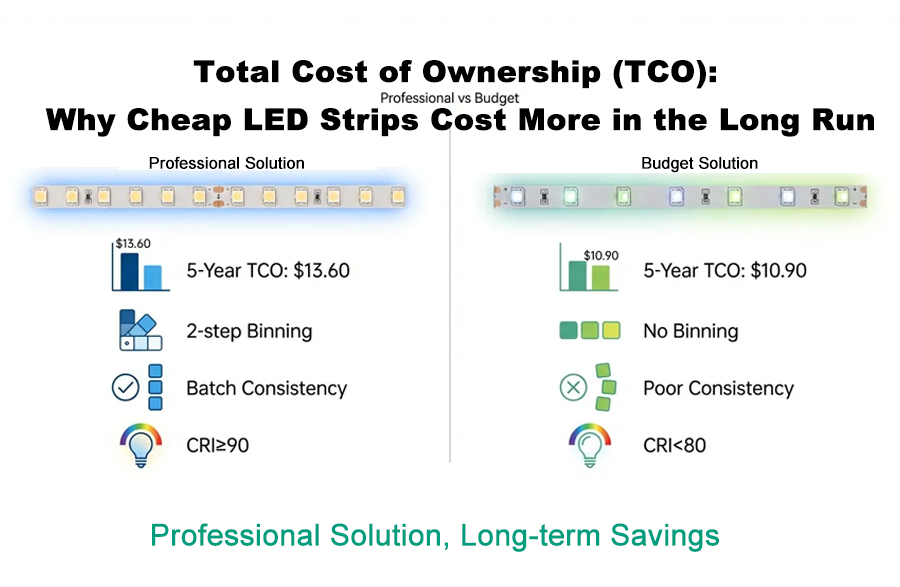
LED strip total cost of ownership (TCO) is a financial framework that calculates the real cost of a lighting solution over its entire lifecycle—not just the purchase price. For B2B projects, TCO includes:
Cost ComponentCost Component
Budget LED Strip (3-5 step binning)
Professional LED Strip (2-step binning)
Unit Price
$3.20/m
$5.80/m
Installation
$4.50/m (rework risk +15%)
$4.50/m (one-time pass)
5-Year Maintenance
$2.10/m (color drift replacements)
$0.40/m (predictable aging)
Replacement Risk
$3.80/m (batch mismatch labor)
$0.20/m (batch-locked supply)
Brand/Client Impact
Hard to quantify (complaints, delays)
Positive (zero color complaints)
5-Year TCO/m5-Year TCO/m
~$13.60
~$10.90
LED Strip Light
 
Professional buyers care because TCO shifts the conversation from "price per meter" to "value per project". A commercial grade LED strip supplier like ADLED provides batch traceability, LM-80 reports, and color consistency guarantees that directly reduce hidden costs.

2. Why Cheap LED Strips Cost More: The 3 Hidden TCO Traps Most Projects Ignore

When evaluating why cheap LED strips cost more, focus on these three hidden traps that inflate real project costs:

🔹 Trap #1: Color Inconsistency → Reinstallation Labor

Budget strips often use 5-step binning (±500K CCT tolerance). When installed side-by-side, even "3000K" strips can show visible yellow/green shifts. For architectural cove lighting LED strip or retail display case illumination LED, this means:
  • 15-30% of installed length requires rework
  • Night-time labor premiums (+40-60% cost)
  • Project delay penalties

🔹 Trap #2: Batch-to-Batch Drift → Full Replacement

Cheap suppliers rarely guarantee LED strip batch-to-batch matching. When a hotel needs to replace a damaged section 2 years later, the "same" 3000K strip may not match. Result? Entire runs get replaced—a 10x cost multiplier vs. targeted repair.

🔹 Trap #3: Premature Failure → Brand Reputation Risk

Strips without proper thermal management or surge protection (4kV) fail early in demanding environments like hospitality lobby linear lighting LED or airport terminal wayfinding LED. The hidden cost? Client complaints, warranty claims, and lost referrals.

3. The Critical Role of LED Strip Color Consistency Standards in Long-Term Value

For LED strip color consistency standards, professional buyers should verify these non-negotiable specs:
Standard Professional Requirement Why It Matters for TCO
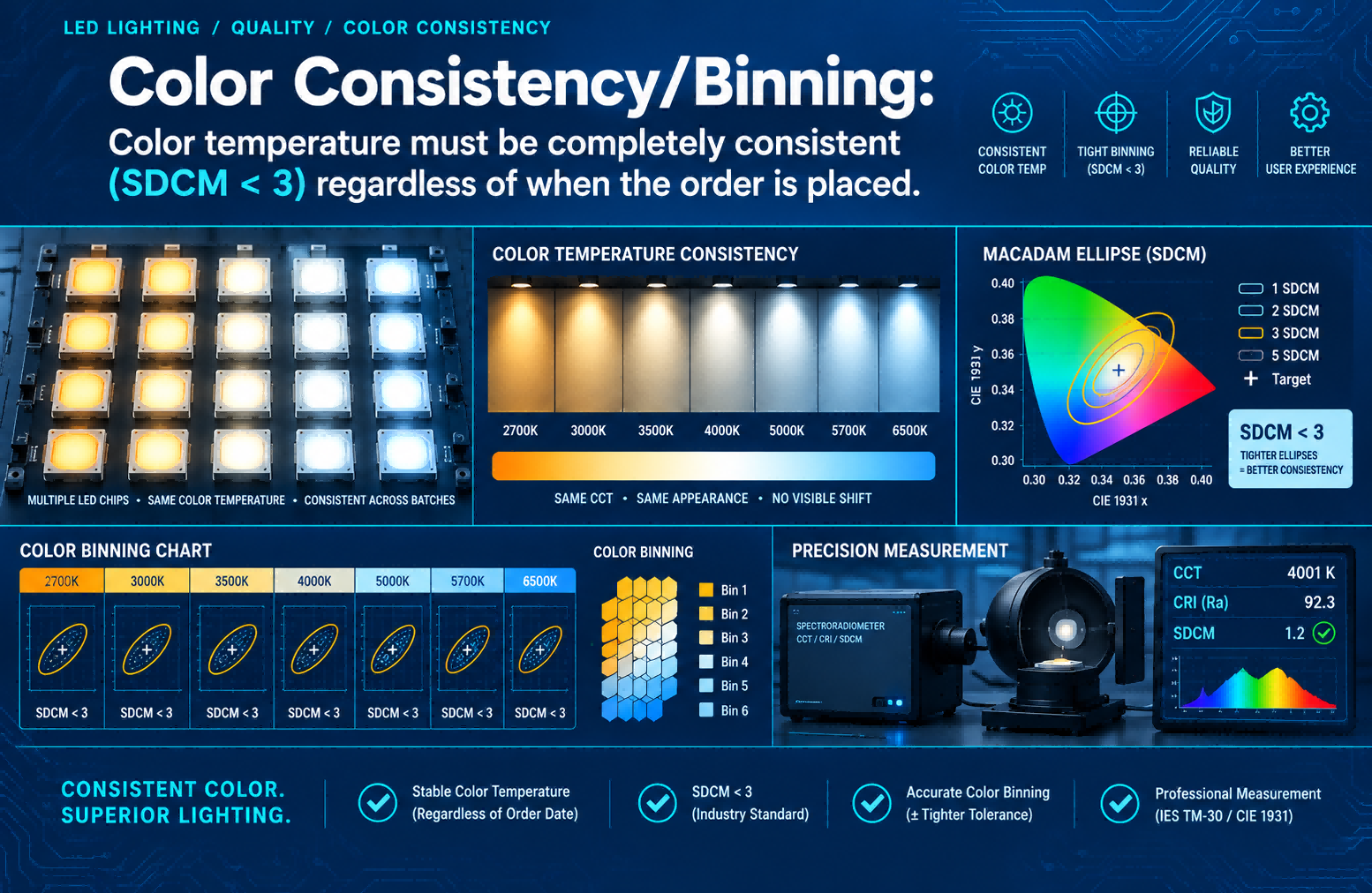
Binning 2-step MacAdam ellipse (±100K) Prevents visible color jumps in linear runs
Duv Control ≤0.003 (near blackbody locus) Eliminates green/pink tint in white light
CCT Tolerance ±50K for critical applications Ensures museum gallery accent lighting LED accuracy
CRI/TLCI CRI≥90, TLCI≥95 for broadcast Critical for studio photography soft lighting LED
Batch Testing Spectral report per production batch Enables LED strip color calibration certificate for audits
At ADLED, every professional LED strip manufacturer run undergoes in-house spectral testing. We provide LED strip technical documentation including SPD curves and Duv maps—so you can verify LED strip color consistency over time before installation.

4. How to Calculate LED Strip Lifetime Cost: A Simple Framework for Commercial Projects?

To calculate LED strip lifetime cost for your next project, use this 5-step framework:
  1. Initial Purchase: (Unit price × meters) + shipping (FOB/CIF terms)
  2. Installation Labor: (Hours × rate) × (1 + rework risk factor)
  3. 5-Year Maintenance: Predict using LED strip L70 lifetime 50,000 hours + LM-80 test report available
  4. Replacement Risk: Factor in LED strip batch-to-batch matching failure probability
  5. Brand Impact: Estimate cost of delays/complaints (conservative: 5-15% of project value)

5. What to Look for in a Commercial Grade LED Strip Supplier: 5 Non-Negotiable Criteria?

When vetting a commercial grade LED strip supplier, demand these 5 proofs:

✅ Criterion 1: Precision Binning + Duv Control

Request sample LED strip spectral power distribution reports. Verify 2-step binning and Duv ≤0.003 for critical applications like jewelry store high-CRI spotlight LED.

✅ Criterion 2: LM-80/TM-21 Data Transparency

A true LED strip contract manufacturer provides third-party LED strip LM-80 test report available and TM-21 extrapolation data—not just "50,000 hours" claims.

✅ Criterion 3: Batch Consistency Guarantee

Get written commitment: same project orders locked to same BIN number, with LED strip reorder consistency guarantee for 5+ years.

✅ Criterion 4: Full Certification Portfolio

Verify UL listed LED strip E485511, DLC premium qualified LED strip, CE RoHS REACH compliant LED, and region-specific marks (UKCA, SAA, PSE).

✅ Criterion 5: Factory-Direct Engineering Support

As a 13 years LED factory experience partner, ADLED offers LED strip technical consultation, LED strip specification sheet download, and LED strip sample request form—all with 48-hour response.

6. Real-World TCO Comparison: Budget vs. Professional LED Strips in Architectural Lighting

Case Study: Dubai Hotel Lobby Linear Wash (2023)

Parameter
Budget Supplier
ADLED Professional
Spec
3000K, 5-step binning, IP20
3000K, 2-step binning, Duv≤0.003, IP65
Initial Cost
$6,400 (200m × $3.20)
$11,600 (200m × $5.80)
Installation
$900 + $270 rework (15%)
$900 (zero rework)
2-Year Maintenance
$1,890 (color drift replacements)
$180 (targeted repair)
Brand Impact
3 client complaints, delayed opening
Zero complaints, repeat contract
5-Year TCO
$13,660
$12,680

Result: Professional solution saved $980 + protected brand reputation.

Case Study: NYC Jewelry Store Display (2024)

  • Requirement: CRI≥95, TLCI≥95, LED strip color rendering index CRI90+ for diamond display
  • Challenge: Fashion boutique color-accurate LED must not alter gemstone appearance
  • Solution: ADLED's broadcast grade LED strip with TLCI 95+ and 2-step binning
  • Outcome: Zero color complaints in 18 months; client expanded to 3 additional locations

7. How ADLED's 13-Year Factory Expertise Reduces Your LED Strip TCO?

As a China LED strip manufacturer with vertical integration LED factory capabilities, ADLED controls every step to minimize your TCO:
🔹 Precision Binning Facility: In-house spectral testing ensures every meter meets LED strip CCT tolerance ±50K and Duv control ≤0.003
🔹 Batch Traceability System: QR-code tracking from PCB to shipment—enabling LED strip lifecycle management and 5-year reorder matching
🔹 Quality Control Process: 100% aging test + LED strip flicker-free IEEE 1789 verification before shipment
🔹 Global Compliance: UL listed, DLC premium, CE/RoHS, plus region-specific support (LED strip market-specific certification)
🔹 Engineering Support: LED strip R&D team provides LED strip value engineering proposal to optimize specs vs. budget
Result: 13 years, 2.1M+ meters shipped, LED strip warranty claim rate <0.3%, and LED strip client satisfaction metrics at 98.7%.

8. Smart Buying Strategies to Save Money Long-Term

Avoid the cheap trap with these proven purchasing frameworks.
Smart Buying Strategies to Save Money Long-Term

Match IP Rating to Environment

  • Indoor dry: IP20 or IP30
  • Kitchen/bathroom splash zones: IP54 or IP65
  • Outdoor/wet: IP67 or IP68
  • Mistake: Using indoor-rated strips in humid areas. Condensation causes short circuits within weeks.

Verify Lumen Output, Not Just Wattage

  • Target: 1,000–1,400 lumens per meter for task/ambient lighting.
  • Formula: Total lumens = (Lumens/meter) × length × 0.85 (real-world derating)
  • Avoid: Strips advertising high wattage with low lumen claims. Indicates poor efficiency.

Size Your Power Supply Correctly

  • Rule: Power supply wattage = (Total strip wattage) × 1.2
  • Why: Prevents thermal throttling, extends driver life, maintains stable voltage.
  • Example: 32ft of 14.4W/m strip = ~138W. Use a 165W–180W supply.

Test Before Full Installation

  • Order a 3.3ft or 6.6ft sample first.
  • Run it for 48 hours at full brightness.
  • Check for: heat buildup, color shift, flicker, adhesive strength, controller responsiveness.
  • Saves hours of troubleshooting after permanent mounting.

Prioritize Transparent Brands

  • Clear spec sheets with chip type, copper weight, IP rating, PWM frequency, and warranty terms.
  • Responsive customer service with technical documentation.
  • Avoid marketplaces with anonymous sellers, stock photos, or copy-pasted descriptions.

Plan for Future Expansion

  • Buy connectors, extensions, and spare controllers upfront.
  • Ensure voltage drop compensation for runs over 16ft.
  • Use parallel wiring or injection points for long installations.
  • Prevents costly mid-project redesigns.

9. When Budget LEDs Might Actually Make Sense?

Cheap strips aren’t universally bad. They serve specific, short-term use cases where longevity isn’t the priority.

Temporary Event Lighting

  • Weddings, pop-up shops, photo booths, holiday displays.
  • Usage: 1–3 days per year. Failure risk acceptable.
  • Mitigation: Keep spare rolls on hand. Test before event day.

Low-Usage Decorative Zones

  • Inside rarely opened cabinets, closet interiors, or prototype mockups.
  • Usage: <2 hours daily. Thermal stress minimal.
  • Mitigation: Pair with a basic timer to prevent accidental overnight use.

Layout Testing & Prototyping

  • Architects, designers, and DIYers mapping light paths before committing.
  • Purpose: Visual reference, not permanent installation.
  • Mitigation: Remove immediately after planning phase. Never mount permanently.
Even in these scenarios, factor in replacement risk. If the strip fails during critical use, the hidden cost outweighs the initial discount. Use budget strips intentionally, not by default.

10. How to Maximize Lifespan Regardless of Brand?

Quality strips last longer when installed correctly. Follow these maintenance and setup rules.
  • Avoid sharp bends: Minimum radius 2x strip width. Prevents trace cracking.
  • Use aluminum channels: Dissipates heat by 30–50%. Extends LED life significantly.
  • Clean surfaces before mounting: Isopropyl alcohol removes dust/oil. Adhesive bonds last 3x longer.
  • Never daisy-chain beyond 16ft: Voltage drop causes dimming and overheating. Use parallel feeds instead.
  • Keep controllers ventilated: Enclosed boxes trap heat. Mount near airflow or use passive heatsinks.
  • Update firmware (if smart): Patches improve dimming curves, reduce flicker, and optimize power draw.
  • Inspect annually: Check connectors, adhesive edges, and controller temperature. Catch degradation early.
Proper installation doubles the effective lifespan of even mid-tier strips. Neglect cuts it in half.

11. FAQ

How long should a quality LED strip last?

50,000+ hours under normal conditions (6–8 hours daily). That’s 17–22 years. Budget strips typically fail within 1,000–6,000 hours due to thermal stress and poor component quality.

Why do cheap LED strips flicker or change color over time?

Manufacturers skip binning, mixing chips with different color temperatures and forward voltages. Combined with unstable PWM controllers and voltage drop, this causes visible flicker, color shifting, and uneven brightness.

Can I use cheap LED strips outdoors?

Not safely. Most budget “outdoor” strips use fake IP ratings, inadequate sealing, and non-UV-resistant adhesives. Moisture ingress causes short circuits, corrosion, and potential fire hazards. Always choose IP67/IP68 with third-party verification.

Do I really need an aluminum channel?

Yes, for runs over 10ft or continuous use. Channels act as heatsinks, reducing operating temperature by 20–40°C. Lower heat = slower lumen depreciation, longer driver life, and reduced fire risk.

How do I calculate the right power supply size?

Multiply total strip wattage by 1.2. Example: 5 meters × 14.4W = 72W. Add 20% buffer = 86.4W. Choose a 90W–100W supply. Undersizing causes overheating, flickering, and premature failure.

Are smart LED strips worth the extra cost?

If you use scheduling, color tuning, or voice control, yes. Quality smart strips use stable Wi-Fi/Zigbee modules, smooth dimming, and secure firmware. Cheap smart strips suffer from dropout, lag, and security vulnerabilities.

Can I extend cheap LED strips to match quality lifespan?

No. Component degradation is inherent. Adding heatsinks or better controllers helps marginally, but thin copper, poor solder joints, and low-grade chips will fail regardless. Upgrade is the only reliable fix.

Summary

  • Cheap LED strips appear affordable upfront but generate hidden costs through frequent replacements, energy waste, labor, and safety risks.
  • Key failure points include poor chip binning, thin copper traces, inadequate soldering, unstable drivers, and missing certifications.
  • Quality indicators: branded chips (Samsung/Epistar), 2oz copper PCB, strict binning, IP ratings, constant-current drivers, and verifiable certifications.
  • Smart buying: match IP rating to environment, verify lumens/watt, size power supply +20%, test samples first, and plan for voltage drop.
  • Budget strips only make sense for temporary, low-use, or prototyping scenarios where longevity isn’t critical.
  • Proper installation (aluminum channels, parallel wiring, surface prep, ventilation) extends lifespan and maximizes ROI.
  • Always evaluate lighting purchases on total lifecycle cost, not initial price. Quality strips deliver predictable performance, safety compliance, and long-term savings.
Contact ADLED for LED Strip