

2026-04-13
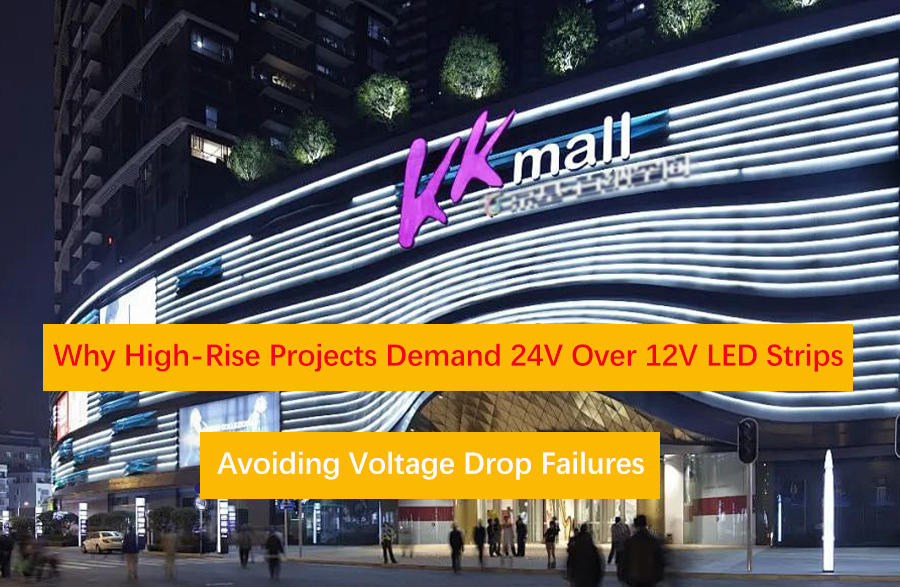
Why High-Rise Projects Demand 24V Over 12V LED Strips: Avoiding Voltage Drop Failures
Why High-Rise Projects Demand 24V Over 12V LED Strips: Avoiding Voltage Drop Failures
Picture this: you’ve just completed a spectacular LED lighting installation on the facade of a 40‑story commercial tower. At night, the first few floors glow brilliantly, but as your eyes travel upward, the light fades — the top floors look dim, uneven, and disappointing. What went wrong?
Voltage drop. This is the hidden enemy of every high‑rise LED project. When electricity travels through long distances of copper traces on an LED strip, resistance gradually reduces the voltage reaching the far end. The result? Dimming, color shifts, flickering, and in severe cases, complete failure of the LEDs furthest from the power source.
For high‑rise buildings — where lighting runs can exceed 100 meters vertically and horizontally — voltage drop isn’t a minor inconvenience. It’s a project‑killing failure that can turn a million‑dollar lighting design into an embarrassing eyesore.
The solution is surprisingly straightforward: choose 24V LED strips instead of 12V.
In this comprehensive guide, we’ll explain the science behind voltage drop, compare 12V and 24V systems with real test data, demonstrate why high‑rise projects specifically demand 24V, and show you how our premium 24V LED strips can help you deliver flawless, uniform illumination from the ground floor to the rooftop — every time.

-
Understanding Voltage Drop — The Physics Behind the Fade
-
12V vs 24V LED Strips — A Technical Head‑to‑Head Comparison
-
Why High‑Rise Projects Demand 24V LED Strips
-
Real‑World Data: How Voltage Drop Impacts 12V vs 24V Systems
-
Practical Solutions — Power Injection, Wire Gauge, and Constant‑Current Strips
-
Case Study: 24V Success in a High‑Rise Facade Lighting Project
-
Installation Best Practices for High‑Rise 24V LED Systems
-
Why Choose Our 24V LED Strips for Your High‑Rise Project
-
Conclusion — The Clear Winner for High‑Rise Lighting
-
FAQ
1. Understanding Voltage Drop — The Physics Behind the Fade
What Exactly Is Voltage Drop?
Voltage drop is the gradual loss of electrical potential as current travels through a conductor. It occurs because every material through which electricity flows — including the copper traces on an LED strip — has inherent electrical resistance. The longer the path, the more resistance, and the more voltage is lost.
Think of it like water flowing through a garden hose: at the faucet, pressure is high. But as water travels through a long hose, friction against the hose walls reduces pressure, and the stream at the end is weaker. Voltage works the same way — the “pressure” of electricity decreases over distance.
What Causes Voltage Drop in LED Strips?
Four main factors determine how severe voltage drop will be in your installation: