

2026-05-09
Why Outdoor Signs Fail in 6 Months:IP65 vs. IP68 Modules in Extreme Weather
Why Outdoor Signs Fail in 6 Months: IP65 vs. IP68 Modules in Extreme Weather
Outdoor LED signs are expected to run 24/7, yet many owners report premature failures within six months. The root cause rarely lies in poor design or weak chips. It almost always traces back to mismatched waterproof ratings, environmental stress, and overlooked installation details. Understanding how IP65 and IP68 LED modules actually perform under real-world conditions can save thousands in replacements, downtime, and brand damage.
1. The 6-Month Failure Cycle: What Actually Breaks First
2. IP Ratings Decoded: More Than Just Two Numbers
3. IP65 Outdoor Performance: The Good, The Bad, The Fails
4. IP68 Outdoor Performance: Built for the Worst, But at What Cost?
5. Extreme Weather Stress: How Each Rating Holds Up
6. The Hidden Weak Links No One Talks About
7. The True Cost of "Cheap" vs. "Over-Engineered"
8. How to Pick the Right Module for Your Climate
9. Installation Best Practices That Extend Lifespan
10. Maintenance Schedules That Prevent Failures
11. Regional Considerations & Case Studies
12. Troubleshooting Common Failure Modes
13. Future-Proofing Your Investment
14. FAQ
15. Summary
2. IP Ratings Decoded: More Than Just Two Numbers
3. IP65 Outdoor Performance: The Good, The Bad, The Fails
4. IP68 Outdoor Performance: Built for the Worst, But at What Cost?
5. Extreme Weather Stress: How Each Rating Holds Up
6. The Hidden Weak Links No One Talks About
7. The True Cost of "Cheap" vs. "Over-Engineered"
8. How to Pick the Right Module for Your Climate
9. Installation Best Practices That Extend Lifespan
10. Maintenance Schedules That Prevent Failures
11. Regional Considerations & Case Studies
12. Troubleshooting Common Failure Modes
13. Future-Proofing Your Investment
14. FAQ
15. Summary
1. The 6-Month Failure Cycle: What Actually Breaks First
- Moisture ingress remains the primary killer of outdoor LED modules. Water enters through micro-gaps in seals, connectors, or housing edges that expand and contract with temperature changes. Even microscopic openings allow humidity to penetrate, leading to corrosion that compounds over weeks.
- Thermal stress from daily temperature swings causes material expansion and seal fatigue. A sign facing direct sunlight can reach 70°C (158°F) during the day, then drop to near freezing at night in desert or mountain climates. This 50+ degree daily swing stresses every component.
- UV degradation affects external gaskets, potting compounds, and wire insulation. Standard rubber gaskets harden and crack within months under intense UV exposure, creating pathways for water entry that didn't exist during installation.
- Electrical corrosion from salt, pollution, or acid rain accelerates trace oxidation on PCBs. Coastal areas see corrosion rates 3-5x faster than inland locations. Industrial zones with chemical pollutants experience similar accelerated degradation.
- Vibration & wind load loosens fasteners and breaks internal solder joints. Signs in high-wind corridors or near highways experience constant micro-movements that fatigue connections over time.
- Installation shortcuts void manufacturer warranties before the first storm hits. Missing sealant, improper torque on fasteners, or unsealed conduit entries create immediate failure points that manufacturers won't cover.
2. IP Ratings Decoded: More Than Just Two Numbers
-
First digit (solids):
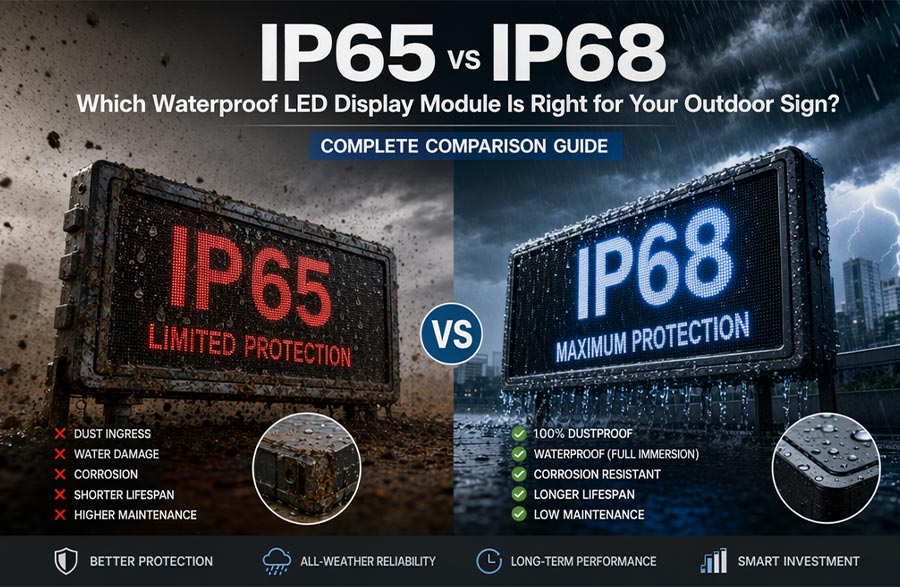
Both IP65 and IP68 score "6" (dust-tight). Dust protection is not the differentiator for outdoor signage. Fine particulate matter, sand, and pollution are completely blocked by both ratings.
-
Second digit (liquids): This is where performance diverges significantly.
-
IP65: Protected against low-pressure water jets from any direction. Tested with 12.5mm nozzle at 30kPa pressure from 3 meters distance. Suitable for standard rain and occasional splashes.
-
IP68: Designed for continuous submersion under specified depth and pressure. Manufacturers must declare exact depth (typically 1-3 meters for signage) and duration. Handles driving rain, standing water, and high-humidity climates.
-
Testing vs. Reality:
Lab ratings use controlled, clean water at room temperature with no wind, UV exposure, or thermal cycling. Field conditions introduce wind-driven rain at 60+ mph, temperature extremes from -30°C to +50°C, chemical pollutants, salt spray, and mechanical stress that labs do not replicate.
-
Manufacturer Variance:
Not all IP68 modules are equal. Sealing methods vary dramatically: some use silicone gaskets, others use potting compounds, and premium units combine both. Potting quality, venting design, connector sealing, and housing material determine actual field performance. Always request third-party test certificates rather than accepting self-declared ratings.
-
The IP67 Middle Ground: