

2024-08-26
The structure of LED strip lights
LED strip lights are known for their slim design, flexibility, and efficient lighting performance. But what exactly makes up an LED strip light? Understanding the structure of LED strip lights helps us better appreciate their functionality, durability, and how to choose the right type for different applications. From the LED chips and PCB board to the resistors, adhesive backing, and protective coating, each component plays a vital role in delivering stable and long-lasting illumination. In this article, we’ll break down the structure of LED strip lights and explain the purpose of each part in detail.
1. LED
The core part of LED strips is the LED lamp beads, LED is an electronic component, it can be converted into light energy, at the same time has a high efficiency, low energy consumption, long life and so on. Most of the LED light strips on the market today use LED light beads as the light source. The difference is that LED light beads are available in different brightness, colours and sizes.
LED (Light Emitting Diode), a light-emitting diode, is a solid-state semiconductor device that can convert electrical energy into visible light. It can directly convert electricity into light. The heart of the LED is a semiconductor chip. One end of the chip is attached to a bracket, one end is the negative pole, and the other end is connected to the positive pole of the power supply, so that the entire chip is encapsulated by epoxy resin. LED can directly emit red, yellow, blue, green, cyan, orange, purple, and white light.
There are many categories of SMD lamp beads. We can classify them by size, color, or model and purpose.
SMD patch lamp beads are divided into the following categories according to size. The numbers of these models represent their width and length:
SMD2835: 28x35mm
SMD3528: 35x28mm
SMD2216: 22x16mm
SMD2210: 22x10mm
SMD5050: 50x50mm
SMD5730: 57x30mm
SMD3014: 30x14mm
SMD315: 3x15mm
SMD patch lamp beads are divided into the following categories according to size. The numbers of these models represent their width and length:
SMD2835: 28x35mm
SMD3528: 35x28mm
SMD2216: 22x16mm
SMD2210: 22x10mm
SMD5050: 50x50mm
SMD5730: 57x30mm
SMD3014: 30x14mm
SMD315: 3x15mm
SMD LED Lamp beads, according to the light-emitting colour, can be divided:
Colorful series, breakpoint series, fantasy series, SMD white series, SMD red series, SMD orange series,SMD yellow series, SMD blue series, SMD violet series, RGB series, dual-colour (red-orange, red-green) and so on.
Colorful series, breakpoint series, fantasy series, SMD white series, SMD red series, SMD orange series,SMD yellow series, SMD blue series, SMD violet series, RGB series, dual-colour (red-orange, red-green) and so on.
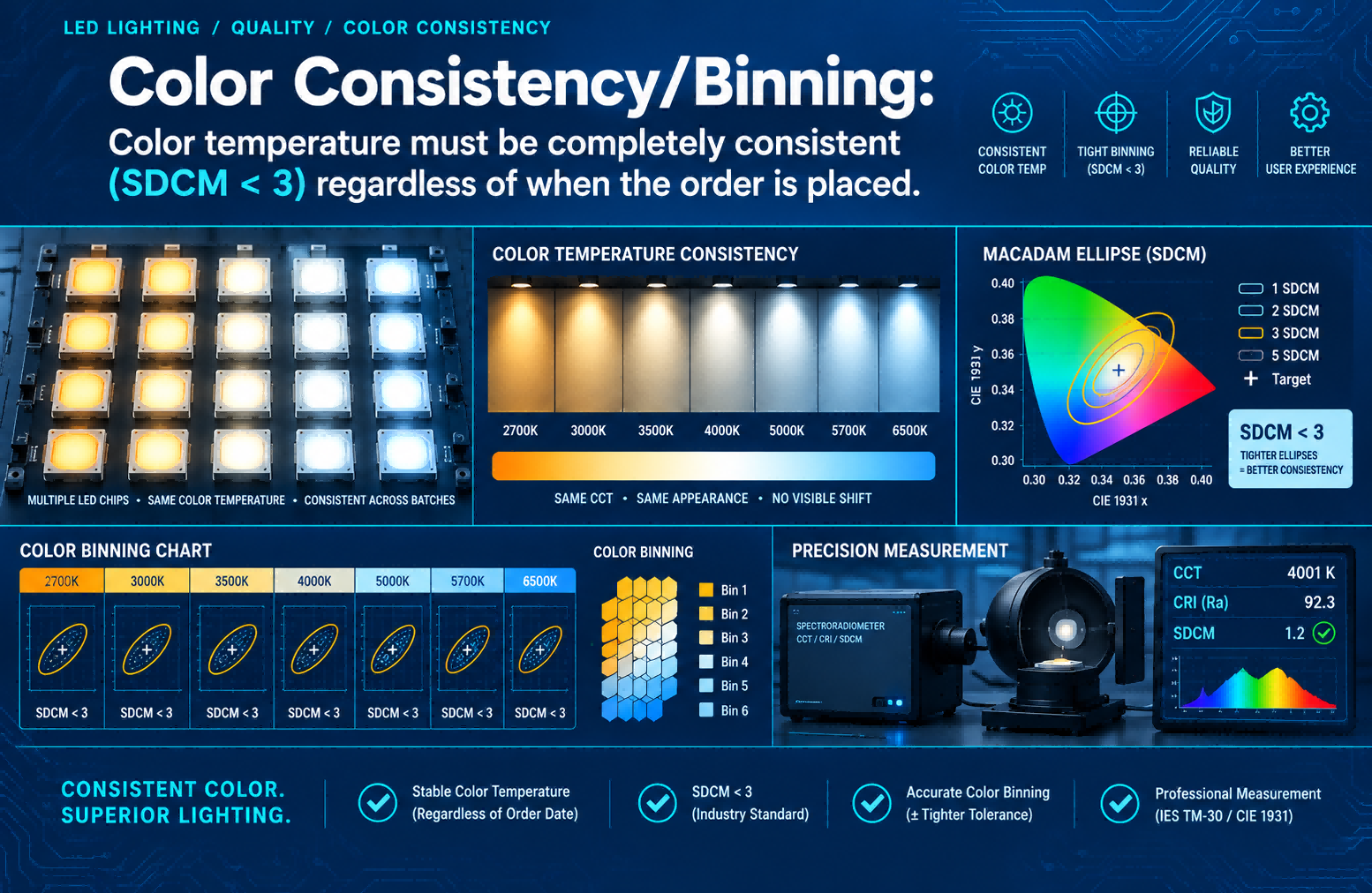
LED light beads have a variety of colours, the more common are white, red, green, blue, white, yellow, purple and so on. The white light includes warm white, natural than, positive white, cold white, colour temperature 2500K, 2700K, 3000K, 4000K, 5000K, 6500K, 10000K and so on.
The color diversity of LED lamp beads comes from the fact that their internal chips can emit light of different wavelengths. For example,
red LED lamp beads emit red light with a wavelength of about 620-750 nanometers;
blue LED lamp beads emit blue light with a wavelength of about 450 nanometers
green LED lamp beads emit green light with a wavelength of about 500-550 nanometers;
yellow LED lamp beads emit yellow light with a wavelength of about 580-600 nanometers; purple LED lamp beads emit purple light with a wavelength of about 420-450 nanometers. These color classifications are based on the scientific principles of light wavelength and color perception.
The color diversity of LED lamp beads comes from the fact that their internal chips can emit light of different wavelengths. For example,
red LED lamp beads emit red light with a wavelength of about 620-750 nanometers;
blue LED lamp beads emit blue light with a wavelength of about 450 nanometers
green LED lamp beads emit green light with a wavelength of about 500-550 nanometers;
yellow LED lamp beads emit yellow light with a wavelength of about 580-600 nanometers; purple LED lamp beads emit purple light with a wavelength of about 420-450 nanometers. These color classifications are based on the scientific principles of light wavelength and color perception.
In addition, LED lamp beads can also produce more colors by combining chips of different colors. For example, red, green and blue primary color LED lamp beads can produce rich colors, including full color, by mixing in different proportions. This technology takes advantage of the principle of three primary colors, that is, the human visual system is particularly sensitive to red, green and blue, and most visible light is made up of these three colors mixed in different proportions. By precisely controlling the brightness and chromaticity of each color, accurate color adjustment and display can be achieved.
With the rapid development of modern technology, LED (Light Emitting Diode) has become an important light source widely used in LED strip, lighting, signal and other fields. In the field of LED light strips, the accuracy and effect of color reproduction has become an important indicator, among which light strip color index is one of the important indicators for evaluating the color reproduction ability of LED lighting strip.
Color Rendering Index, referred to as CRI, is an indicator used to measure the ability of light source to restore the color of an object. Generally speaking, it is the ability of the human eye to compare the color of the object perceived by the light source when it is irradiated on the object with the color seen under natural light. The value range of CRI is between 0 and 100. The larger the value, the stronger the ability of the light source to restore the color and the more realistic the color.
Color Rendering Index, referred to as CRI, is an indicator used to measure the ability of light source to restore the color of an object. Generally speaking, it is the ability of the human eye to compare the color of the object perceived by the light source when it is irradiated on the object with the color seen under natural light. The value range of CRI is between 0 and 100. The larger the value, the stronger the ability of the light source to restore the color and the more realistic the color.
Light strips CRI value is affected by many factors, mainly including the following:
1. Light source spectral distribution: different LED light source has a different spectral distribution, the spectral distribution is closer to natural light, the better the colour reproduction ability.
2. Light-emitting colour temperature: LED light-emitting colour temperature has an important impact on the colour reproduction ability, in general, the light-emitting colour temperature is closer to daylight, the better the colour reproduction ability.
3. Colour saturation: the higher the colour saturation, the better the colour reproduction ability.
4. Light source brightness: light source brightness for colour reproduction also has a certain impact, too low or too high brightness may lead to a decline in colour reproduction ability.
2. Light-emitting colour temperature: LED light-emitting colour temperature has an important impact on the colour reproduction ability, in general, the light-emitting colour temperature is closer to daylight, the better the colour reproduction ability.
3. Colour saturation: the higher the colour saturation, the better the colour reproduction ability.
4. Light source brightness: light source brightness for colour reproduction also has a certain impact, too low or too high brightness may lead to a decline in colour reproduction ability.
The luminous efficiency of lighting strips, that is, luminous efficiency, refers to the ratio of the luminous flux emitted by the light source to the power consumed, and is a key indicator to measure the energy-saving performance of the light source. Luminous efficiency reflects the ability of the light source to convert energy into electromagnetic radiation and the efficiency of the human eye's perception of this radiation.
Luminous flux of strip LED lights refers to the radiant power that the human eye can perceive, which is the product of the radiant energy of a certain band per unit time and the relative visibility of the band. Since the relative visibility of the human eye to light of different wavelengths is different, when the radiation power of light of different wavelengths is equal, the luminous flux is not equal. The unit of luminous flux is lumen (lm), and 1 lumen is equal to the luminous flux emitted by a point light source with a uniform luminous intensity of 1 candela (cd) in a solid angle of 1 steradian (sr).
Luminous flux of strip LED lights refers to the radiant power that the human eye can perceive, which is the product of the radiant energy of a certain band per unit time and the relative visibility of the band. Since the relative visibility of the human eye to light of different wavelengths is different, when the radiation power of light of different wavelengths is equal, the luminous flux is not equal. The unit of luminous flux is lumen (lm), and 1 lumen is equal to the luminous flux emitted by a point light source with a uniform luminous intensity of 1 candela (cd) in a solid angle of 1 steradian (sr).
Brightness of LED strip lighting is a physical quantity that describes the luminous intensity of the surface of a luminous body. It is defined as the ratio of the light intensity in this direction to the area of the light source "seen" when the human eye observes the light source from one direction, that is, the luminous intensity per unit projection area. Brightness is represented by the symbol L, and the unit is candela per square meter (cd/m²). The brightness of a light source is related to its surface area. Under the same luminous intensity, the larger the luminous area, the lower the brightness; vice versa. The brightness is also related to the direction of the luminous surface. The brightness values of the same luminous surface in different directions are different, and are usually measured in the direction perpendicular to the line of sight.

2. PCB board
PCB (Printed Circuit Board) is the carrier of strip lighting, which can be cut into different lengths as needed. PCB often has some lines or text printed on it, which is usually completed by etching or printing during the production process.
Common PCB boards are divided into single-sided boards and double-sided boards. Single-sided boards and double-sided boards are two different manufacturing processes and designs of circuit boards. Single-sided boards have only one layer of circuit traces, while double-sided boards have two layers of circuit traces. Single-sided boards are suitable for simpler circuits and have low manufacturing costs, but the number and complexity of circuit connections are limited; while double-sided boards can greatly increase the number and complexity of circuit connections. All ADLED light strips use double-sided boards.
Common standard PCB sheet copper thicknesses for flex LED strip lights include 1oz, 2oz, 3oz, and 4oz. Among them, 2oz is the most commonly used, which can ensure the softness of strip lights and also ensure good heat dissipation of best LED strip lights. Some best LED tape also use 3oz PCB boards.
According to the width, the PCB board of good LED strip lights can be divided into 2mm, 3mm, 4mm, 4.5mm, 5mm, 6mm, 8mm, 10mm, 12mm, 13mm, 15mm, 20mm, 30mm, 40mm.
The color of the PCB board of LED tape light is usually white, black, and gold.
The color selection of the PCB board of strip lighting mainly depends on its usage scenario and design requirements. Black PCB board performs well in some applications due to its unique visual effect and stability. For example, black PCB board can provide a better visual experience under certain lighting effects, especially in applications that need to hide the line or enhance certain lighting effects. In addition, black PCB board may be more suitable for certain design styles or themes visually.
The color selection of the PCB board of strip lighting mainly depends on its usage scenario and design requirements. Black PCB board performs well in some applications due to its unique visual effect and stability. For example, black PCB board can provide a better visual experience under certain lighting effects, especially in applications that need to hide the line or enhance certain lighting effects. In addition, black PCB board may be more suitable for certain design styles or themes visually.
On the other hand, white PCB board is becoming more and more popular in some applications due to its clean and simple appearance. White PCB board can provide better visibility and contrast, especially when it is necessary to emphasize the clarity of the line or provide better visual effects, white PCB board is a good choice.
Gold PCB boards were mostly used in the early days of tape lights or in the low-end market, but are now gradually being eliminated by the market.
The connection method of components on the circuit board usually uses parallel and series connection. The connection method formed by the components arranged side by side is calLED parallel connection. In parallel connection, there is no influence of mutual connection between components, and they operate independently.
The connection method formed by components arranged one after another is calLED series connection. In series connection, all components must share the current and voltage in the circuit, so the total resistance of series components will be higher than the total resistance of parallel components. Parallel and series connection also affect the resistance, current and voltage of the circuit.
The connection method formed by components arranged one after another is calLED series connection. In series connection, all components must share the current and voltage in the circuit, so the total resistance of series components will be higher than the total resistance of parallel components. Parallel and series connection also affect the resistance, current and voltage of the circuit.
3. Circuit design
The circuit of low voltage LED light strips usually includes 12v LED tape light and 24v strip light. The voltage of constant voltage flexible LED strip is stable. For example, for 12v LED strip light, the input voltage cannot be 5V or 15V. 5V voltage is too low and 12v LED ribbon lights will not light up. 15v will cause 12 volt DC LED strip lights to burn out.
4. Resistor
Resistor, generally referred to as resistor, refers to all electronic or electrical components used to generate resistance. The operation of a resistor follows Ohm's law, and its resistance value is defined as the quotient obtained by dividing its voltage by its current.
5. Adhesive
Soft LED strip lights uses a special adhesive material, whose main function is to firmly stick the best quality LED strip to a fixed object so that it can play a normal lighting role. The commonly used adhesive material for flexible light strips on the market is 3M adhesive.
3M adhesive is an adhesive material with excellent adhesion and high temperature tolerance, which can maintain long-lasting adhesion in various environments. Its thickness and strength can be customized according to customer needs to meet different application requirements.
3M adhesive is an adhesive material with excellent adhesion and high temperature tolerance, which can maintain long-lasting adhesion in various environments. Its thickness and strength can be customized according to customer needs to meet different application requirements.
6. Shell
The shell is used to protect smd LED strip, and it is also a key part to beautify and increase the application scene. Common materials include PVC, silicone, etc. Different shell materials can bring different light transmission effects and waterproof performance, and should be selected according to actual needs.
IP65 PU: Waterproof Covered PU Glue
IP65 US: Waterproof Covered Ultra Slim Silicone Glue
IP65 SI: Waterproof Covered Silicone Glue
IP65 HT: Waterproof Heat Shrink Tube
IP67 ST: Waterproof Covered Silicone Tube
IP67 HI: Waterproof Hollow Integrated Silicone Glue
IP68 ST: Waterproof Solid Integrated Silicone Glue
IP65 US: Waterproof Covered Ultra Slim Silicone Glue
IP65 SI: Waterproof Covered Silicone Glue
IP65 HT: Waterproof Heat Shrink Tube
IP67 ST: Waterproof Covered Silicone Tube
IP67 HI: Waterproof Hollow Integrated Silicone Glue
IP68 ST: Waterproof Solid Integrated Silicone Glue
In general, the structural design and material selection of smd led strip light directly affect their performance, service life and applicable scenarios. Choosing a suitable LED flex light strip requires considering the use environment, installation method and required lighting effect.