

The Importance of CRI 95+ and R9 Values in Backlit Acrylic for Retail, Gallery, and Jewelry Lighting
The Importance of CRI 95+ and R9 Values in Backlit Acrylic for Retail, Gallery, and Jewelry Lighting
In high-end architectural acrylic backlighting, light quality dictates product presentation and customer perception. When designing an illuminated translucent counter, a museum display case, or a luxury showcase, translucent acrylic paneling acts as a primary optical diffuser. While acrylic provides smooth diffusion, it creates an optical barrier that alters color fidelity and shifts spectral distribution.
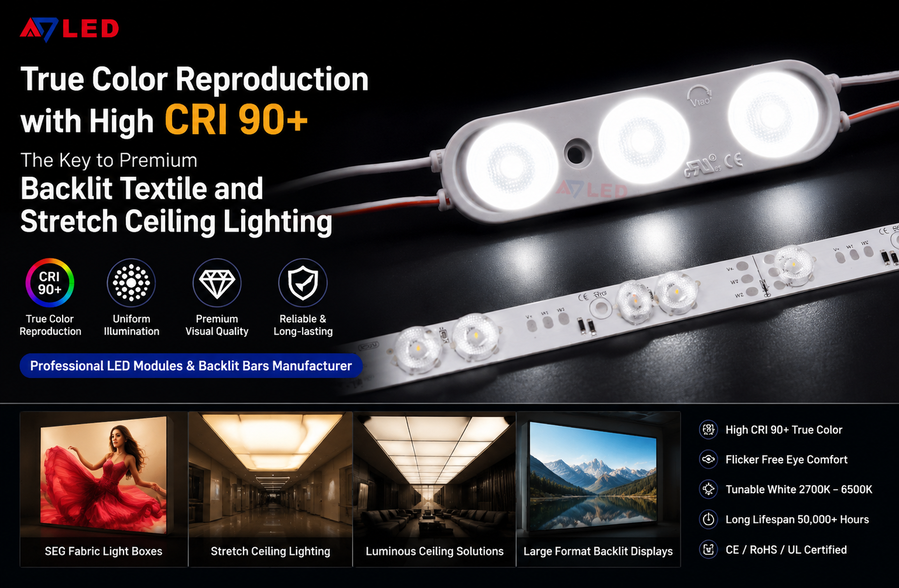
For lighting specifiers, interior contractors, and commercial fixture manufacturers, choosing an unrated LED source leads to muted colors, flat textures, and compromised gemstone fire. Achieving true color rendering behind translucent media requires high general color rendering and targeted saturated red output. Integrating a cri 95+ LED light sheet with high r9 value in acrylic backlighting ensures vivid color retention across commercial retail showcase lighting, art gallery backlighting design, and luxury display backlighting installations.
1. The Hidden Challenge: How Acrylic Diffusion Distorts Color Fidelity and R9 Spectrum
Architectural acrylic diffusers, frosted opal sheets, translucent resin panels, and synthetic quartz surfaces scatter light rays to eliminate direct diode glare and generate uniform surface illumination. However, the physical and optical properties of acrylic resins—specifically polymethyl methacrylate (PMMA)—selectively absorb, refract, and scatter different wavelengths across the visible light spectrum.
This optical transmission curve causes a noticeable spectral shift. Warm wavelengths—specifically saturated red (represented by the r9 value in acrylic backlighting metric) and deep skin tones (r15)—suffer attenuation as light passes through thick or dense diffusion sheets.
- Spectral Absorption: Standard diffuser materials attenuate longer wavelengths in the 610–700 nm region faster than cooler blue wavelengths, depressing the effective color rendering index of the output light.
- Color Shift: A low-CRI backlight behind translucent acrylic causes warm-toned merchandise to appear dull, desaturated, or grayed out.
- Light Scattering Loss: Without a high-density, full spectrum LED light sheet, achieving uniform acrylic backlighting requires thicker diffusers, which exacerbates optical loss and further distorts the transmitted color fidelity backlight module performance.
Material Thickness and Optical Density Impact
Different grades and thicknesses of acrylic panels impact light transmission differently. For example, a 3mm opal acrylic sheet typically allows 30% to 45% light transmission, while a 6mm or 10mm frosted slab reduces transmission significantly while shifting the color temperature toward the cool blue spectrum.
When light encounters titanium dioxide (TiO2) particles embedded within diffusing acrylic to scatter light, these microscopic particles reflect blue light more efficiently than red light (a phenomenon similar to Rayleigh scattering). As a result, warm spectral components emitted by the light source are lost internally.
For high end retail lighting supplier and museum grade LED supplier teams, overcoming this optical barrier requires an engine with an over-engineered spectral distribution. Standard CRI 80 or CRI 90 light engines are insufficient; only a source calibrated with cri 95+ LED light sheet technology and r9 > 80 maintains true color rendering after transmission through backlit acrylic light panel surfaces.
2. Why High R9 Value in Acrylic Backlighting is Critical for Gemstones, Fine Art, and Luxury Goods
Color Rendering Index (CRI Ra) measures how accurately a light source reveals colors relative to a natural light source, averaged across the first eight pastel test color samples (R1 to R8). However, CRI Ra ignores vibrant, saturated colors.
The r9 value in acrylic backlighting metric measures saturated red rendering. Because red wavelengths are essential for rendering gold, rose gold, gemstones, oil paintings, leather goods, and human skin tones, a low r9 value directly damages visual presentation in luxury retail showcase lighting and gallery panel installations.
| Metric Index | Standard Commercial | High CRI Requirement | Impact Behind Acrylic |
|---|---|---|---|
| CRI Ra (R1-R8) | Ra 80 - Ra 90 | Ra 95+ | Overall color neutrality |
| R9 (Saturated Red) | R9 0 - R9 50 | R9 80 - R9 95 | Gold/Ruby warmth & luster |
| R15 (Skin Tones) | R15 < 70 | R15 90+ | Luxury leather & cosmetics |
| TM-30 Rf / Rg | Rf 80 / Rg 90 | Rf 95+ / Rg 100+ | Color fidelity & saturation |
TM-30-18 Evaluation: Beyond Traditional CRI Metrics
Modern lighting specifiers increasingly rely on the IES TM-30-18 system, which evaluates color fidelity (Rf) and color gamut (Rg) across 99 individual color evaluation samples (CES). While traditional CRI Ra can be artificially inflated by boosting green or yellow spectrums, TM-30 provides a complete 360-degree color vector graphic.
In acrylic backlighting applications, an Rf ≥ 95 and an Rg ≈ 100 ensure that the color saturation curve does not collapse after light passes through dense diffusers. A high tm-30 LED light sheet ensures that saturated colors remain in their true spatial coordinates without desaturation or hue shifting.
Impact on High Jewelry and Gemstones
In a high jewelry showcase lighting setup, diamonds, gold display light sheet setups, and ruby displays depend on full spectrum LED light sheet illumination. Gold alloys contain subtle copper and red undertones. If illuminated by a backlight with an inferior r9 value in acrylic backlighting, gold appears brassy or pale, while rubies and garnets lose their inner saturation.
Impact on Fine Art and Museum Displays
In gallery wall backlighting and illuminated artwork panel installations, pigments like cadmium red, vermilion, and deep ochres degrade visually under low R9 light sources. High tlci gallery lighting and high tm-30 LED light sheet specifications ensure that art installations receive zero color shift LED backlight transmission, preserving the artist's intended color balance.
Impact on Luxury Goods and Leather
High-end retail store fixture lighting relies on rich visual texture. Leather handbags, cosmetics, and luxury watch cabinet backlighting look supple and vibrant when illuminated by high r15 skin tone LED light engines emitting a balanced r9 saturated red LED spectrum.
3. Maximizing Visual Brilliance: Why Use a CRI 95 LED Light Sheet for Jewelry Displays?
Jewelry display cases present strict physical and optical requirements. Space inside a luxury display case or backlit acrylic store fixture is constrained, preventing the use of bulky fixtures. A cri 95 LED light sheet for jewelry displays provides an ideal optical engine for compact, high lux display backlighting.
Eliminating Hotspots in Shallow Cavities
Traditional linear LED tape installed in shallow display boxes creates visible dots and hot spots unless placed at a considerable distance from the acrylic diffuser. An ultra thin LED backlighting sheet utilizes a matrix LED backlighting sheet design with closely spaced surface-mount diodes. This matrix structure achieves dotless LED backlighting with optical depths as shallow as 15 mm to 20 mm.
Precision Color and Temperature Selection
Jewelry types require specific color temperatures to maximize sparkle, contrast, and luster:
- 6000K jewelry display light: Enhances the fire, contrast, and scintillation of platinum, silver, and white diamonds.
- 3000K luxury retail backlight / 2700K warm white LED sheet: Highlights yellow gold, rose gold, and warm gemstones like topaz and amber.
- cct tunable LED light sheet / tunable white backlighting panel: Allows curators and retail staff to dynamically adjust color temperature via DALI or 0-10V control systems, adapting the showcase to specific collections.
Integrating a cuttable flexible LED sheet directly into an illuminated jewelry pedestal or diamond showcase backlight panel maximizes lux output while keeping internal thermal build-up low, protecting delicate jewelry pieces from heat degradation.
4. Selecting the Right Backlit LED Strip for Gallery Panel and Museum Display Cases
While matrix sheets excel in surface illumination, large-scale museum exhibition lighting solutions and architectural backlit walls often utilize a combination of rigid and flexible linear engines. Specifying a backlit LED strip for gallery panel applications requires balancing intensity, run length, and spectral stability over time.
Large-Scale Wall Wash and Panel Lighting
For art gallery backlighting design, translucent art backlighting, and large-scale backlit translucent stone or illuminated onyx display panel installations, lighting designers use rigid backlit LED strip configurations mounted inside deeper perimeter cavities. These strips feature specialized optical TV backlight lenses (160° to 175° wide-beam angles) that pitch light broadly across the back of the panel, drastically reducing the number of strips required while delivering smooth, homogeneous light distribution.
Museum-Grade Spectral Safety
Museum exhibit display LED light sheet and strip systems must protect sensitive artifacts from degradation:
- Museum Grade UV-Free Backlight: High-quality commercial LED backlighting systems emit zero ultraviolet (UV) or infrared (IR) radiation, preventing non fading artwork lighting damage over thousands of hours of operation.
- Precise Color Consistency: Utilizing 2-step or 3-step MacAdam ellipse binning ensures zero visible color deviation between adjacent gallery exhibit lighting strip panels.
- High-Efficiency Driver Integration: Constant current LED sheet designs protect sensitive museum installations against voltage fluctuations, flickering, and micro-strobe effects.
5. Flexible LED Sheet vs. Rigid Backlit Strip: Choosing the Optimal Acrylic Backlighting LED Sheet
Selecting between a flexible LED panel for acrylic and a rigid backlit LED strip depends on mechanical constraints, cavity depth, and project scale. B2B commercial lighting specifiers and trade fixture contractors evaluate both form factors based on site specifications.
| Architectural Parameter | Flexible LED Light Sheet | Rigid Backlit LED Strip |
|---|---|---|
| Optimal Optical Depth | Ultra-shallow (10 mm - 30 mm) | Medium to Deep (50 mm - 150 mm) |
| Surface Adaptability | Curved, 3D, Column, Spherical | Flat, Linear, Planar Surfaces |
| Custom Trimming | 2D Cuttable at every single diode | Linear cut points (every 50mm) |
| Mounting Mechanics | 3M Adhesive, Screws, Staples | Aluminum Channel, Clips, Screws |
| Primary Application | Jewelry counters, curved acrylic | Large gallery walls, lightboxes |
When to Specify a Flexible LED Light Sheet
A paper thin LED light sheet or bendable LED light panel is designed for complex, shallow, or curved spaces.
- 2D Cuttable Flexibility: An acrylic backlighting LED sheet can be cut into custom geometric shapes along pre-printed grid lines without breaking the internal circuit. This allows seamless installation around structural pillars, corners, and irregular retail display shapes.
- Curved Acrylic Backlighting: For curved counters, columns, and 3D retail fixture illumination, a flexible PCB LED sheet curves around tight radii down to 20 mm without micro-cracking solder joints.
- Ultra-Shallow Cavities: Due to its paper-thin profile (under 2 mm thickness), a modular backlit LED tile or matrix sheet sits directly against the base board in ultra-thin backlit frame profiles.
When to Specify a Rigid Backlit LED Strip
Rigid backlit LED strips are engineered for flat, long-run, high-intensity applications:
- Large Planar Backlighting: Architectural backlit walls, trade show booth backlighting, and commercial backlit counter designs benefit from rigid aluminum-backed strips that offer enhanced thermal dissipation and physical structural rigidity.
- Deep Optical Cavities: When optical cavity depth exceeds 50 mm, rigid strips utilizing wide-angle optical lenses provide uniform acrylic backlighting at lower material costs per square meter.
6. Key Technical Specifications for Commercial Acrylic Backlighting: 24V, Zero Hotspots, and Thermal Control
Engineering a reliable, commercial-grade architectural acrylic backlighting system requires adherence to strict electrical, thermal, and optical parameters.
1. Voltage Standardization & Low Voltage Safety
Low voltage dc24v sheet systems are standard in commercial installations. Compared to 12V systems, 24v LED light sheet layouts reduce operating current by half, minimizing line loss, thermal buildup, and voltage drop across continuous backlighting runs. Class 2 power LED sheet compliance ensures safe installation inside enclosed showcase cavities.
2. Optical Uniformity and Pitch-to-Depth Ratio
Achieving zero hotspot backlighting requires calculating the ratio between LED diode pitch (P) and the optical distance (D) to the acrylic diffuser. To maintain dotless, homogeneous light distribution, the distance from the diode emitting surface to the acrylic panel (D) should equal or exceed the distance between individual LEDs (P). When D ≥ P, light cones overlap smoothly beneath the acrylic sheet. High density LED backlighting matrix designs keep P small (often under 10 mm to 15 mm), allowing optical cavities as thin as 15 mm.
3. Thermal Management and Lifespan
Heat buildup degrades LED lifespan, accelerates lumen depreciation, and induces color shift over time.
- Heavy Copper PCB Substrate: Commercial-grade LED backlighting matrix engines utilize 2oz or 3oz rolled copper flexible printed circuit boards (FPC) to distribute heat across the entire sheet surface.
- Low Heat Generation: Operating high-efficiency LEDs at lower drive currents yields low heat LED light sheet performance, reaching a long lifespan LED sheet rating of over 50,000 hours to L70 standards.
4. Installation Mechanics and Maintenance
Commercial contractors prefer systems that streamline job-site assembly:
- Pre-Applied Thermal Adhesive: Quality light sheets incorporate high-tack double sided tape LED sheet backings on the rear FPC layer, enabling rapid peel-and-stick application to metal backplates.
- Plug-and-Play Interconnects: Integrated quick-connect terminal blocks allow installer teams to bridge adjacent light sheets or rigid strips without field soldering, drastically lowering field labor costs.
5. International Regulatory and Safety Compliance
Commercial lighting specifier solutions and architectural projects require certified components to pass electrical inspections and code compliance:
- North America: UL listed LED light sheet, ETL listed light panel, FCC approved LED backlighting, and Title 24 compliant lighting options.
- Europe & Global: CE certified LED backlight, UKCA certified LED panel, RoHS compliant LED sheet, REACH compliant LED sheet, and CB certified backlight sheet certifications.
- Ingress Protection: Indoor showcase projects utilize ip20 indoor LED light sheet versions, while wet-location counters, outdoor signage, or water-feature integration require ip65 waterproof LED sheet or ip67 outdoor backlight panel specifications.
7. Partner with ADLED: Your Trusted 13-Year Flexible LED Light Sheet Manufacturer for OEM/ODM Projects
Executing complex high-end retail, gallery, and jewelry lighting projects requires more than off-the-shelf components; it demands an experienced manufacturing partner.
As a 13 year LED factory China based in Shenzhen, ADLED (//www.adledlights.com/) is a professional flexible LED light sheet manufacturer, direct factory LED light sheet supplier, and trusted LED light sheet vendor serving global lighting distributors, engineering contractors, and OEM brand partners.
Engineering and OEM/ODM Capabilities
- Custom Size & Grid Tailoring: As a custom size LED light sheet factory, ADLED produces bespoke LED backlighting panel units tailored to exact showcase dimensions, equipped with thermal-rated mounting backing or screw holes.
- Spectral Customization: ADLED offers custom CCT matching (2700K to 6500K), cct tunable LED light sheet matrices, and specialized high R9 saturated red formulations for jewelry display case backlighting and museum display case backlight applications.
- Rigorous Quality Control: Every high quality LED factory lot undergoes integrating sphere testing, thermal imaging checks, and 100% burn-in testing to verify lumen output, color consistency, and optical uniformity.
Whether you require a custom backlit LED light sheet layout for a cosmetic display acrylic backlight, an illuminated onyx display panel in a luxury hotel lobby, or bulk LED light sheet orders for global retail rollouts, ADLED delivers factory-direct engineering, trade-price value, and technical specifier support.
Elevate your next backlighting project with true spectrum accuracy. Request a custom quote or engineering specification sheet from ADLED today to discover how our high-CRI, high-R9 flexible LED light sheet and backlit strip solutions bring commercial illuminated acrylic panels to life.
Frequently Asked Questions (FAQ) for Specifiers, OEMs & Contractors
Q: Why is high R9 essential when backlighting acrylic in luxury jewelry display cases?
Standard LED lights often suppress saturated red light. When light passes through translucent acrylic diffusers, longer red wavelengths undergo natural optical attenuation. A low R9 VALUE (below 50) renders gold pale, copper brassy, and rubies grayed out. Our CRI 95+ light sheets deliver an R9 > 80 (up to 95), ensuring that deep red hues, warm gold alloys, and vibrant gemstones maintain rich saturation and natural color fidelity after passing through acrylic media.
Q: How do I calculate the pitch-to-depth ratio to eliminate hotspots in shallow jewelry pedestals?
To achieve a completely HOTSPOT-FREE, dotless illumination behind translucent acrylic, the distance (D) from the LED diode to the acrylic surface must be equal to or greater than the LED pitch distance (P) between individual diodes (D ≥ P). For shallow display boxes with an optical cavity depth of only 15mm to 20mm, our high-density MATRIX LED LIGHT SHEET features tight diode spacing, allowing uniform light diffusion without dark zones or shadow lines.
Q: What CCT (Correlated Color Temperature) is recommended for high jewelry display backlighting?
We recommend tailored CCT selection based on the gemstone type:
- 6000K Cool White: Accentuates the fire, scintillation, and brilliance of diamonds, platinum, and silver jewelry.
- 3000K / 2700K Warm White: Enhances the deep luster of 18K yellow gold, rose gold, amber, and warm-toned gemstones.
- TUNABLE WHITE (2700K–6500K): Integrates with DALI or 0-10V dimming systems, allowing retailers to adjust color temperature on demand for rotating seasonal collections.
Q: How do your backlighting engines perform under TM-30-18 color evaluation standards?
Traditional CRI Ra only averages eight pastel colors, which can conceal gaps in the light spectrum. Our museum-grade LED engines are tested under TM-30-18 standards, achieving a Color Fidelity Index (Rf ≥ 95) and Color Gamut Index (Rg ≈ 100) across 99 color evaluation samples. This guarantees zero color shift, preserving the precise pigment balance of oil paintings, historic textiles, and translucent artwork panels.
Q: Are ADLED light sheets safe for museum artifacts sensitive to light damage?
Yes. Our full-spectrum LED engines produce a UV-FREE and IR-FREE light output, eliminating harmful ultraviolet ray degradation and thermal infrared beam stress. Combined with FLICKER-FREE constant current drivers, our systems satisfy strict museum exhibition lighting mandates and prevent long-term artwork fading.
Q: How do you guarantee color consistency across large illuminated gallery walls?
We enforce strict SDCM (Standard Deviation Color Matching) controls within a 2-STEP / 3-STEP MACADAM ELLIPSE binning standard. Whether using flexible light sheets or rigid backlit LED strips across expansive backlit onyx or acrylic walls, every panel delivers identical color temperature without visible tint variation between adjoining tiles.
Q: Can your flexible LED sheets be cut and shaped on-site for custom display fixtures?
Yes. Our FLEXIBLE LED LIGHT SHEET features a modular, 2D CUTTABLE printed circuit design. Contractors can trim the sheet with scissors along designated cut lines—by diode block or square grid—without breaking the electrical loop. This enables seamless field fitting around curved pillars, angular showcases, and irregular architectural counter shapes.
Q: What safety certifications and compliance standards do your LED products meet for import?
As a 13-year direct factory manufacturer, ADLED products carry complete international compliance for global distribution:
- North America: UL LISTED, ETL LISTED, FCC CERTIFIED, and California TITLE 24 high-efficacy compliant.
- Europe & International: CE CERTIFIED, UKCA MARKED, RoHS COMPLIANT, and CB TESTED.
- Ingress Protection: Standard IP20 for indoor retail cabinets, and silicone-encapsulated IP65 / IP67 for high-humidity display environments.
Q: What are the thermal specs and expected lifespan of your DC24V light sheets?
Our sheets are constructed with heavy-duty 3oz ROLLED COPPER FPC (Flexible Printed Circuit) layers that rapidly conduct heat across the substrate, maintaining low operating temperatures. Powered by low-voltage DC24V Class 2 power sources, our LEDs achieve a rated lifespan of over 50,000 HOURS (L70) with minimal lumen depreciation and zero spectral shift over extended commercial use.
Q: What OEM/ODM customization services does ADLED provide for fixture manufacturers?
We provide comprehensive OEM/ODM factory solutions, including custom PCB dimensions, customized LED diode spacing (pitch), specialized spectrum tuning (custom CCT / R9 / TM-30 targets), pre-wired quick-connect terminal blocks, custom 3M thermal tape backings, and private-label packaging for global importers and distributors.