{当前产品的产品关键词轮巡使用}
2026-02-05

How to Choose LED Bar Lighting for Lightbox Advertising?

LED Bar Lighting Selection Guide for Lightbox Advertising

Unlike flexible LED strips that can bend and conform to curves, LED Bars are mounted on aluminum PCBs, offering superior heat dissipation, consistent brightness, and long-term reliability. This guide summarizes key considerations when selecting LED Bars for advertising lightboxes, helping you make informed decisions without getting lost in technical jargon.
LED bar light is usually used by advertising companies, who need to purchase a large number of light boxes for billboard production and installation. are also used in shopping malls and retail stores, where light box advertisements are regularly replaced for in-store displays and promotions. LED bars are also commonly seen in exhibitions, large-scale exhibitions and exhibition projects, where light boxes are used extensively for product display and promotion. LED module can even be used in municipal projects and urban public facilities such as light boxes for bus stops and subway station billboards.Of course, many lighting companies, such as retailers, exhibition company or distributors, also purchase a large quantity of LED backlight bars and edge lit LED bars. 
1.What is LED Bar for LED Light Box?
2.Lightbox Lighting Analysis: Back-lit vs. Edge-lit
3.Benefits of LED Bar for Lightbox Graphics
4.LED Light Bar Applications
5. Brightness (Lumens) and Uniformity Matter Most
6. Color Quality: CRI and CCT
7. Power Efficiency and Thermal Management
8.IP Rating for Environmental Protection
9 .Voltage Stability and Dimming Compatibility
10.Physical Dimensions and Mounting
11. Brand Consistency and Batch Matching
12.Total Cost of Ownership (Not Just Upfront Price)
13.Certification and Warranty
FAQ
Summary

1. What is LED Bar for LED Light Box?


LED bar for lightbox is a highly efficient light source designed to illuminate the interior of a lightbox, ensuring that the advertising images or logos inside the lightbox can be displayed clearly and brightly.

LED bar for display box light is usually divided into two types: side lit LED bar for double-sided lightboxes and backlit LED bar for single-sided light boxes. Not only can they be quickly installed inside the lightbox, but they can also provide a uniform visual effect, making the advertising content more attractive and visually impactful. Whether it is used for outdoor advertising or indoor display, LED bar for SEG printing is an ideal choice for achieving high-quality lighting effects. 
What is LED Bar for LED Light Box?

2. Lightbox Lighting Analysis: Back-lit vs. Edge-lit


In the actual project,the different structure of the advertising lightbox directly determines the arrangement of the LED light source.
 
Currently the mainstream lightbox lighting is divided into two categories.

Backlit Lightbox Lighting


A backlit rigid LED strip is used as the main light source of the light box. The LED strip is arranged on the back panel of the light box,and the lightpenetrates thediffusion clothor lightguideplatevertically to formahighuniformity of the front lighting.Suitable for lightboxes with thickness >3Omm. Combined with a wide-angle lens diffusion light bar (e.g.17o°), it can cover a larger area and reduce shadows and dark spots.
Backlit Lightbox Lighting

Edge-lit Lightbox Lighting


Edge-lit lightbox Lighting is a rigid edge-lit LED strip installed in the lightbox frame; the light spreads sideways with the help of light guide cloth or diffusion cloth, forming a soft and even light effect on the whole surface of the screen. It is suitable for a cloth light box with a thickness of 60-12omm.This kind of lightbox is suitable for hanging, wall-mounting, and other forms, which is very suitable for shopping mall guides, chain brand windows, booth lighting, and other application scenarios.
Edge-lit Lightbox Lighting
The following table summarizes the main differences between the two types of light boxes:
Comparison items
Light source position
Beam angle
design
Recommended light
box thickness
Typical application scenarios
Back-lit
light box
The strip is located at the
back of the screen
Wide angle lens
(170°)
≥30mm
Light box advertisement, window, station
light box, stretched ceiling
Edge-lit
light box
Stripes are arranged on both
sides of the frame
Narrow angle
lens (15x45°)
60-120mm
Fabric light box, shopping mall guide,
exhibition display system

3. Benefits of LED Bar for Lightbox Graphics

LED bar for exhibition lightboxes has the characteristics of low voltage operation, low heat generation and high safety, especially suitable for long-term use in public places. In addition, ADLED LED bar for banner light box uses a 1.6mm thick aluminum substrate, which has fast heat dissipation function and effectively extends the service life. With these advantages, LED bar has become an ideal choice in the fields of advertising, display and signage, which can significantly improve brand exposure and advertising effects.

Uniform Lighting


The LED bar for lightbox banner provides uniform brightness, ensuring that there are no dark areas or light spots on the advertising screen or logo in the light box, and the image is clear and the color is vivid.

ECO


Compared with traditional light sources, LED bar for LED light box frame have lower energy consumption and longer life, which not only reduces energy consumption but also reduces maintenance costs. In addition, LED bar for light box do not contain harmful substances and are more environmentally friendly.

Long Life


Modern LED bar for LED light box display have a lifespan of tens of thousands of hours, which reduces the frequency of replacement and related maintenance costs, and ensures the continuous and stable lighting effect of the light box.

Easy to Install and Maintain


LED bar for LED display boxes is simple in design and quick to install. It usually adopts a modular design, which is easy to replace and maintain, saving time and labor costs.

Strong Adaptability


LED Bar for fabric lightboxes can be customized according to different light box designs and is suitable for a variety of application scenarios, such as outdoor advertising, shopping mall displays, exhibitions, etc., to meet the needs of different sizes and shapes.

4. LED Light Bar Applications

Backlit LED bar & edgelit LED bar are an ultra-bright, energy-efficient and cost-effective lighting solution for light box and display lighting applications. LED bars are widely used in advertising lightboxes, whether it is a large outdoor billboard or a small indoor display light box, which can achieve uniform light distribution and enhance the visual effect of advertising content. In display signs, LED light bar are particularly suitable for brand display in places such as shopping malls, exhibitions and retail stores. In recent years, backlit LED strip has been widely used in stretch ceilings to provide soft and uniform indoor lighting. In addition, some architects also use backlight LED bars or edge lit LED bars for architectural landscaping lighting.
LED Light Bar ApplicationsLED Light Bar Applications

5. Brightness (Lumens) and Uniformity Matter Most

For advertising, uniform illumination is non-negotiable. Hotspots or dark zones distract viewers and reduce professionalism.
  • Look for LED Bars with high lumen output per meter (typically 1,500–3,000 lm/m for standard applications).
  • Choose models with diffused lenses or built-in secondary optics to spread light evenly.
  • For shallow lightboxes (<5 cm depth), opt for LED Bars with wide beam angles (120° or more) to minimize visible LED points.
Remember: higher brightness isn't always better—it must be balanced with diffusion and box design.

6. Color Quality: CRI and CCT

Color Rendering Index (CRI) measures how accurately a light source reveals true colors. For retail or brand-critical signage, aim for CRI ≥ 80 (ideally ≥90). Low-CRI lighting can make reds look brown or blues appear dull—damaging brand consistency.
Correlated Color Temperature (CCT) defines the "warmth" or "coolness" of white light:
  • 3000K–4000K: Warm to neutral white—ideal for hospitality or luxury branding.
  • 5000K–6500K: Cool white/daylight—best for high-visibility retail, transportation hubs, or modern aesthetics.
Stick to a single CCT across all LED Bars in one lightbox to avoid color mismatch.

7. Power Efficiency and Thermal Management

LED Bars are mounted on aluminum-core PCBs, which act as heat sinks. This design significantly improves lifespan compared to flexible strips.
  • Check power consumption per meter (e.g., 10W/m, 20W/m). Lower wattage with high lumens = better efficiency.
  • Ensure your power supply matches the total wattage and voltage (usually 12V or 24V DC).
  • Avoid overdriving LEDs—operating below max rated power extends life and reduces lumen depreciation.
A well-cooled LED Bar can last 50,000+ hours with minimal brightness loss.

8.IP Rating for Environmental Protection

LED Lights For Light Box 12V 24V 18LEDs 3030 Edge Lit LED Bar
If your lightbox is exposed to moisture, dust, or outdoor elements, Ingress Protection (IP) rating is critical:
  • IP20: Basic indoor use only—no protection against water or dust.
  • IP65: Protected against low-pressure water jets—suitable for covered outdoor areas or humid interiors (e.g., food courts).
  • IP67/IP68: Fully waterproof—ideal for direct outdoor exposure or washdown environments.
Note: Higher IP ratings often involve silicone coating or encapsulation, which may slightly reduce brightness but greatly enhance durability.

9. Voltage Stability and Dimming Compatibility

Most LED Bars run on constant voltage (12V or 24V). Key tips:
  • 24V systems experience less voltage drop over long runs, making them better for large lightboxes.
  • If dimming is needed (e.g., for nighttime reduction or ambiance), confirm compatibility with PWM (Pulse Width Modulation) or 0–10V dimming protocols.
  • Avoid cheap drivers—voltage fluctuations cause flickering and shorten LED life.
Always use a high-quality, UL/CE-certified power supply matched to your LED Bar's specs.

10. Physical Dimensions and Mounting

LED Bars come in standard lengths (e.g., 30cm, 60cm, 100cm) and widths (8mm–20mm). Consider:
  • Profile height: Must fit within your lightbox cavity without blocking diffuser panels.
  • Mounting holes/slots: Pre-drilled holes simplify installation on aluminum frames or back panels.
  • Cuttable sections: Some LED Bars allow cutting at designated points for custom sizing—verify before ordering.
  • Modular designs enable easy replacement if one segment fails.

11. Brand Consistency and Batch Matching

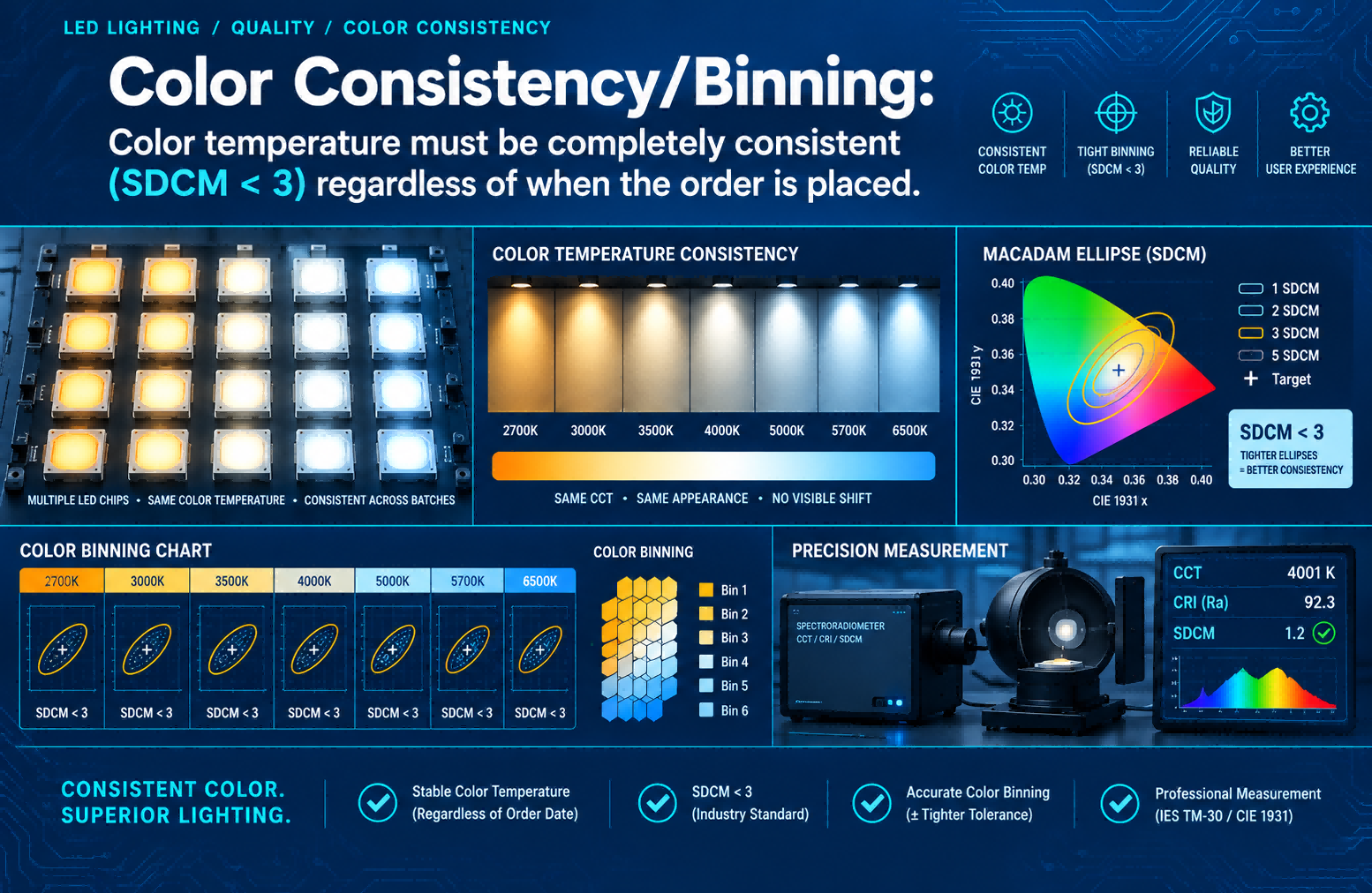
For multi-unit rollouts (e.g., chain stores), request binning data from suppliers. LEDs are manufactured in "bins" based on CCT and brightness. Using LED Bars from the same bin ensures visual uniformity across locations.
Ask for:
  • Same production batch number
  • Certified CRI and CCT values
  • Photometric reports (if available)
This prevents noticeable differences between lightboxes installed weeks apart.

12. Total Cost of Ownership (Not Just Upfront Price)

While LED Bars cost more upfront than flexible alternatives, they offer lower lifetime costs due to:
  • Longer lifespan (fewer replacements)
  • Lower energy use
  • Reduced maintenance (no re-taping or re-soldering)
Factor in labor, downtime, and electricity over 3–5 years—not just the purchase price.

13. Certification and Warranty

Reputable manufacturers provide:
  • Safety certifications (UL, CE, RoHS)
  • LM-80 or TM-21 reports for lumen maintenance
  • 3–5 year warranties
Avoid uncertified products—they may fail prematurely or pose fire risks.
By focusing on these ten practical factors, you can confidently select LED Bars that deliver brilliant, reliable, and efficient lighting for any advertising lightbox—without over-engineering or overspending.
Certification and Warranty

FAQ

1. Can I mix LED Bars and flexible LED strips in the same lightbox?

Technically yes, but not recommended. Differences in brightness, color temperature, and beam angle often create visible inconsistencies. Stick to one type for uniform results.

2. How many LED Bars do I need for a 1m x 2m backlit lightbox?

Typically, place LED Bars every 15–20 cm apart. For a 2m length, that's about 10–13 bars (60cm each, staggered). Always prototype first to test uniformity.

3. Do LED Bars require a heatsink?

They're already mounted on aluminum PCBs that act as passive heatsinks. Additional heatsinks are rarely needed unless enclosed in a sealed, non-ventilated housing.

4. Are LED Bars repairable?

Individual LEDs usually aren't replaceable, but since they're modular, you can swap out entire segments. Choose models with plug-and-play connectors for easier service.

5. What's the biggest mistake people make when installing LED Bars?

Overlooking power distribution. Long runs without proper gauge wiring or mid-span power injection cause voltage drop, leading to dimming at the far end.

Summary

Selecting the right LED Bar for advertising lightboxes hinges on balancing brightness, color quality, environmental resilience, and long-term reliability. Prioritize uniform illumination, verify CRI/CCT consistency, match IP ratings to your environment, and invest in quality power supplies. While LED Bars have a higher initial cost, their durability, efficiency, and professional appearance make them the superior choice for commercial signage. Always test a small setup before full deployment—and when in doubt, consult with a lighting specialist familiar with signage applications.
Contact ADLED for LED Bars