

2026-04-21
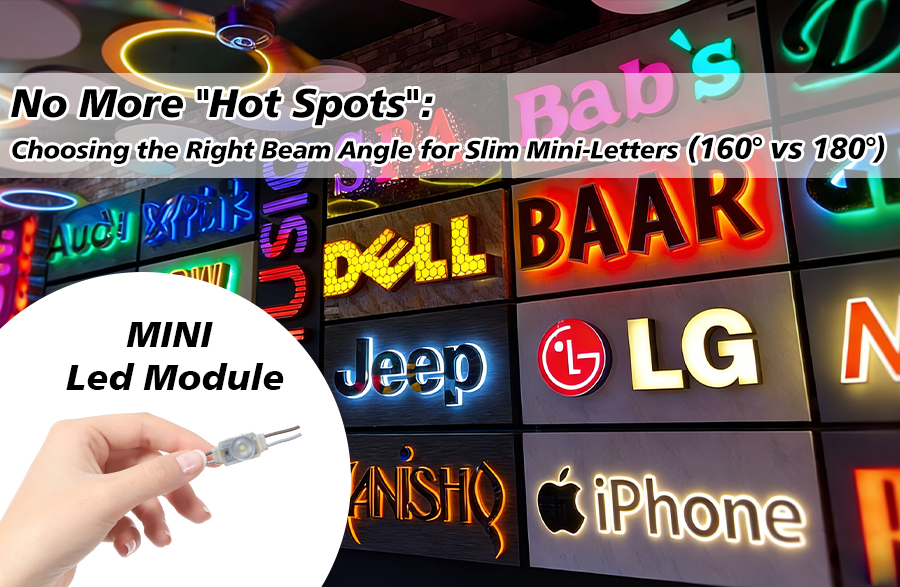
No More "Hot Spots": Choosing the Right Beam Angle for Slim Mini-Letters (160° vs 180°)
No More "Hot Spots": Choosing the Right Beam Angle for Slim Mini-Letters (160° vs 180°)
For commercial architects, retail visual merchandisers, studio integrators, hospitality designers, and smart home specifiers, selecting between 160° and 180° LED strips is not a preference—it is a technical decision that dictates visual integrity, installation tolerances, and long-term project credibility. This guide delivers a concise, specification-ready framework to eliminate hotspots, optimize light distribution, and align optical performance with high-end commercial applications.
1. The Optical Reality: Why Hotspots Occur in Thin Applications
2. 160° vs 180°: Definitive Comparison
3. Application Mapping: Which Angle Fits Your Project?
4. Engineering & Installation Parameters for Flawless Results
5. Common Specifying Mistakes & How to Avoid Them
6. Specification Checklist for Designers & Integrators
7. Smart Integration & Dimming Compatibility
8. ROI & Maintenance Considerations
9. Final Specification Framework
10. Summary
2. 160° vs 180°: Definitive Comparison
3. Application Mapping: Which Angle Fits Your Project?
4. Engineering & Installation Parameters for Flawless Results
5. Common Specifying Mistakes & How to Avoid Them
6. Specification Checklist for Designers & Integrators
7. Smart Integration & Dimming Compatibility
8. ROI & Maintenance Considerations
9. Final Specification Framework
10. Summary
1. The Optical Reality: Why Hotspots Occur in Thin Applications
Hotspots form when LED point sources project concentrated luminous intensity beyond the diffusion capacity of the cover material. In ultra-thin channels (typically 3–8 mm depth), light has minimal travel distance to scatter before exiting the diffuser. If the emission angle is too narrow or too wide relative to the diffusion layer, two failures emerge:
-
Localized Bright Spots:
LEDs remain visible as discrete points.
-
Edge Darkening / Center Washing:
Overlapping cones create uneven gradients.
The physics is straightforward. Luminous intensity (candela) concentrates along the primary emission axis. As the beam widens, peak intensity drops, but spatial coverage increases. In confined geometries, excessive coverage without adequate diffusion distance causes light to strike the diffuser at steep angles, reducing internal reflection and increasing direct transmission. This creates the visible "dot" effect professionals call hotspotting.
Key takeaway: Hotspot elimination is not about higher lumen output. It is about angular distribution matching the optical path length.
2. 160° vs 180°: Definitive Comparison
The numerical difference of 20° represents a fundamental shift in optical behavior. Below is a condensed technical breakdown for rapid specification.
|
Parameter
|
160° LED Module
|
180° LED Module
|
|---|---|---|
|
Emission Profile
|
Wide forward cone with controlled lateral spill
|
Near-hemispherical, full forward + significant side emission
|
|
Peak Intensity Distribution
|
Higher central candela, tighter overlap zone
|
Lower central candela, broader overlap zone
|
|
Diffusion Distance Requirement
|
4–6 mm for uniform spread
|
6–10 mm for uniform spread
|
|
Channel Depth Compatibility
|
3–8 mm ultra-thin, shallow coves
|
6–12 mm standard, deep architectural channels
|
|
Hotspot Risk
|
Low to moderate (requires precise diffuser matching)
|
Moderate to high if mounted too close to diffuser
|
|
Light Loss to Sidewalls
|
Minimal (directional control)
|
Higher (requires reflective channel lining)
|
|
Ideal Substrate Interaction
|
Matte acrylic, frosted polycarbonate, micro-prismatic films
|
Translucent fabric, back-painted glass, deep light wells
|
|
Control Precision
|
Excellent for zoning, dimming stability
|
Requires higher PWM resolution to avoid visible banding
|