{当前产品的产品关键词轮巡使用}
2026-07-15

Solving the Hot Spot Problem Spacing Guide for 160 Degree Wide Angle Modules in Slim Letters

Solving the "Hot Spot" Problem: Spacing Guide for 160° Wide Angle Modules in Slim Letters

In the high-stakes world of premium signage, visual perfection is non-negotiable. For premium brand signage integrators and luxury retail VM agencies, a single visible LED dot or a subtle "zebra stripe" effect can compromise the integrity of a multi-million dollar brand installation. As design trends shift towards increasingly minimalist aesthetics, the demand for ultra-slim channel letters and shallow-depth light boxes has surged. However, achieving flawless illumination in these constrained spaces presents a significant engineering challenge: the "hot spot" problem.
Traditional LED modules often struggle to mix light effectively within depths of less than 30mm, resulting in uneven brightness patterns known as ribbing. This comprehensive guide explores how 160 degree wide angle LED modules offer a superior solution, providing a detailed spacing guide to help professionals eliminate hot spots in slim LED signs. Whether you are designing for a boutique hotel, a healthcare wayfinding system, or a high-end jewelry display, understanding the physics of light distribution is key to delivering uniform lighting for shallow depth signage.
LED Module Spacing for Channel Letters

Why Traditional LEDs Fail in Slim Profiles: The Challenge of Hot Spots and Ribbing

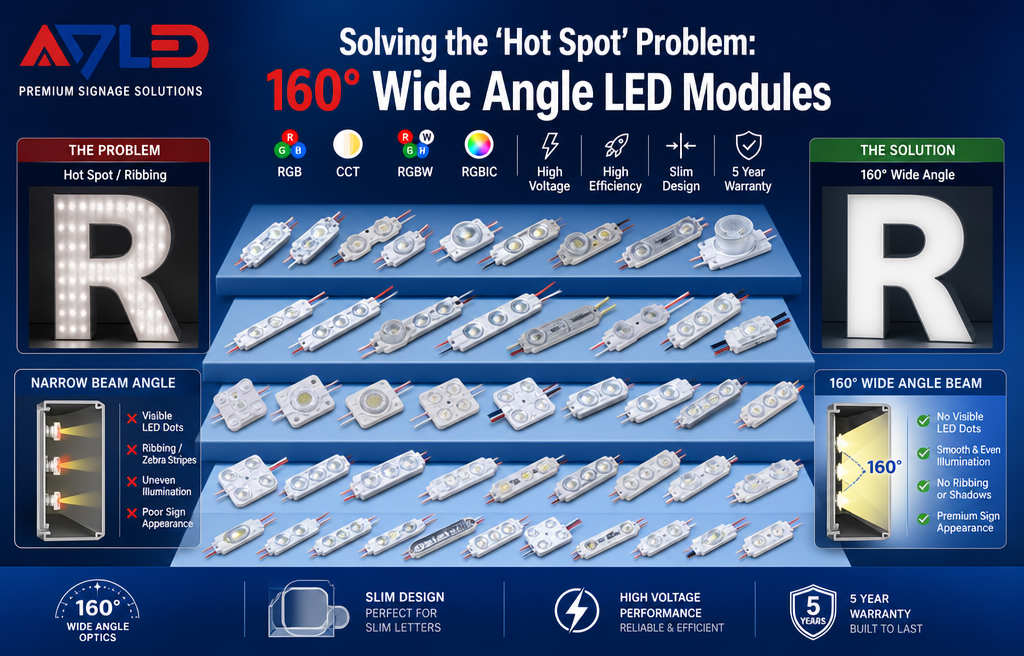
The "hot spot" or "ribbing" effect occurs when individual LED sources are visible through the face of a sign, creating alternating bands of bright and dark areas. This phenomenon is particularly prevalent in slim LED signs where the distance between the LED source and the diffuser face (the mixing distance) is insufficient for the light to blend seamlessly.

The Physics of Light Mixing

Light from an LED emits in a specific pattern, typically defined by its beam angle. Standard LEDs often have a beam angle of 120 degrees. In a deep cabinet (e.g., 100mm+), this light has ample space to spread and overlap with neighboring LEDs before hitting the face. However, in a shallow cavity LED backlighting setup (e.g., 15-25mm), the light hits the diffuser before it has fully expanded. This results in bright circles directly above each LED and darker zones in between.

Limitations of High-Density Strips

A common misconception is that simply increasing the density of LEDs will solve the problem. While high density LED strips for narrow letters can reduce the gap between hot spots, it does not eliminate them if the beam angle remains narrow. Furthermore, higher density leads to increased heat generation, higher power consumption, and greater complexity in wiring, which can compromise the reliability of the installation. For commercial LED module manufacturer for slim letters, the goal is not just more LEDs, but smarter optical control.

The Cost of Visual Imperfection

For luxury retail brands and high-end hospitality designers, visual imperfections are unacceptable. A ribbing effect in LED channel letters can make a sign look cheap and poorly engineered, damaging the brand's perceived value. Therefore, finding a hotspot-free LED lighting solution is not just a technical requirement but a business imperative.

The Science of Uniformity: How 160 Degree Wide Angle LED Modules Solve Depth Issues

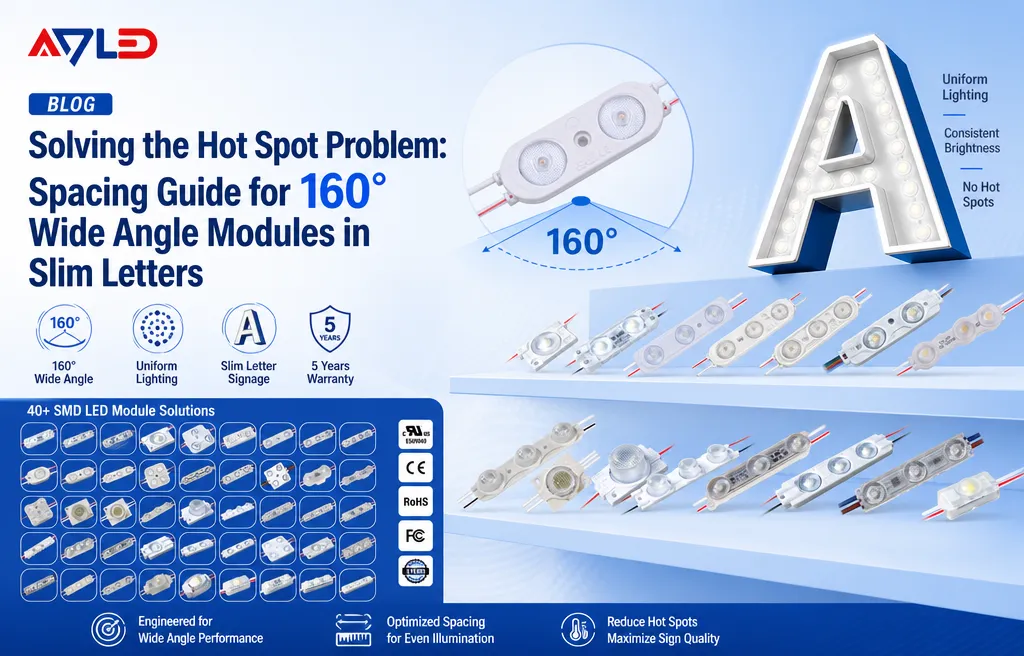
The solution to the hot spot problem lies in optical engineering. 160 degree wide angle LED modules are specifically designed to emit light over a much broader area compared to standard LEDs. This wider dispersion allows the light to cover more surface area per module, reducing the number of modules required while improving uniformity.

Secondary Optics and Lens Technology

Unlike standard SMD LEDs that rely on the epoxy lens for distribution, wide-angle modules often incorporate secondary optics or specialized lens arrays. These optical lens LED for no hotspots components refract and diffuse the light at the source, creating a Lambertian distribution LED strips effect. This ensures that light is emitted evenly across a 160-degree arc, maximizing lateral spread within the shallow cabinet.

Reduced Module Count and Improved Efficiency

By using 160° beam angle LED modules, installers can increase the spacing between LEDs without sacrificing uniformity. This reduces the total number of modules needed, lowering material costs and simplifying installation. Additionally, fewer modules mean less heat generation, which enhances the longevity of the system. This efficiency is crucial for energy saving LED lighting solutions in large-scale installations like airport wayfinding signs or shopping mall directories.

Precision Beam Control

Advanced precision beam control LED technology ensures that light is directed exactly where it is needed. Asymmetric lens LED for slim signs can be engineered to throw light further in one direction, optimizing coverage for narrow letter strokes. This level of control is essential for achieving seamless illumination LED technology in complex geometries.

Precise LED Module Spacing for Channel Letters: A Depth-Based Calculation Guide

Determining the correct LED module spacing for channel letters is critical for achieving uniformity. The general rule of thumb is that the spacing between LEDs should be equal to or slightly less than the depth of the channel. However, with 160 degree wide angle LED modules, this ratio can be optimized.

The Spacing-to-Depth Ratio

For standard 120-degree LEDs, a 1:1 spacing-to-depth ratio is recommended. For 160 degree wide angle LED modules, a ratio of 1.2:1 or even 1.5:1 can often be achieved without visible hot spots. For example:
20mm Depth: Use a spacing of 25-30mm.
30mm Depth: Use a spacing of 40-45mm.
50mm Depth: Use a spacing of 60-75mm.
This flexibility allows for uniform lighting for shallow depth signage with fewer components. It is essential to use an LED spacing calculator tool or conduct physical prototypes to verify the optimal spacing for specific materials and diffusers.

Edge Distance Considerations

In addition to inter-LED spacing, the distance from the LED to the edge of the letter (edge drop-off) must be considered. A general guideline is to maintain an edge distance of at least half the inter-LED spacing. This prevents dark borders around the perimeter of the sign. For small font channel letters, this margin may need to be reduced, requiring the use of mini LED modules for tiny fonts or reflective side walls to bounce light into the edges.

Impact of Diffuser Quality

The choice of diffuser plays a significant role in spacing tolerance. A high-quality diffuser panel for uniformity with >85% light transmission and appropriate haze levels can help mask minor spacing irregularities. However, relying solely on the diffuser to hide poor spacing can result in light loss and reduced brightness. Therefore, balancing LED module spacing for channel letters with diffuser selection is key.
160 Degree Wide Angle LED Modules

Achieving Uniform Lighting for Shallow Depth Signage: Best Practices for <3cm Cabinets

Signs with a depth of less than 30mm present the greatest challenge for uniform illumination. In these ultra-thin LED module for 2cm depth applications, every millimeter counts. Here are best practices for achieving uniform lighting for shallow depth signage:

Maximize Internal Reflection

Use high-reflectivity materials for the back and sides of the channel. A reflector sheet for LED signs with >95% reflectance can significantly improve uniformity by bouncing stray light back towards the face. This effectively increases the mixing distance without increasing the physical depth of the sign.

Optimize Diffuser Selection

Choose a diffuser with a high haze value to scatter light effectively. However, balance this with transmission efficiency to maintain brightness. A >85% light transmission diffuser is often ideal for slim signs. Avoid using overly thick diffusers, which can absorb too much light and require higher power inputs.

Use Specialized Wide-Angle Modules

Standard LEDs are rarely suitable for depths under 20mm. Instead, use dedicated ultra-thin LED module for 2cm depth solutions featuring 160 degree wide angle LED modules. These modules are engineered to provide wide angle LED for uniform coverage even in extremely tight spaces.

Consider Side-Lit Alternatives

For depths under 15mm, consider edge-lit LED technology for large formats as an alternative. While this guide focuses on backlit solutions, edge-lit systems can provide superior uniformity in ultra-slim profiles by using a light guide plate (LGP) to distribute light evenly across the face.
Uniform Lighting for Shallow Depth Signage

Selecting the Best LED Modules for Small Font Channel Letters and Intricate Logos

Small fonts and intricate logos pose unique challenges due to their narrow strokes and complex shapes. Finding the best LED modules for small font channel letters requires a combination of miniaturization and optical precision.

Miniature Wide-Angle Modules

For narrow strokes, standard-sized modules may not fit or may cause overcrowding. Mini LED modules for tiny fonts with integrated wide-angle lenses are ideal. These modules provide precise optical control LED modules in a compact form factor, ensuring that even the thinnest parts of a letter are evenly illuminated.

Flexible Strip Solutions

In some cases, flexible edge-lit LED strips or high density LED strips for narrow letters may be more appropriate than rigid modules. These can be bent to follow the contours of complex logos, ensuring consistent light distribution throughout the design. Ensure that the strips have consistent brightness LED strips and <3% color variation LED batches to maintain visual coherence.

Color Consistency and CRI

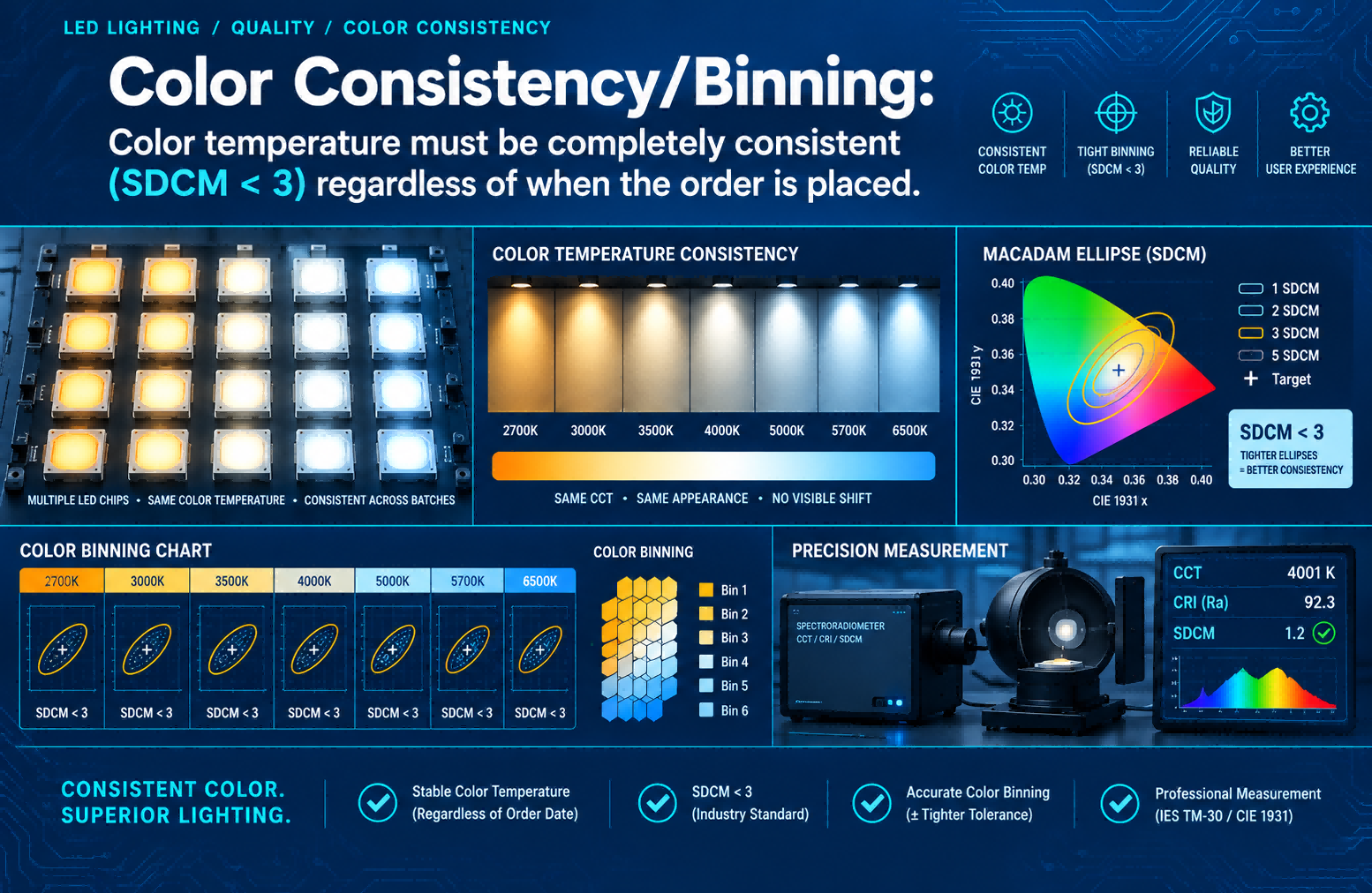
For luxury applications, color accuracy is paramount. Use LEDs with CRI >90 LED for jewelry displays or CRI 95+ LED for luxury goods to ensure that brand colors are rendered accurately. Binning control LED strips and MacAdam ellipse <3 LED quality guarantees that there are no visible color shifts across the sign, which is especially noticeable in small, closely spaced elements.
Mini LED Modules for Tiny Fonts

Optimizing Reflection and Diffusion: Key Components for Hotspot-Free Results

Achieving a hotspot-free LED lighting solution involves more than just selecting the right LED. The entire optical system, including reflectors and diffusers, must be optimized.

Reflector Materials

The internal surfaces of the channel letter act as a reflector cavity. Using white PVC or aluminum with a matte white finish can enhance light mixing. Avoid glossy surfaces, which can create secondary reflections and glare. A reflector sheet for LED signs can be added to the back of the channel to boost efficiency and uniformity.

Diffuser Types

There are two main types of diffusers: opal acrylic and polycarbonate films. Opal acrylic provides excellent diffusion but can reduce brightness. Polycarbonate films are thinner and offer higher transmission but may require tighter LED spacing. For slim profile LED light box solution, a combination of a thin opal sheet and a micro-prismatic film can offer the best balance of uniformity and brightness.

Sealing and Protection

For outdoor applications, ensure that the diffuser is properly sealed to prevent moisture ingress, which can cause clouding and uneven lighting over time. Use waterproof glue for outdoor signs and IP67 LED for outdoor slim signs rated modules to ensure long-term durability.

Real-World Applications: From Luxury Retail Displays to Hospital Wayfinding Systems

The principles of wide-angle lighting and precise spacing apply across various industries. Here is how different sectors benefit from these solutions:

Luxury Retail and Hospitality

In luxury retail stores and boutique hotels, signs are often viewed from close range. Eliminate hot spots in slim LED signs is critical to maintaining a premium aesthetic. 3000K warm white LED for luxury creates an inviting atmosphere, while uniform lighting for shallow depth signage ensures that logos appear crisp and professional.

Healthcare and Wayfinding

In hospitals and airports, clarity and readability are essential. LED lighting solutions for wayfinding systems must be free of distractions like flickering or uneven brightness. Flicker-free LED for camera recording and stable brightness LED performance ensure that signs are easy to read in all lighting conditions. IP65 LED for indoor signage protects against cleaning chemicals and humidity.

Jewelry and Watch Displays

Jewelry showcases require high CRI lighting to accurately display gemstones. CRI 95+ LED for luxury goods combined with no-dark-spot LED technology ensures that every facet of a diamond is illuminated evenly. Custom LED solutions for small font signs allow for discreet branding within the display case without compromising the visual appeal of the products.

Exhibition and Events

For international exhibition and event builders, speed of installation and visual impact are key. Wholesale LED strips for exhibition stands with quick connect LED plugs enable rapid assembly. 160 degree wide angle LED modules reduce the number of connections required, minimizing potential points of failure.
LED Lighting Supplier for Premium Signage

Partner with a Professional LED Manufacturer for Custom Optical Solutions

Selecting the right partner is crucial for successful project execution. A commercial LED module manufacturer for slim letters with extensive R&D capabilities can provide customized solutions tailored to your specific needs.

Technical Support and Consultation

Look for a LED supplier with optical design service who can provide professional LED technical consultation. They should offer IES file wide angle LED data for lighting simulations and LED sample request for uniformity testing to validate performance before full-scale production.

Quality Assurance and Certification

Ensure that the manufacturer is an ISO9001 certified LED manufacturer with SGS audited LED lighting factory status. Products should be UL listed LED for North America, CE marked LED for Europe, and RoHS compliant LED materials. LM-80 TM-21 LED report data verifies the long-term reliability of the LEDs.

Global Supply Chain and Logistics

For multinational projects, choose a global shipping LED manufacturer for exhibitions with experience in wholesale LED solutions for Europe and wholesale LED modules for North America. Factory direct LED pricing for projects and flexible MOQ LED supplier for prototypes allow for cost-effective scaling from prototype to mass production.

Conclusion

Solving the "hot spot" problem in slim channel letters requires a deep understanding of optical physics and precise engineering. By utilizing 160 degree wide angle LED modules and adhering to proper LED module spacing for channel letters, professionals can achieve uniform lighting for shallow depth signage that meets the highest aesthetic standards. Whether for luxury retail displays, hospital wayfinding systems, or jewelry showcases, the right lighting solution enhances brand perception and user experience. Partnering with a reliable LED supplier for slim signs who offers custom LED solutions for small font signs and comprehensive technical support ensures successful project outcomes. As technology advances, the ability to eliminate hot spots in slim LED signs will continue to improve, offering even greater design freedom for architects and designers.

FAQ

What is the ideal spacing for 160° wide angle LED modules in a 20mm deep channel?

For a 20mm depth, a spacing of 25-30mm is typically recommended for 160 degree wide angle LED modules. This ratio allows for sufficient light mixing to eliminate hot spots in slim LED signs while maintaining high efficiency. Always test with samples to confirm based on your specific diffuser.

Can I use standard 120° LEDs for shallow depth signage?

 Standard 120° LEDs can be used, but they require much tighter spacing (often 1:1 ratio or less) to achieve uniform lighting for shallow depth signage. This increases cost and heat. 160 degree wide angle LED modules are preferred for depths under 30mm as they provide better uniformity with wider spacing.

How do I choose the best LED modules for small font channel letters?

For small fonts, look for mini LED modules for tiny fonts with wide beam angles. Ensure they have consistent color temperature LED and high CRI if color accuracy is important. Precise optical control LED modules help direct light into narrow strokes without spill.

What role does the diffuser play in eliminating hot spots?

The diffuser scatters light to blend the individual LED beams. A high-quality diffuser panel for uniformity with appropriate haze can significantly reduce visible hot spots. However, it cannot compensate for excessively wide LED spacing. A balance between LED module spacing for channel letters and diffuser quality is essential.

Are wide angle LEDs suitable for outdoor signage?

Yes, provided they are rated for outdoor use. Look for IP67 LED for outdoor slim signs and UV resistant LED diffusers for signs. 160 degree wide angle LED modules with proper sealing and weatherproof LED lighting for exterior protection perform well in outdoor environments.

How can I verify the uniformity of my LED layout before installation?

Use lighting simulation software with IES file wide angle LED data provided by the manufacturer. Alternatively, build a small prototype section to visually inspect for ribbing effect in LED channel letters. Request LED sample request for uniformity testing from your supplier.

What certifications should I look for in LED modules for commercial projects?

Ensure modules are UL listed LED for North America, CE marked LED for Europe, and RoHS compliant LED materials. LM-80 TM-21 LED report confirms longevity. For healthcare, check for IEC 62471 photobiological safety compliance.

Can I retrofit existing slim signs with wide angle LEDs?

Yes, retrofit LED kits for signs are available. Replacing standard LEDs with 160 degree wide angle LED modules and adjusting spacing can significantly improve uniformity. Ensure the new modules fit within the existing housing and that the power supply is compatible.
LED Module Spacing for Channel Letters