

2026-06-12
Spending USD500 on One Service Call Why Constant Current LED Modules Ensure 5 Years of Zero Maintenance
Spending $500 on One Service Call? Why Constant Current LED Modules Ensure 5 Years of Zero Maintenance
Imagine getting a frantic call from your top client at 9:00 AM. The massive outdoor sign you installed for their flagship store just six months ago is half-dark. A single section of letters is flickering violently, ruining their brand image. To fix it, you have to hire a technician, rent a boom lift, and block a busy commercial street. By the time the technician replaces a few cheap, burnt-out components, the invoice on your desk totals $500 for just one service call.
For global buyers, managing projects under tight margins means that repeated maintenance calls are not just an annoyance; they are a financial black hole. In markets like Europe and North America, the skyrocketing cost of field labor means that a single truck roll can completely wipe out the profit margin of an entire signage installation. If you are tired of losing your hard-earned profits to endless post-installation repairs, it is time to look under the hood of your hardware. As an experienced LED manufacturer with a 13 years LED experience, we have seen firsthand how low-quality components drain a company's bottom line. The ultimate solution to this costly problem lies in transitioning from standard setups to premium constant current LED modules designed for a total maintenance-free LED systems experience.
The Hidden Drain: How Labor Fees Explode and Why You Must Reduce LED Maintenance Costs
In the commercial lighting sector, many sign makers and contractors fall into a common trap: optimizing for the initial purchase price while ignoring the long-term total cost of ownership. When you buy cheap lighting components, you might save a few hundred dollars upfront on bulk LED modules. However, you are unknowingly signing up for a recurring cycle of high signage maintenance services fees that will plague your business for years.
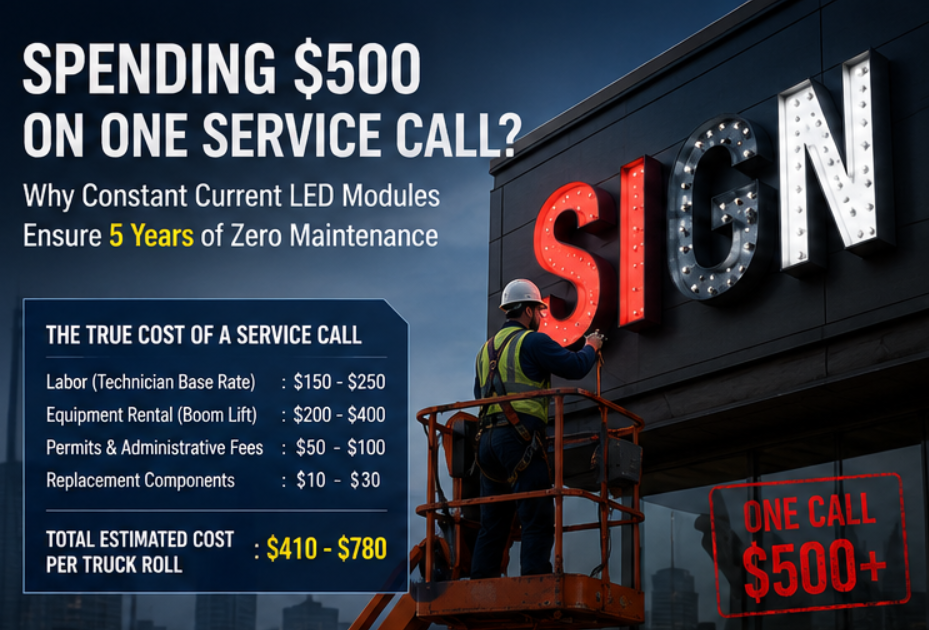
When an outdoor sign fails, the expenses escalate rapidly. You cannot simply send a technician with a ladder to fix a building facade installation or a high-rise outdoor billboard lighting display. You need heavy equipment, proper safety permits, and certified professionals who understand professional sign lighting compliance standards. These compounding expenses are why smart business owners realize they must find a permanent way to reduce LED maintenance costs.
By upgrading to a durable LED light source, you protect your profits. For solutions for electrical contractors and lighting for sign makers, the math is simple: preventing just two service calls over a five-year period saves over $1,000 per sign location. Instead of treating lighting failures as an inevitable cost of doing business, installing energy-efficient LED modules built on advanced constant current technology turns a recurring liability into a long-term LED lighting investment that keeps your clients happy and your service teams focused on new revenue-generating projects rather than endless repairs.
Constant Voltage vs. Constant Current: The Technical Reason Behind Early Signage Failures
To understand why traditional sign illumination fails prematurely, we must look at the electrical engineering principles that govern these products. Most standard sign boards utilize a constant voltage system. In a traditional constant voltage setup, the power supply delivers a fixed voltage (typically 12V or 24V) across the parallel circuit, and the internal resistors on each unit regulate the flow of electricity.
While this setup is simple and inexpensive for a professional LED module factory to mass-produce, it has a critical engineering flaw known as voltage drop. As the electrical current travels further down a long run of linear lighting or interconnected signage, the resistance within the copper traces causes the voltage to decrease gradually. To compensate for this drop, units closer to the power supply receive a higher current, while the modules at the far end of the run dim significantly, destroying your high color consistency LED goals.
This imbalance triggers a dangerous phenomenon called thermal runaway. The overdriven components generate excessive heat because they lack proper thermal management LED modules layout. As the temperature rises, the internal resistance of the high brightness LED chips drops, causing them to draw even more current. This cycle continues until the high-quality SMD LED material degrades, leading to a noticeable zero color shift LED failure, flickering, and eventual total burnout.