{当前产品的产品关键词轮巡使用}
2026-07-14

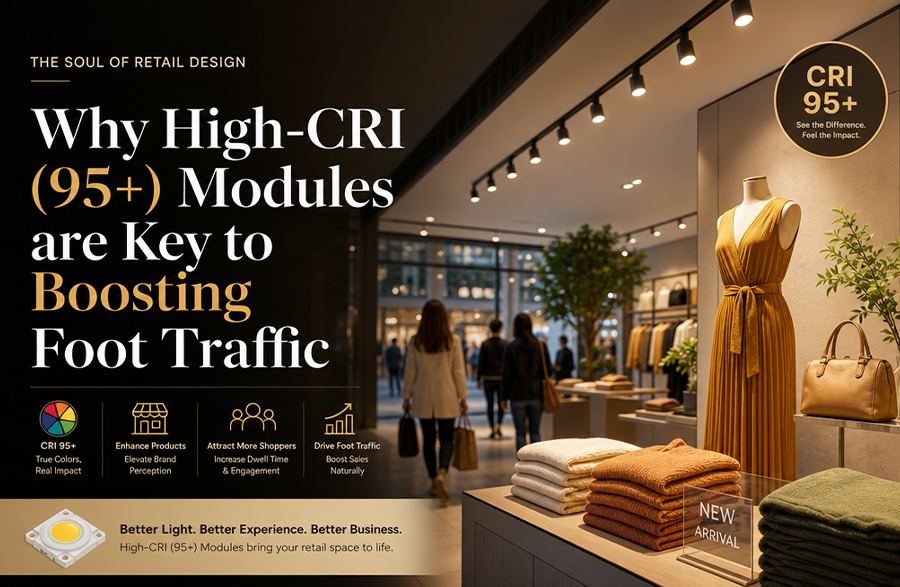
The Soul of Retail Design: Why High-CRI (95+) Modules Are Key to Boosting Foot Traffic

The Soul of Retail Design: Why High-CRI (95+) Modules Are Key to Boosting Foot Traffic

Introduction: The Silent Salesperson
What Is CRI, and Why Does It Matter?
The Psychology of Light: How High CRI Influences Customer Behavior
The Science of High-CRI Modules: Beyond the Basics
Foot Traffic: The Lifeblood of Retail
The Business Case for CRI 95+: Calculating ROI
Implementation Guide: How to Spec CRI 95+ Modules
The Future of Retail Lighting
Conclusion: Lighting as Competitive Advantage
Frequently Asked Questions (FAQs)

Introduction: The Silent Salesperson

Walk into any successful retail store, and you will feel it before you consciously register it. The space draws you in. Products seem to glow with an almost magnetic appeal. Colors pop. Textures invite touch. You linger longer than you planned, and you leave with items you did not know you wanted.
This is not accidental. This is the work of retail design’s most powerful—and most underestimated—silent salesperson: lighting.
In the competitive landscape of brick-and-mortar retail, where foot traffic is the lifeblood of revenue, every element of store design must work in service of one goal: getting customers through the door and keeping them there. Among all these elements—layout, signage, merchandising, scent, music—lighting stands apart. It is the foundation upon which everything else is built. And at the heart of effective retail lighting lies a single, non-negotiable specification: high Color Rendering Index (CRI), specifically CRI 95+.
This blog explores why high-CRI lighting modules are not just a technical upgrade but a strategic imperative for retailers who want to boost foot traffic, increase dwell time, and drive sales. We will examine the science behind color rendering, the psychology of customer behavior, the financial ROI of CRI 95+, and practical steps for implementation.
Introduction: The Silent Salesperson   Introduction: The Silent Salesperson

What Is CRI, and Why Does It Matter?

Understanding the Color Rendering Index

The Color Rendering Index (CRI) is a quantitative measure of a light source’s ability to reveal the true colors of objects, compared to an ideal or natural light source (daylight). The scale runs from 0 to 100, with 100 representing perfect color rendering.
A CRI of 80 has long been the baseline for commercial lighting. A CRI of 90 is considered “high CRI” and is recommended for most retail applications. But CRI 95+ represents a different tier altogether. It adds precision in the red spectrum and captures subtle tonal gradations that become visible when customers compare products side by side or hold items near their skin.

What Is CRI, and Why Does It Matter?

CRI 90 vs. CRI 95+: The Critical Difference

The jump from 80 to 90 CRI is significant. The jump from 90 to 95 is smaller in technical terms—but in retail, that final gap can determine whether a tomato looks appetizing or merely acceptable.
Here is why: CRI averages the fidelity of only eight pastel reference colors (R1–R8). It does not account for saturated colors like deep reds or blues. This is where R9—the measure of deep red rendering—becomes critical. Many “90 CRI” luminaires actually have an R9 value below 20. In retail environments, R9 impacts skin tones (vital for cosmetics and apparel fitting rooms) and the “freshness” perception of meats, berries, and wood finishes.
CRI 95+ modules typically deliver R9 values of 50 or higher, ensuring that reds appear rich and saturated rather than dull or brown. For a fresh-focused store, the 15 to 25 percent premium for CRI 95+ typically recovers within one produce cycle through reduced markdowns and higher sales velocity.

The Psychology of Light: How High CRI Influences Customer Behavior

Light as a Stimulus

Retail lighting operates within the Stimulus-Organism-Response (S-O-R) framework: lighting (stimulus) affects customers’ psychological and physiological states (organism), which in turn shapes their behavioral responses-. High-CRI lighting is not just about visibility—it is about emotion, perception, and decision-making.
Humans are incredibly responsive to visual stimuli-1. In a retail setting, lighting acts as a silent influencer. It creates atmosphere, draws attention to products, and affects emotions—all of which impact how shoppers navigate the store and what ends up in their carts.

The Freshness Factor

In food retail, appearance is everything—and lighting controls how products are perceived-1. High CRI lighting (CRI 90+) makes fruits, vegetables, meats, and seafood appear more vibrant, fresher, and more appealing. Shoppers associate rich color and brightness with freshness, so lighting directly affects how confident they feel in your products.
Consider this: under CRI 80 lighting, meat can appear slightly brown instead of fresh red. Customers perceive lower quality and reach for alternatives. Tomatoes lose the vibrant saturation that signals ripeness-12. The result is not a direct complaint. It is a lower basket size and higher spoilage rate. CRI 95+ eliminates this problem by rendering reds with the intensity they deserve.
The Psychology of Light: How High CRI Influences Customer Behavior  The Psychology of Light: How High CRI Influences Customer Behavior  The Psychology of Light: How High CRI Influences Customer Behavior

The Confidence Builder

In fashion retail, the stakes are equally high. High CRI (above 90) is critical in clothing retail because it ensures fabrics’ colors and details look natural and appealing-. Poor CRI can make clothes look dull or misleading, which harms customer trust.
When customers can trust what they see—when a “Midnight Blue” dress actually looks blue in the fitting room rather than black—they buy with confidence-. This confidence translates directly into fewer returns, higher conversion rates, and stronger brand loyalty.
The Psychology of Light: How High CRI Influences Customer Behavior  The Psychology of Light: How High CRI Influences Customer Behavior

Extended Dwell Time

When customers feel comfortable and engaged in a space, they naturally spend more time exploring. Extended dwell time leads to increased product interaction, which translates to higher conversion rates and larger purchases. It is a chain reaction that starts with how the environment feels, and lighting is the foundation of that feeling.
High-CRI lighting contributes to visual comfort by reducing eye strain and creating environments that feel more natural and inviting-. Customers do not consciously think “this lighting makes me want to stay longer”—they simply feel more comfortable and engaged.

The Science of High-CRI Modules: Beyond the Basics

What Makes CRI 95+ Modules Different?

High-CRI LED modules achieving 95+ are engineered with advanced phosphor technologies that deliver a more complete spectral power distribution. Unlike standard LEDs that may have gaps in the spectrum—particularly in the red region—CRI 95+ modules use narrow-band red phosphor technology to ensure accurate color rendering across the full visible spectrum.
Leading manufacturers like Lumileds have developed technologies such as CrispWhite, which brings a vivid and bright look to retail settings while maintaining high CRI and efficacy within 1-2 lumens per watt of standard CRI versions-. This means retailers no longer have to choose between color quality and energy efficiency.

TM-30: The Next Generation of Color Quality Measurement

While CRI remains the industry standard, it is a limited metric. The U.S. Department of Energy’s research has shown that two LED sources can share an identical CRI of 90 while producing vastly different visual results.
TM-30 is a newer color scale that measures color rendering and saturation across 99 colors, rather than CRI’s eight-. For retailers serious about color quality, specifying both CRI ≥ 90 and strong TM-30 fidelity values (Rf and Rg) ensures that products look their best under any lighting condition.

The R9 Imperative

As noted earlier, R9—the measurement of deep red rendering—is often the weak link in “90 CRI” products. For high-impact merchandising, a common industry heuristic is to specify CRI ≥ 90 with R9 ≥ 50. Always request an LM-79 report to verify the R9 value, as “nominal” 90 CRI claims may not reflect actual performance.

Foot Traffic: The Lifeblood of Retail

The Window Display Effect

The Window Display Effect  The Window Display Effect
Your shop window is the bridge between the street and your store-2. Lighting plays a crucial role in drawing customers inside. High-CRI lighting in window displays ensures that products appear vibrant and true to life—not washed out or artificially colored.
When passersby see merchandise that looks beautiful, they are more likely to step inside. This is the first and most direct way that high-CRI lighting boosts foot traffic.

The Entry Experience

The Entry Experience
Once customers cross the threshold, the lighting experience must continue to impress. Storefront and entry lighting attracts foot traffic and makes a strong first impression-. A bright, welcoming entry with high-CRI illumination signals quality and care, inviting customers to explore further.

Wayfinding and Navigation

Beyond aesthetics, lighting helps guide the customer journey-1. Brighter zones naturally draw the eye, helping you direct attention to feature displays, seasonal promotions, or high-margin departments-1. By layering general, accent, and task lighting, retailers can create a visual rhythm that moves customers smoothly through the store, increasing both comfort and time spent shopping.

The Data Behind the Impact

The numbers speak for themselves. An ENERGY STAR study found that U.S. grocers who switched to LED lighting saw their sales grow by 19 percent-. A jewelry store that switched to high-CRI LED spotlights saw a 22 percent rise in engagement time and a 15 percent increase in sales of high-end pieces-. Controlled retail trials have shown that meat sections under CRI 95+ lighting increased sales by 8 to 12 percent.
These are not marginal gains. These are transformative results that directly impact the bottom line.

The Business Case for CRI 95+: Calculating ROI

The Cost of Poor Lighting

Poor lighting is not a cost-saving measure—it is a revenue drain. When products look dull or colors appear off, customers perceive lower quality. They buy less. They return more. They leave faster. And they may not come back.
The hidden cost of CRI 90 in fresh food, for example, manifests as lower basket sizes and higher spoilage rates-12. In fashion, color-mismatch returns erode margins and customer trust. In jewelry, poor rendering makes gemstones look flat and reduces perceived value.

The Premium Worth Paying

Yes, CRI 95+ modules carry a premium—typically 15 to 25 percent over CRI 90 equivalents-12. But for the right retail segments, this premium pays for itself quickly.
Retail Segment
CRI 95+ Value
Payback Driver
Supermarket fresh food
Critical for meat, produce, deli
Higher basket size, reduced markdowns
Cosmetics and beauty
Essential for trial counters
Lower return rates, higher conversion
Jewelry and watches
Required for gemstone fire and metal luster
Perceived value increase, longer dwell time
Apparel and fashion
Important for premium and seasonal lines
 Fewer color-mismatch returns

Energy Efficiency Without Compromise

Modern high-CRI LED modules are remarkably efficient. Lumileds’ 95 CRI CoBs with CrispWhite technology offer light output within 1-2 percent of standard CRI versions and efficacy within 1-2 lumens per watt-. This means retailers can achieve superior color quality without sacrificing energy savings.
Smart lighting controls can further enhance efficiency. Dimmable, tunable lighting and smart sensors can be utilized based on time of day or foot traffic, saving energy while maintaining consistent quality.

Implementation Guide: How to Spec CRI 95+ Modules

Step 1: Identify Color-Critical Zones

Not every square foot of your store requires CRI 95+. Prioritize zones where color accuracy directly impacts sales:
  • Produce, meat, and seafood departments: Freshness perception is everything
  • Fitting rooms: Customers need to see how garments and cosmetics look on their skin
  • Jewelry and watch displays: Sparkle and luster drive perceived value
  • Cosmetics counters: Color matching requires precision
  • Premium apparel and seasonal collections: Brand image depends on accurate color presentation

Step 2: Verify Supplier Claims

Many suppliers label products CRI 95+ while delivering 92 or 93. Procurement teams should require three documents before placing an order:
  1. Independent test report: Request IES LM-79 or equivalent testing from a third-party lab, not an in-house certificate. The report should list CRI, R9 red rendering, and TM-30 color fidelity values.
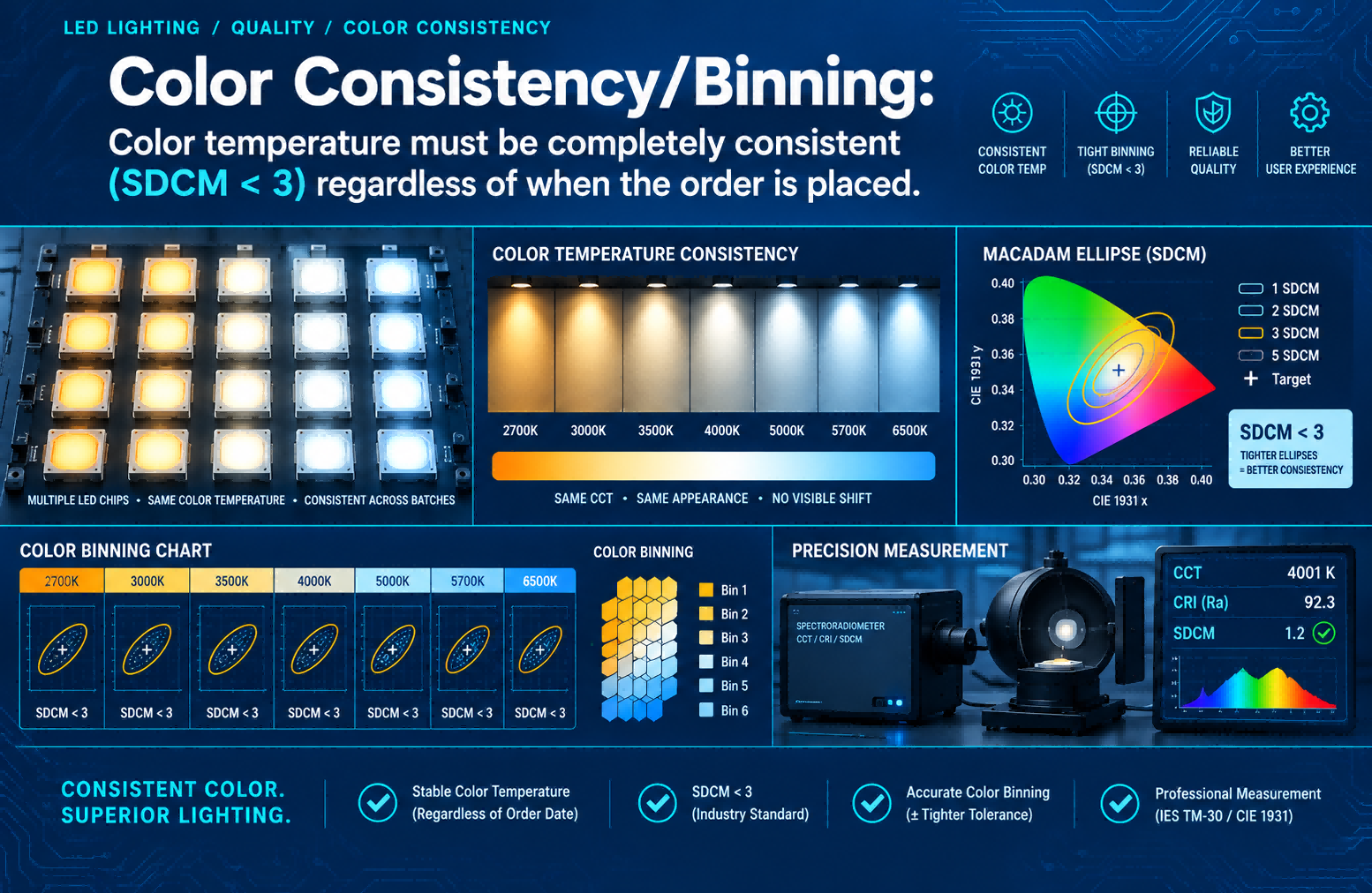
  2. Batch-level verification: Color quality varies between LED chip batches. Ask for binning data showing 3-step MacAdam ellipse tolerance or tighter. Generic certificates cover the chip manufacturer's average, not the actual batch installed in your fixtures.
  3. Physical demo with your products: Bring three items to the supplier's showroom: a red apple or tomato, a piece of white fabric, and a skin-tone reference. Under true CRI 95+, the red looks saturated, the white looks clean without pink or green cast, and the skin tone looks natural.

Step 3: Layer Your Lighting

Successful retail lighting combines multiple layers:
  • Ambient lighting: General illumination for navigation and safety
  • Accent lighting: Focused light on key products and displays
  • Task lighting: Functional light for service areas and counters
High-CRI modules should be the foundation of your accent lighting strategy, ensuring that hero products receive the most accurate and flattering illumination.

Step 4: Consider Color Temperature

CRI is not the only variable. Color temperature (measured in Kelvin) also affects product appearance. Warm lighting (2700K–3000K) in dining and fitting areas encourages lingering, while cooler temperatures (4000K–5000K) in fresh food sections reinforce cleanliness and freshness-1. The best results come from matching both CRI and color temperature to your products and brand identity.

The Future of Retail Lighting

Trends Shaping 2026 and Beyond

Retail lighting is evolving rapidly. Key trends include:
  • Quantum Dot LEDs (QDLED): Offering CRI up to 97 with purer colors and reduced energy losses
  • Tunable white LEDs: Allowing color temperature adjustment throughout the day to match natural circadian rhythms
  • Minimalist track lighting: Creating clean store appearances while maintaining flexibility
  • Field-adjustable fixtures: Offering flexibility in design and reducing inventory for distributors

Lighting as Experiential Design

As one industry expert noted, “Collaboration and experiences now sit at the heart of the shopping journey, with online supporting the physical store”. The result is retail that is “more immersive, more relevant and more connected to customers than ever before”.
Lighting is central to this transformation. It is no longer a background utility—it is a strategic tool for creating experiences that cannot be replicated online.

Conclusion: Lighting as Competitive Advantage

In a retail environment where every footstep matters, high-CRI (95+) lighting modules are not an expense. They are an investment in foot traffic, dwell time, conversion, and brand loyalty.
The science is clear: accurate color rendering builds customer confidence, reduces returns, and increases basket size. The psychology is undeniable: comfortable, inviting environments keep customers engaged and spending. And the business case is compelling: the premium for CRI 95+ pays for itself through measurable sales lift and operational savings.
Retailers who treat lighting as a strategic asset—not a facilities cost—will be the ones who thrive in an increasingly competitive landscape. Those who ignore the power of high-CRI lighting will watch customers walk past their doors and into the stores that look, feel, and sell better.
The soul of retail design is not in the fixtures or the finishes. It is in the light that brings everything to life. Choose CRI 95+. Your customers—and your bottom line—will thank you.

Frequently Asked Questions (FAQs)

Q1: What is the difference between CRI 90 and CRI 95+ in practical retail terms?

CRI 95+ adds precision in the red spectrum and captures subtle tonal gradations that become visible when customers compare products side by side or hold items near their skin. In practical terms, this means meat looks fresher (not brown), tomatoes look riper, skin tones look natural in fitting rooms, and gemstones display their full fire and brilliance. While the technical difference is small, the perceptual and commercial difference can be significant—particularly in food, fashion, cosmetics, and jewelry retail.

Q2: Is CRI 95+ worth the extra cost for my store?

For most retail segments where color drives purchase decisions—fresh food, apparel, cosmetics, jewelry—yes. The 15 to 25 percent premium typically recovers within one produce cycle through reduced markdowns and higher sales velocity. For discount retailers, warehouses, and general merchandise with low color sensitivity, CRI 90 may be sufficient. Use the decision framework in this blog to assess your specific needs.

Q3: How do I verify that a lighting product truly delivers CRI 95+?

Require three things from your supplier: (1) an independent IES LM-79 test report from a third-party lab listing CRI, R9, and TM-30 values; (2) batch-level binning data showing 3-step MacAdam ellipse tolerance or tighter; and (3) a physical demo where you bring your own products (red apple, white fabric, skin-tone reference) to see the difference firsthand.

Q4: Can I use CRI 95+ modules throughout my entire store?

You can, but it is not always necessary or cost-effective. Prioritize color-critical zones: produce and meat departments, fitting rooms, jewelry displays, cosmetics counters, and premium apparel sections. Use CRI 90 or even 80 for back-of-house areas, warehouses, and general transit zones where color accuracy is less important.

Q5: How does high-CRI lighting affect energy consumption and operating costs?

Modern high-CRI LED modules are highly efficient. Leading products like Lumileds’ 95 CRI CoBs offer light output within 1-2 percent of standard CRI versions and efficacy within 1-2 lumens per watt-. Combined with smart controls (dimming, sensors, scheduling), high-CRI lighting can actually reduce energy costs while improving the customer experience. The energy savings help offset the premium for higher CRI modules.
If you have any questions about the product, please contact us!