Commercial Grade LED Modules Manufacturer | ADLED
2026-05-29

Why Cheap Modules Turn Yellow The Critical Impact of Low Quality Silicone Encapsulation

Why Cheap LED Modules Turn Yellow: The Critical Impact of Low-Quality Silicone Encapsulation on Long-term Reliability

In the competitive landscape of the global sign industry, the difference between a premium installation and a costly failure often comes down to a few cents in material costs. For corporate identity (CI/VI) project managers and architectural lighting consultants, the most dreaded sight is a pristine white channel letter or lightbox turning a murky yellow just months after installation. This phenomenon is not just an aesthetic flaw; it is a symptom of material degradation that threatens brand integrity and spikes maintenance expenses.
As a China LED factory with over 13 years of expertise, we have analyzed thousands of failed units from the market. The culprit is almost always the same: low-grade encapsulation. In this deep dive, we explore why cheap modules fail and how adled light solutions ensures long-term reliability of LED modules through superior silicone encapsulation.

The Science of Degradation: Why Do LED Modules Turn Yellow Over Time?

To understand the LED aging mechanism, one must look at the LED encapsulation material properties. The encapsulation layer serves as a protective barrier for the LED chip, managing both light extraction and environmental shielding. When a professional led supplier chooses a potting compound, they are deciding the future of that module’s clarity retention.
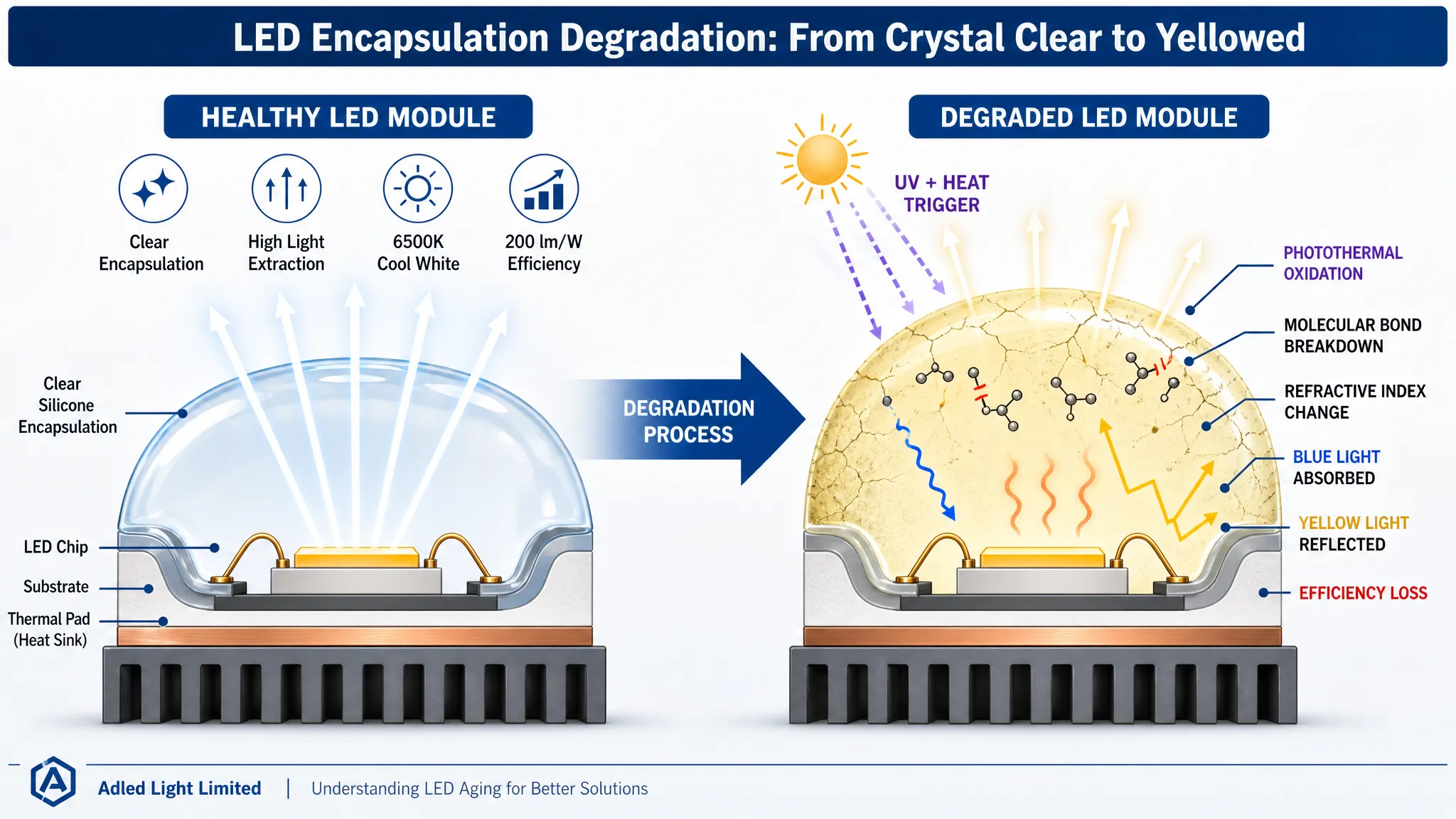
The primary reason for yellowing is photothermal oxidation. LED chips, especially high-power commercial grade LED components, generate significant heat. When this heat combines with constant UV exposure from direct sunlight, it triggers a chemical reaction in low-quality polymers. This reaction breaks down the material molecular bond, leading to a change in the material’s high refractive index. As the clear coating degrades, it begins to absorb blue light and reflect yellow light, resulting in a visible color shift.
For architectural contours and hospitality lighting, this degradation means the carefully selected 6500k cool white begins to look like an aged, nicotine-stained surface. This process also affects high luminous efficacy, as the yellowed layer acts as a filter, trapping light and reducing the overall 200 Lm/w efficiency of the system.
nti-yellowing LED Modules, UV Resistant LED Sign Lighting

LED Module Silicone vs Epoxy: The $0.05 Choice That Costs You Thousands

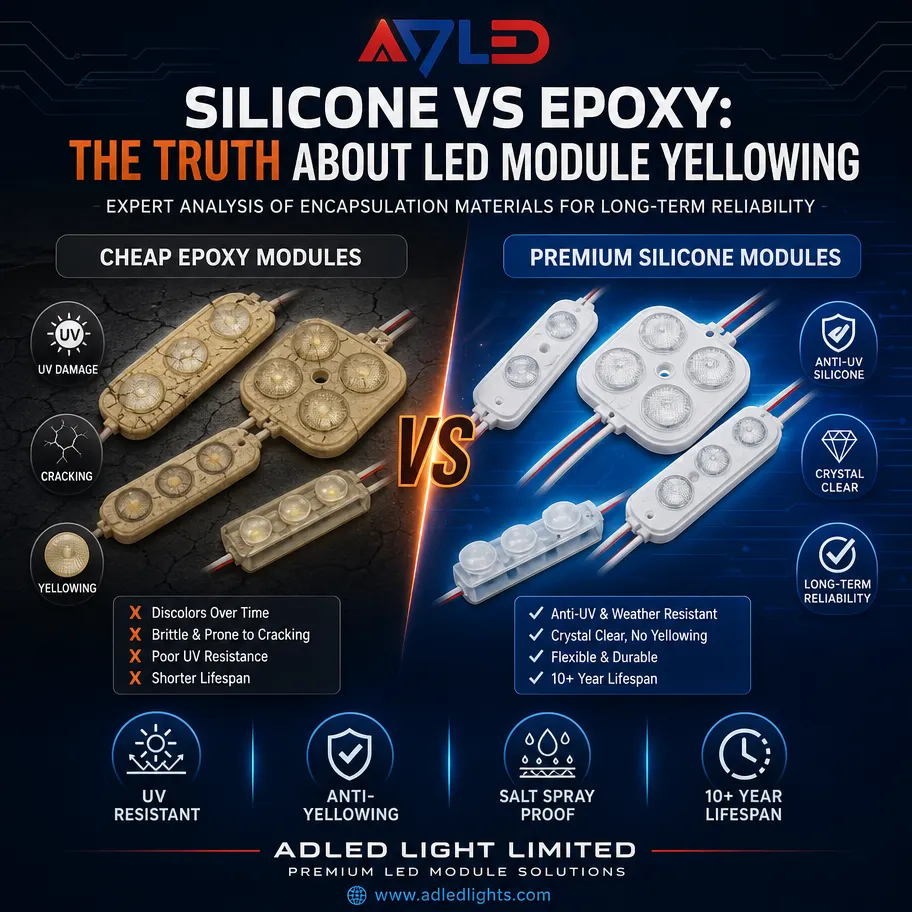
In the world of LED module wholesale, price wars often lead manufacturers to substitute optical grade silicone with cheap epoxy resin. At a glance, they look identical. However, the LED module silicone vs epoxy debate is the most critical technical distinction for any signage lighting manufacturer.
Epoxy resin degradation is a common failure point. Epoxy is a rigid polymer. While it is cheap and offers good initial structural integrity, it has poor thermal stability. Under the heat cycles of a digital signage backlight, epoxy becomes brittle. Its high thermal expansion coefficient causes it to pull away from the LED chip, leading to encapsulant cracking and total failure. More importantly, epoxy has almost zero uv aging resistance.
In contrast, silicone encapsulation is the gold standard. Silicone is an elastomer with high elasticity vs brittleness performance. It remains flexible from -40°C to 150°C, making it ideal for outdoor weatherability. Silicone possesses a unique chemical structure that is transparent to UV light, meaning it does not absorb the energy that causes yellowing. Choosing a direct manufacturer that prioritizes silicone ensures that your bulk LED modules won't require a total replacement in six months. For a global LED distributor, selling epoxy-based modules is a liability that destroys supply chain reliability.

Identifying Anti-yellowing LED Modules: What Premium Signage Makers Look For

Professional sign makers do not just buy lights; they buy peace of mind. To source true anti-yellowing LED modules, you must look beyond the spec sheet. High-end signage maintenance tips always suggest verifying the potting compound quality.
True anti-yellowing technology is found in the purity of the silicone. Premium modules use silicone with a high refractive index to maximize light output while maintaining clarity grade. When evaluating a professional LED supplier, ask for their LED encapsulation material properties report. Look for keywords like gas permeability and chemical resistance.
A custom LED modules provider like ADLED uses specific formulations that prevent sulfuration—a common issue where atmospheric pollutants penetrate the module and turn the silver plating on the LED chip black. By ensuring a tight hermetic sealing, we provide a B2B LED solutions package that keeps retail store fronts and luxury brand signage looking brand new for years.
LED Encapsulation Material Properties ,Long-term Reliability of LED Modules

UV Resistant LED Sign Lighting: Surviving Harsh Sunlight and Extreme Climates

For an engineering contractors in extreme climate environments, the environment is the enemy. Whether it is the intense UV of a middle east signage project or the arctic cold performance required for canadian winter ready installations, the module must be harsh environment rated.
Uv resistant LED sign lighting requires more than just silicone; it requires a holistic approach to environmental resilience. This includes a self-cleaning surface to prevent dust buildup that can accelerate heat retention, and an anti-oxidation coating protecting the PCB from corrosion resistance issues in coastal environment ready areas. Salt spray resistant housing is also essential for high-rise building logos near the ocean.
Our modules undergo an accelerated aging test and a 1000-hour uv test to simulate years of exposure in desert climate rated conditions. This ensures that even in high uv exposure areas, the color shift prevention remains within a 3-step macadam ellipse. For project-based LED supply, this level of testing is the only way to guarantee the signage will last the duration of the contract.

Beyond Color Shift: How Poor Encapsulation Destroys Your Brand’s Visual Identity

For corporate identity signs and bank logo consistency, color is the brand. If a global LED distributor provides modules that yellow at different rates, the batch uniformity is lost.
Imagine a gas station canopy where three letters are bright white and two are dingy yellow. This inconsistency signals a lack of quality and professionalism to the consumer. This is why one bin only binning strategies are vital. When paired with high-quality silicone, one bin only ensures that every module across multiple lightboxes or fascia signage projects remains perfectly matched.
Poor encapsulation also leads to no visual flicker issues and voltage drop compensation failures as the internal components corrode. For airport wayfinding and metro station signs, these failures are not just ugly—they are functional hazards. By investing in premium LED sourcing, brand managers protect their brand reputation protection and ensure performance consistency across global fleets.

Testing for Excellence: From One Bin Only to 1000-Hour UV Resistance Tests

At our iso9001 factory, we do not guess—we measure. Our 7-step qc process is designed to filter out the vulnerabilities that cause yellowing. Every batch of commercial grade LED modules is subjected to rigorous testing.
Thermal cycling robustness involves moving from extreme heat to extreme cold to test shore hardness and flexibility. We prioritize ip rating certification, testing for ip68 waterproof and ip67 protection to ensure no moisture ingress. Furthermore, we verify lumen maintenance and the l70 lifespan to guarantee operational longevity.
We use premium Lumileds chips and are a proud Samsung LED partner, ensuring that the engine of our module is as reliable as the encapsulation. Every project comes with quality inspection reports and lm-80 tested LEDs data, giving authorized LED vendors the evidence they need to win competitive bids. Ensuring color rendering accuracy and a high cri 90+ is standard for our hospitality lighting and casino brilliance projects.
LED Encapsulation Material Properties ,Long-term Reliability of LED Modules

Long-term Reliability of LED Modules: The Key to Lowering Maintenance Costs

The total cost of ownership (tco) is the only metric that matters for industrial lighting supply. While a bulk discount available on cheap modules might save 10% upfront, the replacement cost savings of a premium module are massive.
Consider a pylon sign modules installation on a highway. The cost of the modules is less than 5% of the total project. However, if they fail, the cost of renting a crane and blocking traffic to replace them is astronomical. By focusing on long-term reliability of LED modules, we offer a maintenance-free lighting solution that provides a much higher roi on premium LED.
Our 7-year warranty and 12-year service life expectations are backed by field-proven performance. We help our clients achieve sustainable signage lighting by reducing waste and ensuring low depreciation of light output over a decade of use. For those looking for a professional LED supplier, we offer industry leader insights to help you avoid the pitfalls of cheap manufacturing.
Long-term Reliability of LED Modules

Conclusion: Why Adled Light Limited is the Trusted Partner for Global CI/VI Projects

After 13 years as an industry leader insights provider and contract lighting manufacturer, ADLED Light Limited understands that our success is tied to your project’s success. We provide scalable lighting solutions that address the specific needs of architectural contours, cove lighting, and outdoor billboard LED.
Whether you need to check stock availability for a fast-moving retail store fronts rollout or require a custom solution request for a complex edge-lit signage project, our team is ready. We do not just offer wholesale pricing; we offer reliable sourcing and technical support that helps you secure your project roi.
Don't let cheap encapsulation turn your brand yellow. Choose the premium LED sourcing partner that understands the chemistry of light. We invite you to compare models and see why our high-efficiency LED components are the best LED for signage in the market today.
Ready to upgrade your signage standards?
  • Contact our engineers to get a quote for your next global ci/vi project.
  • Click here to request a sample kit and witness our non-yellowing technology.
  • Visit our site to download specification pdf for our anti-yellowing LED modules.
  • Inquire now to check stock availability and fast global shipping options.
  • Partner with us to experience the benefits of traceable batch numbers and global project references.
Experience the difference that 13 years of China LED factory expertise makes. Visit //www.adledlights.com and let’s build something brilliant together.
LED Module Silicone vs Epoxy  Contact us

Frequently Asked Questions: Expert Insights on LED Module Reliability

Why do white LED modules in outdoor signages develop a yellowish tint after several months?

The primary reason for discoloration is the degradation of the encapsulation material. While many suppliers in the China LED factory market use epoxy to reduce costs, this material has poor UV resistance and low thermal stability. Under constant sunlight and heat, epoxy undergoes photothermal oxidation, breaking the material molecular bond and causing a permanent color shift. At ADLED, we use optical grade silicone with superior clarity retention to ensure our anti-yellowing LED modules maintain their original CCT for years, even in high UV exposure areas.

What is the difference between Silicone and Epoxy encapsulation for outdoor LED modules?

The LED module silicone vs epoxy debate centers on long-term reliability of LED modules. Epoxy is rigid and prone to encapsulant cracking due to its high thermal expansion coefficient. Conversely, silicone encapsulation is an elastomer with excellent elasticity vs brittleness properties. It remains flexible during extreme temperature cycles, which is critical for outdoor weatherability. For a signage lighting manufacturer, choosing silicone means fewer service calls and a much higher ROI on premium LED components.

How does ADLED ensure color consistency across large-scale CI/VI branding projects?

For global corporate identity signs, color uniformity is non-negotiable. We implement a strict one bin only binning strategy, ensuring that every module in your high-volume LED purchase comes from the same production batch. By maintaining SDCM < 3 (MacAdam Ellipse 3-step), we eliminate visible color variance between different store locations. This level of batch uniformity is why we are a trusted professional LED supplier for luxury brands and financial institutions worldwide.

Can your LED modules withstand extreme climates like Middle Eastern heat or Canadian winters?

Yes, our modules are specifically harsh environment rated. For middle east signage, our uv resistant LED sign lighting features high heat dissipation efficiency to prevent thermal degradation. For canadian winter ready projects, our silicone remains flexible at sub-zero temperatures, preventing moisture ingress. Our products undergo an accelerated aging test and are ip68 waterproof certified, ensuring all-weather reliability from the desert to the arctic.

How do high-quality modules reduce the Total Cost of Ownership (TCO) for sign makers?

While bulk LED modules with cheap components have a lower initial price, their replacement cost savings are non-existent. Failures in channel letter lighting or pylon sign modules often require expensive crane rentals and labor. By investing in commercial grade LED solutions with a 7-year warranty and l70 lifespan, you significantly reduce maintenance-free lighting expenses. High luminous efficacy (up to 200 lm/W) also lowers energy bills, providing a clear cost-benefit analysis for the end-user.

What certifications should I look for when sourcing professional LED modules?

A reliable contract lighting manufacturer should provide full transparency. You should look for UL listed modules, CE certification, and RoHS compliance. Furthermore, check for LM-80 tested LEDs data and IP rating certification from third-party labs. At ADLED, our iso9001 factory follows a 7-step qc process, and we provide detailed quality inspection reports to ensure all B2B LED solutions meet international durability standards.
Contact ADLED for LED Module