2025-04-28
WS2811 vs. WS2812B: A Comprehensive Technical Comparison
In the world of dynamic lighting, the names WS2811 and WS2812B are legendary. Whether you are an architect designing a "breathing" skyscraper facade, a sign maker crafting a high-density cyberpunk billboard, or a hobbyist building a reactive gaming setup, these two chipsets are likely at the top of your list.
However, while they share a similar DNA and the same single-wire control protocol, they are far from identical. Choosing the wrong one can lead to significant headaches—ranging from severe voltage drops on long runs to overly complex wiring on compact projects. One is a standalone driver IC that offers industrial-grade flexibility and 12V stability, while the other is a compact, all-in-one smart LED that revolutionized the "plug-and-play" market.
In this comprehensive technical comparison, we’ll LED strip away the jargon to look at the structural differences, power requirements, and thermal management of both. By the end of this guide, you’ll know exactly which "magic" LED is the right fit for your specific application.
1. What Are WS2811 and WS2812B?
2. Structural and Design Differences
3. Data Protocol and Performance Comparison
4. LED Control Mechanisms
5. Power Consumption and Thermal Management
6. Pros and Cons Summary
7. Application Scenarios
8. How to Choose: Decision Factors
9. Final Summary
2. Structural and Design Differences
3. Data Protocol and Performance Comparison
4. LED Control Mechanisms
5. Power Consumption and Thermal Management
6. Pros and Cons Summary
7. Application Scenarios
8. How to Choose: Decision Factors
9. Final Summary
1. What Are WS2811 and WS2812B?
WS2811: The Flexible Driver IC
The WS2811 is a standalone LED driver integrated circuit (IC) developed by Worldsemi. Designed for addressable RGB LED applications, it acts as a controller for external LEDs.
-
Key Features:
-
Requires external MOSFETs and RGB LEDs to form a complete circuit.
-
Operates at 12V DC, ideal for long-distance LED strips.
-
Uses PWM (Pulse Width Modulation) for precise color and brightness control.
-
WS2812B: The All-in-One Smart LED
The WS2812B is a fully integrated addressable LED module combining a driver IC and an RGB LED in a single 5050 (5mm x 5mm) package.
-
Key Features:
-
No external components needed—plug-and-play design.
-
Standard 5V DC operation, compatible with most microcontrollers.
-
Supports daisy-chaining for large-scale installations.
-
2. Structural and Design Differences
Technical Comparison: WS2811 vs. WS2812B Architecture
|
Feature
|
WS2811: Modular Architecture
|
WS2812B: Compact Integration
|
|
Circuit Composition
|
External IC + MOSFETs + RGB LEDs
|
Driver IC & RGB LED co-packaged (5050)
|
|
Design Requirement
|
Requires custom PCB for component integration
|
Pre-wired and ready for "plug-and-play"
|
|
Operating Voltage
|
12V DC (Typical)
|
5V DC (Standard)
|
|
Voltage Drop
|
Low: Minimized over long runs (>10m)
|
High: Restricts maximum LED strip length
|
|
Customization
|
High: Choose specific LED power/color
|
None: Fixed, non-replaceable specs
|
|
Physical Size
|
Larger footprint due to external parts
|
Space-saving, miniaturized design
|
|
Ease of Use
|
Complex wiring and soldering required
|
Simplified prototyping (Arduino/Pi)
|
|
Ideal For
|
Industrial signage & large-scale facades
|
Wearables, DIY projects & small gadgets
|
3. Data Protocol and Performance Comparison
Control Protocol Compatibility
-
Shared Protocol:
-
Both use a single-wire serial communication protocol (800 kHz for WS2812B vs. 400 kHz for WS2811).
-
Compatible with popular libraries like FastLED and Adafruit NeoPixel.
-
-
Key Differences:
-
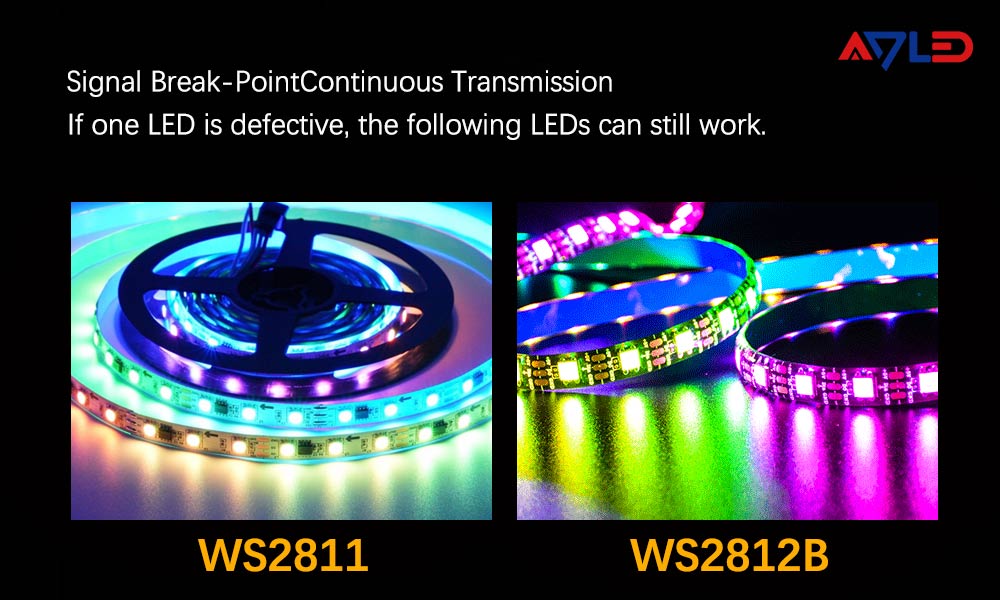
WS2811 relies on external PWM generation, while WS2812B includes internal signal reshaping for noise immunity.
-
Performance Metrics
|
Parameter
|
WS2811
|
WS2812B
|
|
Signal Frequency
|
400 kHz
|
800 kHz
|
|
Max Cascade Length
|
1,024 LEDs (12V)
|
1,024 LEDs (5V)
|
|
Signal Stability
|
Requires external buffering
|
Built-in signal regeneration
|
|
Response Time
|
~1.25 µs per LED
|
~0.8 µs per LED
|
4. LED Control Mechanisms
WS2811 LED Control
-
Uses external MOSFETs to drive LEDs, supporting higher current loads (up to 20mA per channel).
-
Allows customization of LED types (e.g., high-power, waterproof variants).
WS2812B LED Control
-
Built-in constant-current driver (18.5mA per channel).
-
Fixed LED configuration—no option to swap individual LEDs.
5. Power Consumption and Thermal Management
Power Efficiency
|
Parameter
|
WS2811 (12V System)
|
WS2812B (5V System)
|
|
Single LED Power (Full White)
|
0.3W
|
0.2W
|
|
Power per Meter (60 LEDs)
|
18W
|
12W
|
-
WS2811: Higher voltage reduces current draw for long LED strips but increases total power usage.
-
WS2812B: Lower voltage requires thicker power cables for high-density setups.
Thermal Considerations
-
WS2811: Heat distributed across MOSFETs and LEDs—passive cooling often sufficient.
-
WS2812B: Concentrated heat in compact packages—active cooling (e.g., heatsinks) recommended for dense arrays.
6. Pros and Cons Summary
WS2811
-
Pros:
-
High-voltage support for industrial applications.
-
Component-level repairability (replace individual parts).
-
Cost-effective for bulk production.
-
-
Cons:
-
Steep learning curve for beginners.
-
Higher overall system complexity.
-
WS2812B
-
Pros:
-
Beginner-friendly with minimal wiring.
-
Compact size for portable projects.
-
Extensive online community support.
-
-
Cons:
-
Limited to 5V power, requiring voltage boosters for long LED strips.
-
Irreparable if an LED fails (entire module replacement needed).
-
7. Application Scenarios
WS2811 Use Cases
-
Architectural Lighting: Facade illumination, highway signage.
-
Automotive Lighting: Customizable interior/exterior LED setups.
-
Large-Scale Installations: Theme parks, stadiums (12V power advantage).
WS2812B Use Cases
-
DIY Electronics: IoT gadgets, interactive art installations.
-
Wearable Tech: Smart costumes, LED accessories.
-
Home Automation: Under-cabinet lighting, holiday decorations.
8. How to Choose: Decision Factors
|
Factor
|
Choose WS2811 If...
|
Choose WS2812B If...
|
|
Voltage Requirements
|
Long LED strips (12V needed)
|
Short LED strips (5V USB-compatible)
|
|
Customization
|
Flexible LED/MOSFET selection
|
Prefer plug-and-play simplicity
|
|
Budget
|
Bulk orders with lower per-unit costs
|
Small-scale prototypes
|
|
Space Constraints
|
Adequate space for external parts
|
Compact designs (e.g., wearables)
|
|
Technical Skill
|
Experienced in circuit design
|
Beginner or rapid development
|
9. Final Summary
The WS2811 and WS2812B cater to distinct needs in the addressable LED ecosystem:
-
WS2811 excels in professional, high-voltage environments demanding customization.
-
WS2812B dominates hobbyist and space-constrained applications with its simplicity.
10. FAQ
Can I mix WS2811 and WS2812B in the same project?
Not directly. Their voltage and protocol differences require separate power supplies and signal conditioning.
Why does my WS2812B LED strip flicker?
Common causes include insufficient power (add capacitors) or signal degradation (use a logic level shifter).
How to extend WS2811 signal range beyond 10 meters?
Use signal repeaters (e.g., SN74AHCT125N) or segment the LED strip with additional power injection.
Can you cut the WS2812B LED strip?
Virtually all WS2812b LED strips can be cut into multiple smaller LED strips. Each copper soldering disk can be cut in half and used to join the sections together. Wires can be soldered to both ends.
What is the difference between WS2811 and WS2812?
The ws2811 LED strip is an external LED strip with a ws2811 LED strip. Normally it runs on 12V or 24V, so the voltage drop is limited and we can make longer connections.
What power supply is needed for the WS2812B?
The WS2812 and WS2812B require an input voltage of approximately 5 V. The WS2812 should operate between 3.3 V and 5 V and the WS2812B should operate between 4 V and 7 V.
Is RGBW better than RGB?
If you only need basic RGB colors and don't need white, then a basic RGB LED strip is usually the cheaper option. On the other hand, if you need white color for something like task lighting, then the RGB+W option is better for you.
Does the WS2812B need a resistor?
The inputs of the WS2812 operate without resistors.
How does the reset time of the WS2813 compare to the reset time of the WS2815?
The reset time is 250us for the ws2813 and 250us for the ws2815, which allows the WS2813 LED to work better at lower frequencies and in less expensive microcontrollers.
WS2811 VS SM16703 VS UCS1903, which one is better?
The SM16703 and UCS1903 are functionally identical to the ws2811 and look the same. It is not possible to determine the item type without looking closely at the markings on the IC module. They are both 3-pin, positive + negative + single data line.
The SM16703 and UCS1903 are clones based on the ws2811, just like the sk6812 is an upgraded version based on the ws2812 LED. Also, they are from different companies.