

2026-05-20
How to Choose the Right Lightbox Light Source: Eliminate Hotspots in Slim SEG Signs
How to Choose the Right Lightbox Light Source: Eliminate Hotspots in Slim SEG Signs
Introduction: The Hidden Vulnerability in Modern Signage Aesthetics
There is an unmistakable shift in contemporary retail and architectural design toward minimalist elegance. From five-star hotel lobbies to high-end luxury boutiques, brands are heavily investing in ultra-slim, frameless visual elements to elevate their environments. Among these, the integration of linear lighting and backlit graphic displays has become a cornerstone of sophisticated corporate branding and hospitality lighting design.
However, as lightboxes become thinner and fabric graphics become more tensioned, a critical vulnerability emerges: the choice of the internal lightbox light source. When budget-grade lighting components are specified, the structural design is instantly compromised by uneven light distribution, localized shadows, and the dreaded "ladder effect."
For sign makers, exhibition builders, and lighting designers, selecting a substandard lighting solution introduces catastrophic low-quality LED strip risks. Premature lumen depreciation, erratic color shifting, and high on-site maintenance costs can rapidly turn a premium architectural asset into a liability.
Choosing the right lightbox light source is critical for achieving bright, uniform, and energy-efficient advertising displays. Whether you manufacture SEG fabric lightboxes, aluminum snap frame signs, or retail display units, this guide helps you select the optimal LED lightbox lighting for professional results.
What Is a Lightbox Light Source?
A lightbox light source refers to the LED lighting system installed inside advertising lightboxes to illuminate graphics, logos, or promotional content evenly. Modern solutions prioritize:
-
High uniformity (>90% brightness consistency)
-
Energy efficiency (low power consumption, 24V constant current)
-
Long lifespan (50,000+ hours)
-
Easy installation & maintenance
For professional signage, always choose CE/RoHS-certified LED modules or LED bar Light to ensure safety and compliance in global markets.
Main Types of LED Light Sources for Light Boxes
Different light box structures require different lighting solutions. Selecting the correct type of LED source is essential for achieving optimal lighting performance.
1. LED Modules
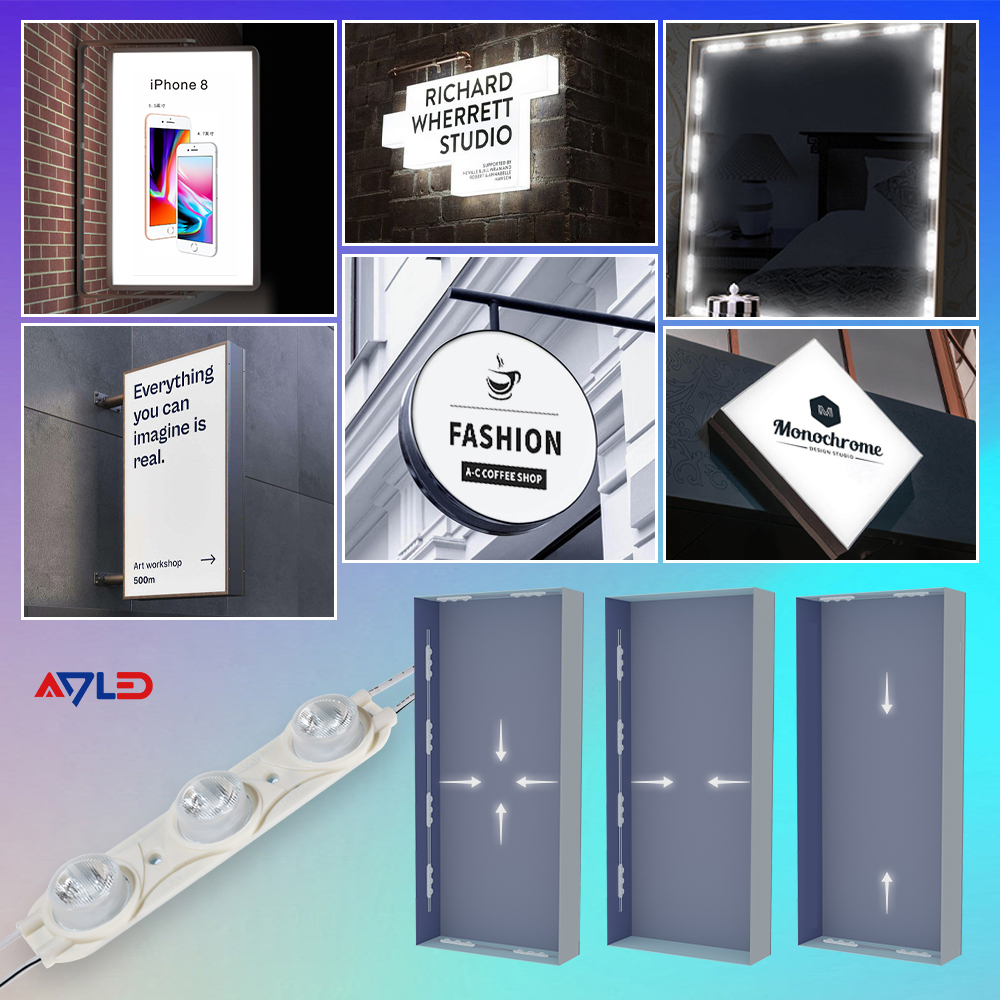
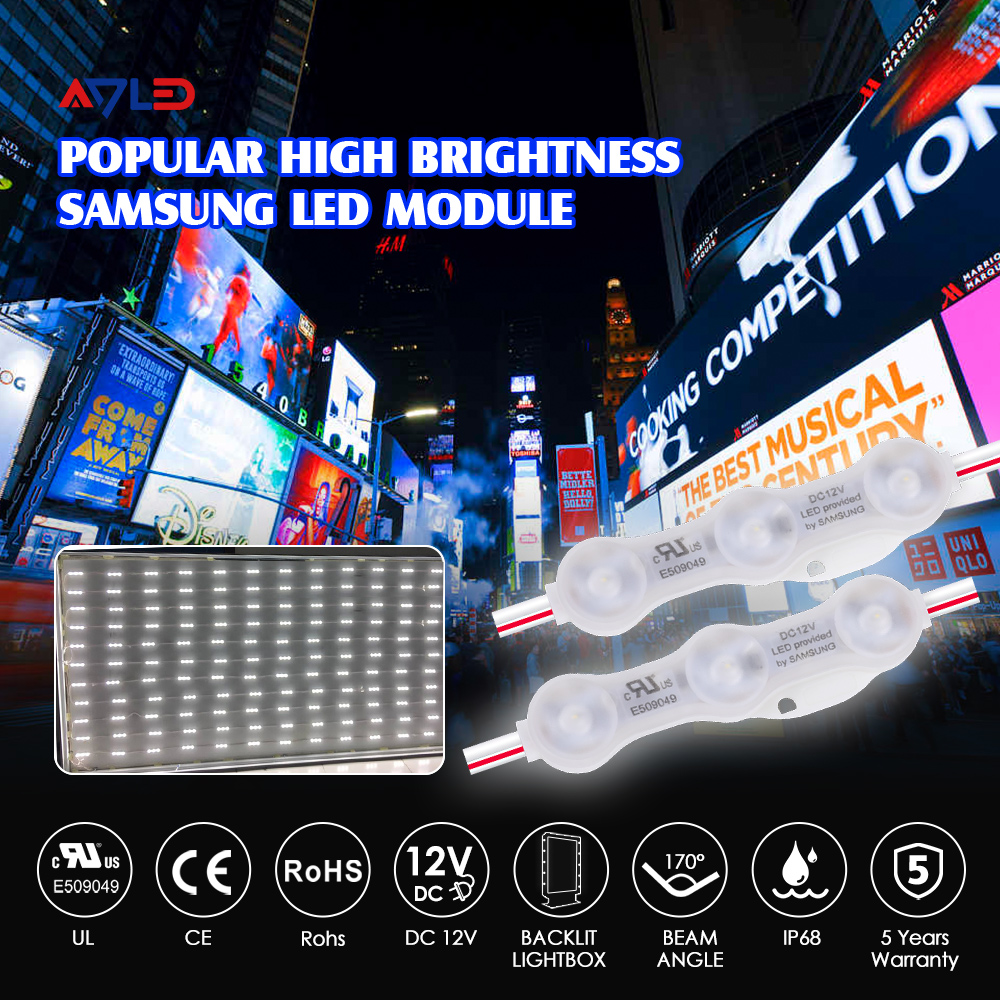
Engineered primarily for heavy-duty commercial cabinetry, 3D channel letters, and deep-cavity enclosures, injection-molded LED modules feature localized secondary optics and robust physical armor.
Optimal Application Framework:
-
High-exposure outdoor architectural signage
-
Large-format backlit fabric lightboxes (SEG)
-
Heavy-gauge thermoformed acrylic sign boxes
-
Double-sided illuminated monument signs
Performance Benchmarks:
-
Optical Dispersion: Integrated 170° batwing PMMA lenses to eliminate localized shadowing and the "ladder effect."
-
Environmental Protection: Solid-silicone potting delivering certified IP65, IP67, or IP68 waterproof ratings for extreme climate.
-
Thermal Management: Exposed aluminum backplanes paired with constant-current IC drivers to prevent thermal runaway and phosphor yellowing.
2. High-Density & COB LED Strips

Designed for low-profile architectural reveals and linear snap-frames, high-density flexible LED strips minimize pitch distance to provide uninterrupted, homogeneous light vectors in highly restricted clearances.
Optimal Application Framework:
-
Ultra-slim profile retail graphics frames (<50mm depth)
-
Luxury cosmetic showcase and retail shelf displays
-
Indirect architectural coves and stretch ceiling perimeter accents
-
Intricate decorative commercial signage
Performance Benchmarks:
-
Dot-Free Resolution: High diode density (up to 810 or 1600 LEDs/m) or Chip-on-Board (COB) architecture to guarantee 100% spot-free, continuous diffusion.
-
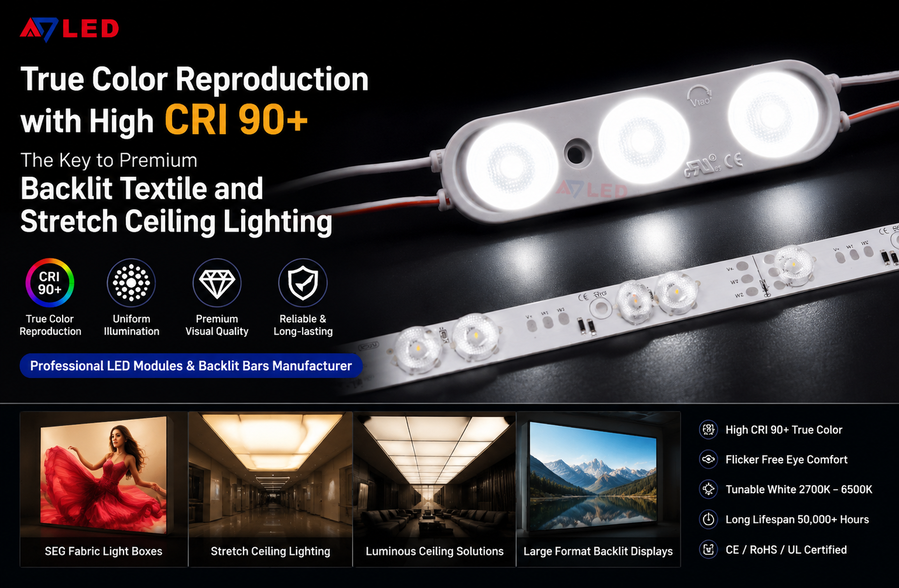
Color Fidelity: High Color Rendering Index (CRI ≥90, with optimized R9≥90metrics) to preserve accurate brand asset color reproduction under fabric tension.
-
Mechanical Elasticity: Field-cuttable, highly flexible copper PCBs (3oz weight) supporting seamless tracing around complex curves.
3. Edge-Lit LED Bars
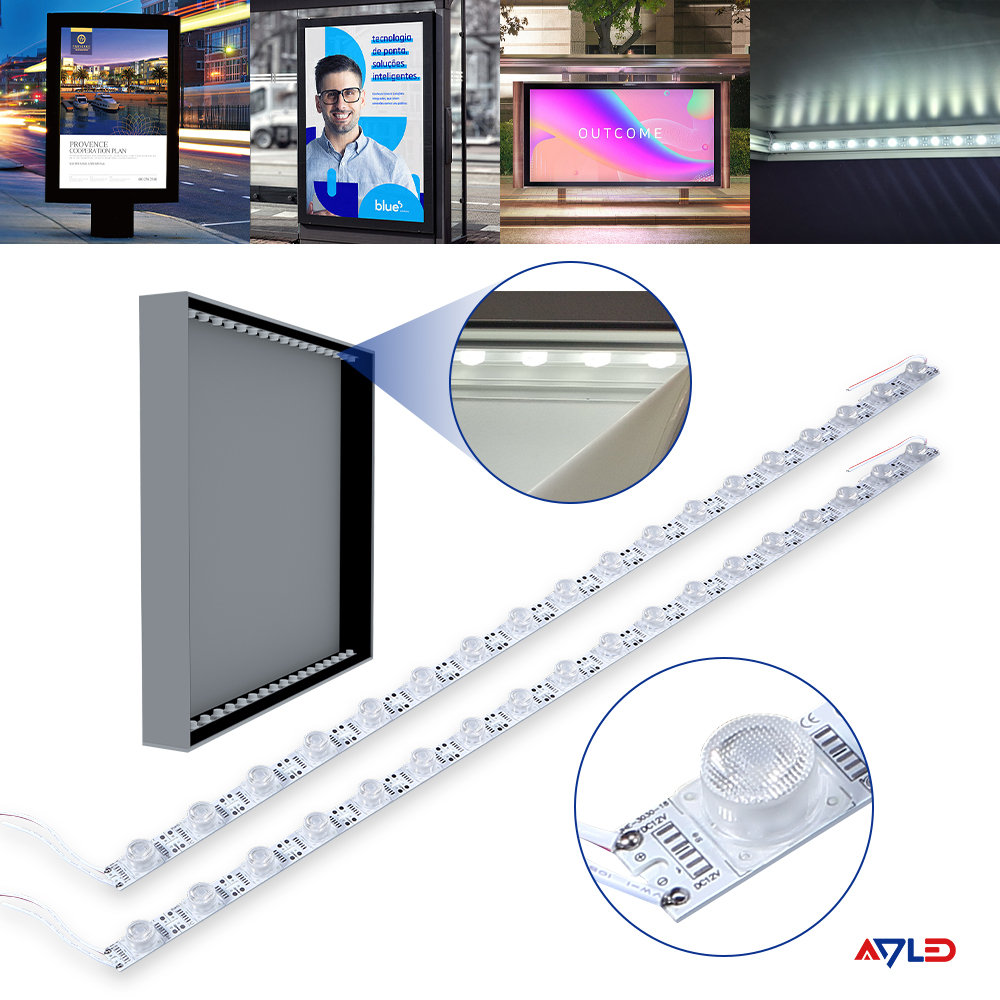
Engineered exclusively for perimeter-mounted routing, edge-lit rigid aluminum bars utilize narrow, directional optics to project intense luminous flux horizontally across an open cavity or light guide panel (LGP).
Optimal Application Framework:
-
Ultra-thin double-sided hanging sign cabinets (e.g., airport terminal totems, transit hubs)
-
Premium retail fabric displays where rear mounting backing is unavailable
-
Sleek architectural glass framing systems
Performance Benchmarks:
-
Linear Punch Geometry: Narrow elliptical or asymmetric lenses (e.g., 15°×45° or 10°×60°) focusing light tightly across spans exceeding 2,000mm to 3,000mm without center brightness drop-off.
-
Structural Optimization: Rigid structural aluminum extrusions acting as self-contained heat sinks, radically minimizing sagging and cabinet material weight.
-
Value Engineering: Minimizes total internal component footprint, delivering a lightweight layout that lowers downstream international shipping and site-handling costs.
4. Backlit LED Bars

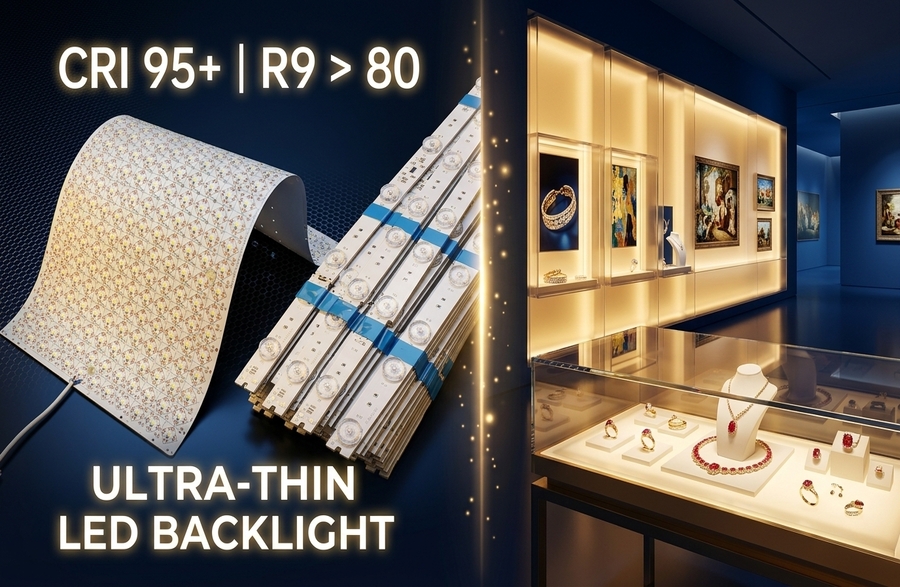
Rigid backlit LED bars are engineered for large-scale, single-sided lightboxes requiring absolute flatness and high lumen density. Unlike flexible strips, these linear bars are built on rigid aluminum printed circuit boards (PCBs) to maintain structural integrity across wide spans.
Optimal Application Framework:
-
Medium to large-format commercial signage cabinets
-
Airport and transit terminal interior advertising displays
-
Airport terminal wall-mounted textile frames
-
Standard architectural backlit panels and lightbox retrofits
Performance Benchmarks:
-
Optical Uniformity: Equipped with mid-power high-efficiency SMD chips and wide-angle diffusion lenses to allow tight spacing and uniform blending at a restricted depth.
-
Thermal Efficiency: The rigid aluminum base provides a direct thermal path to pull heat away from the LED junctions, ensuring a long operational lifespan and minimal lumen degradation under continuous 24/7 commercial operation.
-
Simplified Installation: Pre-drilled screw holes and plug-and-play snap connectors allow rapid, secure alignment onto internal mounting rails without sagging.
5. Lattice LED Backlights

The modular lattice system represents the pinnacle of macro-scale lighting engineering. Designed as a flexible, roll-up grid array, it features rigid light bars pre-wired at precise geometric intervals using heavy-duty, flexible copper cabling.
Optimal Application Framework:
-
Massive, large-format SEG fabric lightboxes (exceeding 3 meters)
-
Architectural luminous walls and grand lobby stretch ceiling installations
-
Fast-assembly exhibition booths and modular trade show display structures
-
Mega-scale outdoor sign cabinets and airport billboard displays
Performance Benchmarks:
-
Macro Scalability: Arrives on-site as a consolidated, roll-up curtain that can be deployed across a 10-square-meter cavity in minutes, cutting manual installation labor time by up to 75% compared to discrete module placement.
-
Electrical Redundancy: Utilizes 24V or 48V constant-current (CC) circuitry with integrated IC drivers on every bar. This setup locks the current across extensive single-ended runs up to 15 or 30 meters, eliminating voltage drop and color shifting.
-
Field Adaptability: The flexible interconnecting wires can be cut between any bar segment, allowing installers to tailor the lattice array to exact frame dimensions directly on-site without breaking circuit continuity.
How To Eliminate Hotspots in Slim SEG Lightboxes?
In the commercial signage and visual merchandising industries, the push toward minimalist, ultra-slim Silicone Edge Graphic (SEG) lightboxes introduces a demanding engineering challenge: eliminating hotspots (localized points of high light intensity that expose individual LED nodes through the translucent fabric face).
When the structural depth—traditionally referred to in optical engineering as the Optical Distance (OD)—is compressed below 50mm, standard 120° bare LED emissions fail to overlap adequately, creating dark bands or the dreaded "ladder effect" . Achieving a homogeneous, premium visual presentation within slim frames requires balancing secondary optics, geometric pitch formulas, and fabric attenuation.
1. The Fundamental Target: The S:OD Ratio
The primary geometric constraint governing light box uniformity is the relationship between Pitch (S)—the center-to-center distance between adjacent LED nodes—and the Optical Distance (OD), which is the clearance between the top of the LED lens and the diffuser fabric.
Target Uniformity Ratio: S/OD≤3:1
For deep, traditional sign cabinets (OD≥100mm), an S:OD ratio of 3:1 allows loose, unlensed LEDs to blend seamlessly. However, when engineering slim SEG profiles where the OD is restricted to 35mm to 50mm, maintaining a 3:1 ratio with standard LEDs requires packing nodes tightly together, which drives up component costs, power consumption, and thermal loads.
2. Deploying 170° Secondary Batwing Optics
To keep the S:OD ratio wide and cost-effective in slim enclosures, sign builders swap standard LEDs for nodes integrated with secondary optics.
| Standard 120° Lens | Premium 170° Wide-Angle Optics |
| Requires Deep Cavity | Slim Cavity |
| Diffuser Fabric | Diffuser Fabric |
|
/ | \
/ | \
/ | \
|
/ / | \ \
/ / | \ \
/ / | \ \
|
| [120° LED] [120° LED] [120° LED] | ---- 170° Wide-Angle LED ---- |
| Result: Visible Hot Spots | Result: Flawless, Even Blending |
Standard diodes exhibit a Lambertian radiation pattern where peak luminous intensity concentrates directly on-axis (0°). By capping individual nodes with an optical-grade PMMA batwing lens, the light path is refracted horizontally.The lens suppresses center-axis light and redirects it outward at a wide 170° angle. This wide optical footprint allows the light cones to overlap uniformly at a fraction of the vertical distance, eliminating hotspots in frames as thin as 35mm while requiring up to 30% fewer LEDs per square meter.
By widening the optical footprint, the light rays overlap perfectly at a much shorter distance. This advanced optical distribution enables the fabrication of ultra-thin profiles down to a depth of 35mm, while allowing sign builders to use fewer rows of LEDs. This reduction cuts component costs and minimizes assembly labor, providing a true low profile LED backlighting system without compromising on luminance uniformity.
3. Selecting the Correct Component Architecture
Depending on the dimensions and installation environment of the slim SEG frame, select one of three optimized architectural configurations to combat hot spots:
|
Component Type
|
Mechanical Layout
|
Ideal Profile Depth (OD)
|
Technical Advantage
|
|
Wide-Angle LED Modules
|
Pre-wired injection-molded block strings anchored along the backplate.
|
40mm - 60mm
|
Robust IP67/IP68 environmental defense; ideal for high-exposure or outdoor signage.
|
|
Rigid Backlit LED Bars
|
Linear aluminum PCBs featuring integrated lenses, mounted in rows.
|
35mm - 50mm
|
Aluminum base serves as a self-contained heat sink, preventing thermal color shifting.
|
|
Roll-Up Lattice Curtains
|
A pre-spaced grid of rigid light bars linked via flexible copper cabling.
|
40mm - 50mm
|
Scalable for grand-format signs; reduces on-site manual assembly time by up to 75%.
|
4. Maximizing Fabric Diffusion & Attenuation
The secondary optics are only half of the optical equation; the physical properties of the textile face play a major role in scattering the remaining direct light vectors.
-
Specify Woven Polyurethane Diffusers: Standard cheap polyester banners lack adequate opacity. Premium SEG projects require heavy-weight, woven polyurethane or silicone-coated diffuser textiles (typically 180g/㎡ to 250g/㎡) engineered specifically for backlighting.
-
Verify Light Transmittance Ratings: Aim for a textile with a light transmittance rating of 60% to 70%. Lower transmittance cuts too much brightness, while higher transmittance allows the raw shape of the LED node to bleed through.
-
Integrate an Internal Diffuser Film: If the mechanical profile cannot be expanded beyond 30mm, stretch a secondary, highly translucent clear diffuser film or thin blockout woven liner roughly 10mm below the primary graphic face to serve as a pre-homogenizing filter.
5. Thermal Management & Electrical Stabilization
Hotspots can also develop over time due to component degradation caused by poor thermal management and voltage drops.
-
Prevent Thermal Color Drifting: Diodes operating inside sealed, ultra-thin profiles build up intense heat pockets. If the layout lacks adequate dissipation, the heat degrades the internal phosphor coating, triggering localized lumen depreciation and a green/yellow color shift. Always mount rigid LED bars directly onto the aluminum frame profiles to channel heat away.
-
Enforce Constant Current Circuits: For large SEG signs with continuous runs exceeding 5 meters, standard constant voltage strips suffer from resistance, causing the far ends of the run to dim and warm up. Utilizing a constant current (CC) electrical architecture ensures that independent onboard ICs lock the exact same milliampere current to every diode, keeping brightness completely uniform across the entire fabric layout.
Choosing Your Lighting Architecture: Backlit vs. Edge-Lit Systems
When planning a commercial signage project, engineers must first establish the mechanical routing of the illumination system. Choosing between a backlit configuration and an edge-lit configuration depends entirely on the depth, dimensions, and structural constraints of the enclosure.
For large, single-sided fabric frames and expansive wall-mounted displays, a dedicated LED backlight for lightboxes is the industry standard. This method positions the light source directly behind the diffusion graphic, delivering a punchy, high-lumen output across the entire surface area.
Conversely, when structural depths are extremely restricted or when a double-sided profile is required—such as in hanging concourse signs or projecting retail displays—specifiers shift toward an edge-lit LED strip for double sided signs. This setup utilizes high-power linear bars equipped with narrow elliptical lenses (e.g., 15°×45°), mounted to the perimeter frame, which shoot light across an internal light guide panel (LGP) or reflective cavity.
Understanding this distinction allows a commercial sign lighting supplier to deliver a reliable system layout engineered specifically to meet the mechanical realities of the architecture.
Edge-Lit vs Backlit Light Boxes
One of the most common questions in the signage industry is whether edge-lit or backlit lighting systems are better.
|
Lightbox Light Source
|
Edge-Lit Light Boxes
|
Backlit Light Boxes
|
|
Mechanical Layout
|
Edge-lit systems position LEDs along the sides of the panel. |
Backlit systems place LED modules directly behind the graphic surface. |
|
Best for
|
Slim light boxes
Indoor applications
Lightweight displays
Energy-saving projects
|
Large-format signage
Outdoor advertising
High-brightness applications
Fabric light boxes
|
|
Advantages
|
Ultra-thin design
Lower power consumption
Elegant appearance
|
Stronger brightness
Better illumination consistency
More suitable for large sizes
|
|
Limitations
|
Less suitable for very large displays
Brightness uniformity may depend on light guide quality
|
Greater installation depth required
Slightly higher energy consumption
|
For most commercial signage projects, backlit LED modules remain the preferred solution for maximum brightness and durability.
Installation & Maintenance Tips for Long-Lasting Performance
✅ Installation Best Practices
-
Use aluminum heat-dissipation channels to extend LED lifespan
-
Maintain 10-15mm distance between LED and diffuser for optimal uniformity
-
Test all modules before final assembly to avoid rework
🔧 Maintenance & Troubleshooting
|
Issue
|
Solution
|
|---|---|
|
Uneven lighting
|
Check LED spacing; add diffuser film; verify driver output
|
|
Flickering
|
Replace incompatible dimmer; check wiring connections
|
|
Dimming over time
|
Verify power supply capacity; clean dust from heat sinks
|
Managing Long-Distance Runs: Constant Current Electrical Stability
Large-scale commercial installations—such as transit hubs, airport terminal advertising walls, and grand hotel exterior sign cabinets—require long, continuous linear lighting runs. In these expansive configurations, standard constant voltage (CV) 12V or 24V LED circuits quickly exhibit their primary limitation: voltage drop.
Voltage drop occurs as electrical current travels through copper trace PCBs; resistance causes a progressive reduction in voltage toward the end of the run. In low-end lighting setups, this manifests as a visible decline in brightness and a noticeable color shift—where the end of a 10-meter run looks noticeably dimmer and warmer than the source end.
To eliminate this failure point across high-capacity LED sign cabinet lights, project engineers must specify a constant current LED backlight strip system. By anchoring independent, onboard integrated circuits (ICs) along the PCB, the system automatically regulates the milliampere current supplied to every individual LED node, regardless of supply line fluctuations or run distance.
Utilizing a constant current topology paired with upgraded 3-ounce copper traces allows continuous single-ended electrical inputs to extend up to 15 or 30 meters. This architecture guarantees perfect lumen consistency from the first module to the very last, delivering the electrical redundancy required by an architectural grade LED strip factory.
Important Factors When Choosing a Light Box LED Solution
1. Brightness Performance
Brightness is one of the most critical factors in signage lighting.
Insufficient brightness reduces advertisement visibility, especially in outdoor environments or brightly lit retail spaces.
When selecting LED products, evaluate:
-
Lumen output
-
Beam angle
-
LED chip quality
-
Power efficiency
High-brightness LED modules are recommended for outdoor and large-format applications.
2. Illumination Uniformity
Uneven lighting creates hot spots and shadow areas that reduce display quality.
To achieve smooth and uniform illumination:
-
Use high density LED strips
-
Select appropriate spacing between LEDs
-
Optimize cabinet depth
-
Use high-quality diffusion materials
Professional signage manufacturers prioritize lighting uniformity because it directly affects visual impact and customer perception.
3. Waterproof Protection
Outdoor signage requires reliable waterproof performance.
For exterior applications, LED products should provide:
-
IP65 protection or above
-
UV resistance
-
Stable operation under extreme temperatures
Poor waterproof performance can lead to early product failure and increased maintenance costs.
4. Heat Dissipation
Efficient thermal management significantly extends LED lifespan.
High-quality LED lighting systems typically include:
-
Aluminum PCB structures
-
Efficient heat sinks
-
Stable constant-current drivers
Lower operating temperatures help maintain brightness stability and reduce lumen depreciation over time.
5. Energy Efficiency
Commercial signage often operates for extended hours every day.
Energy-efficient LED solutions help businesses reduce electricity consumption while maintaining excellent display performance.
Modern LED modules consume substantially less power compared with fluorescent systems while delivering higher brightness levels.
6. Common Applications of Commercial Light Box Lighting
LED light sources are widely used in:
-
Retail store signage
-
Shopping mall advertising
-
Airport displays
-
Restaurant menu boards
-
Exhibition booths
-
Cinema signage
-
Metro station advertising
-
Brand image walls
-
Commercial building signage
Each application may require different lighting specifications depending on installation depth, brightness requirements, and environmental conditions.
FAQ About Lightbox Light Sources
What is the best light source for LED light box?
LED modules with constant current drivers offer the best balance of brightness, uniformity, and longevity for professional advertising lightboxes.
How to replace lightbox LED strips?
1. Power off and disconnect the old strip
2. Clean the aluminum channel
3. Apply new LED strip with 3M adhesive
4. Reconnect wiring (observe polarity)
5. Test before closing the frame
2. Clean the aluminum channel
3. Apply new LED strip with 3M adhesive
4. Reconnect wiring (observe polarity)
5. Test before closing the frame
Can I dim my lightbox light source?
Yes – choose dimmable LED modules compatible with 0-10V, PWM, or TRIAC dimmers. Always confirm driver compatibility before purchase.
How long do lightbox LEDs last?
High-quality LED light sources last 50,000-100,000 hours (5-10 years of 12-hour daily use). Factors like heat management and voltage stability significantly impact actual lifespan.
Why is my lightbox flickering?
Common causes: incompatible dimmer, loose wiring, or low-quality driver. Use certified LED modules with integrated constant-current drivers to minimize issues.
Why Partner with a Professional Lightbox Light Source Supplier?
For signage manufacturers and B2B buyers, sourcing from a specialized supplier delivers:
-
Technical support: Custom voltage, length, and mounting solutions
-
Quality assurance: CE, RoHS, UL, IP-rated certifications
-
Scalability: Bulk pricing, MOQ flexibility, OEM/ODM services
-
Global logistics: DDP shipping, regional warehouse support
Conclusion
Selecting the right LED light source for a light box is essential for achieving professional signage performance.
Whether using LED modules, high density LED strips, or edge-lit lighting systems, businesses should carefully evaluate brightness, uniformity, waterproof protection, energy efficiency, and installation requirements.
A well-designed lighting solution not only improves advertisement visibility but also enhances brand image and reduces long-term operational costs.
For commercial signage manufacturers, distributors, and project contractors, investing in reliable LED lighting technology is critical for delivering durable and visually impressive display solutions.
For more professional signage lighting solutions, high brightness LED modules, and high density LED strips, visit ADLED Light Limited.
Ready to Upgrade Your Lightbox Lighting?
Whether you need wholesale LED backlight modules,edgelight LED bar, custom OEM solutions, or technical guidance for your next project, our team specializes in professional lightbox light source systems for:
-
✅ Advertising sign manufacturers
-
✅ Retail display integrators
-
✅ Exhibition & event builders
-
✅ Architectural signage contractors
-
✅ Fabric lightbox manufacturer
📩 Get a Free Consultation: Share your lightbox specs (size, voltage, application), and we'll recommend the optimal LED solution with competitive B2B pricing.