

2024-08-26
LED Strip Lights Production Process
LED Strip Lights Production Process
LED strip lights have become an essential lighting solution for both commercial and residential applications, thanks to their flexibility, energy efficiency, and customizable design. Behind these versatile lighting products lies a precise and advanced production process that ensures consistent quality, high performance, and long lifespan. From selecting premium raw materials to automated SMT assembly and rigorous quality testing, every step in the LED strip light manufacturing process plays a crucial role in delivering reliable and innovative lighting solutions to the market. In this article, we’ll take you through the key stages of LED strip light production and highlight the technologies that make it all possible.
1. Raw material inspection
The raw material warehouse maintains a constant temperature and humidity environment, and strictly tests raw materials such as lamp beads, resistors, wires, and boards. Samples will be kept for each batch of lamp beads produced for the production of LED light strips, and the quality of the lamp beads will be tested under a microscope magnified 400 times to check the size and details of the lamp beads.

2. Printing solder paste
First stir the tin after warming it up, then put a small amount on the steel screen of the printer. Each LED lighting strips design is made with a stainless steel mold. The best amount is when the scraper moves forward and the tin reaches 3/2 of the scraper. After the first trial printing, pay attention to whether the tin at the LED pad position on the FPC is full, whether there is too little or too much tin, and also pay attention to whether there is a short circuit. This step is very critical. If it is not strictly controlled, it will cause poor quality later. Our company produces high-quality strip lights, so we use lead-free solder paste that meets environmentally friendly materials. Finally, test the thickness of the solder paste.

3. SMT
Put the printed FPC on the fixture and automatically send the board to the SMT position. The program of the SMT machine is pre-programmed. As long as there is no problem with the first board mounting, the subsequent production will be very stable. What needs to be paid attention to here is that the polarity of the LED and the resistance value of the SMT resistor should not be confused. Another thing to pay attention to is that the mounting position should not be offset. Of course, our fully automated all-in-one machine is dedicated to the production of large-volume light strips orders.

4. Intermediate inspection link
It is necessary to pay attention to check the polarity of the LED on lighting strips (whether it is reversed), whether the mounting is offset, whether there is a short circuit, whether the resistance value is correct, etc.
5. Reflow soldering
It should be noted that the reflow temperature must be well controlled. If it is too low, the tin cannot be melted and cold soldering will occur; if it is too high, the FPC will easily bubble. In addition, the preheating temperature should be appropriate. If it is too low, the flux will not evaporate completely, and there will be residue after reflow, affecting the appearance; if it is too high, the flux will evaporate prematurely, causing cold soldering during reflow, and tin beads may be generated. And light up the test.
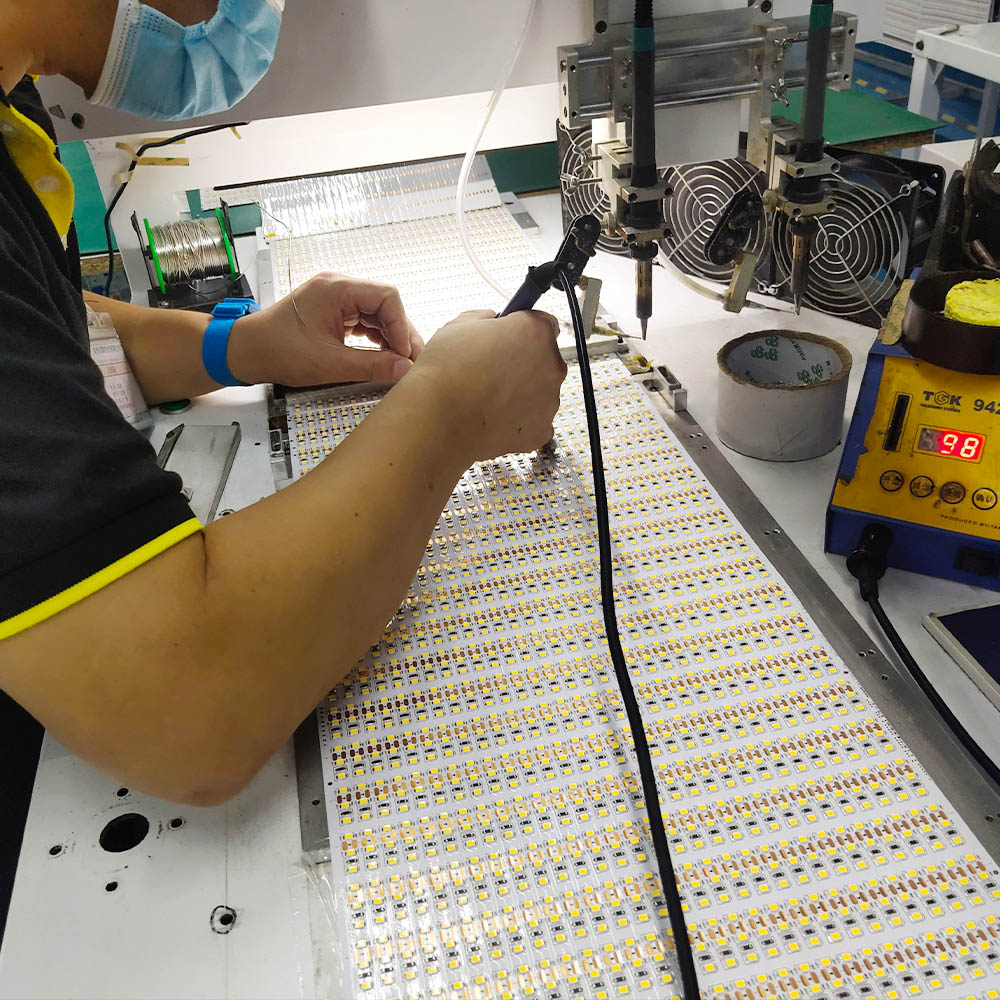
6. Separate and weld the LED tape light boards
LED tape lighting are made up of many sections (usually 24) of 0.5-meter PCB boards. After welding the strips to the length required by the customer, separate LED tape lighting boards to form multiple LED strips.
7. Aging and waterproofing
The welded LED tape lighting will be placed in the aging test room, lit continuously for 8 hours. This test can help us further confirm the quality of LED tape lights. If you want to produce waterproof LED strip lights, you also need to do relevant waterproofing process treatment.

8. Finished product inspection
Here you need to check the appearance of LED ribbon lighting to see if there is any poor welding, tin beads, short circuit, etc. Then there is the electrical inspection to test whether the electrical performance of low voltage strip lighting is intact and whether the parameters are correct.